

close
Choose Your Site
Global
Social Media

Author: Site Editor Publish Time: 2026-07-13 Origin: Site
Global energy efficiency standards are tightening rapidly across the construction sector. Frameworks like NFRC and passive house requirements now force manufacturers to entirely rethink window and curtain wall designs. Standard thermal barriers simply no longer suffice for modern building codes. To meet ambitious U-value targets, aluminum framing systems require much wider, highly complex thermal breaks. The 35.3mm hollow profile emerges as a specialized component designed specifically for deep-cavity systems. It directly solves a critical engineering dilemma where solid strips consistently fail. It provides exceptional thermal insulation without compromising essential structural rigidity. This article provides an evidence-based framework for evaluating these advanced profiles. Procurement and engineering teams will learn how to test, assess, and source the right components. We will cover everything from material integrity standards to precise assembly calibration techniques. You will discover exactly how to optimize your next-generation facade systems for maximum performance.
The 35.3mm hollow geometry reduces convective heat transfer significantly compared to solid strips, making it ideal for heavy-duty casement windows (e.g., 88+ series) and facade systems.
Material composition is non-negotiable; specifying a true PA66 GF25 hollow thermal strip ensures the linear thermal expansion coefficient matches the aluminum extrusion, preventing shear failure.
Hollow chamber designs require strict dimensional tolerances and calibrated rolling pressure during assembly to prevent wall collapse or micro-cracking.
Vendor evaluation must prioritize documented transverse tensile strength testing and customized tooling capabilities.
Modern building envelopes demand uncompromising thermal resistance. You face a constant trade-off during the design phase. You must achieve ultra-low U-factors. Simultaneously, you must maintain a high moment of inertia for large commercial aluminum frames. Standard solid strips often fall short. They provide structural strength but conduct too much heat across wider profiles. The 35.3mm hollow geometry bridges this gap effectively. It provides necessary depth for high-performance fenestration while preserving composite frame rigidity. Engineers rely on it to support heavy glass loads.
Convection mitigation represents the primary advantage of this design. The internal cavity of the 35.3mm profile actively disrupts thermal bridging. A flat solid strip of the exact same width allows continuous heat transfer through its mass. The hollow chamber traps stagnant air instead. Still air acts as an excellent insulator. It minimizes internal air circulation within the frame cavity. This physical barrier prevents outside cold or heat from easily reaching the interior aluminum extrusion. It yields a measurably superior thermal performance curve.
System compatibility determines where you deploy these profiles most effectively. Certain architectural applications demand wider thermal breaks for optimal performance. You will typically integrate these specific strips into three primary configurations:
Deep-frame awning windows: These require expansive profiles to accommodate robust operating hardware while maintaining airtight seals.
Multi-chamber casement designs: Heavy-duty series (such as 88+ or 108 systems) utilize the 35.3mm width to achieve passive house compliance.
Structurally glazed curtain walls: Large continuous facades need massive composite strength to withstand extreme wind loads over high elevations.
Material composition dictates long-term structural success. You cannot compromise on the base polymer. A genuine PA66 GF25 hollow thermal strip serves as the global benchmark for a reason. The polyamide 66 matrix contains exactly 25% glass fiber reinforcement. This specific ratio creates a linear thermal expansion coefficient almost identical to standard aluminum alloys. Metals expand and contract dramatically across extreme temperature fluctuations. The glass-reinforced nylon moves in perfect tandem. This matched expansion rate prevents shear failure. It keeps the dovetail connection secure during freezing winters and scorching summers.
Powder coating compatibility adds another layer of manufacturing necessity. Standard curing cycles often expose aluminum frames to temperatures exceeding 200°C. Pure PA66 GF25 boasts an impressive heat resistance baseline. It comfortably survives 250°C environments for standard curing durations. This thermal stability allows manufacturers to insert and roll the precision thermal break strip first. You can assemble the full composite profile prior to powder coating or anodizing. This sequence streamlines factory operations and improves surface finish uniformity.
You must actively spot "filler" materials during procurement. Substandard vendors sometimes dilute the nylon matrix. They use recycled plastics or cheap ABS blends to cut corners. These inferior materials introduce severe long-term risks. Consider the following common mistakes to watch out for:
Surface inconsistencies: Genuine fiberglass-reinforced nylon presents a uniform, slightly matte finish. Glossy or mottled surfaces often indicate ABS fillers.
Brittleness under stress: Recycled blends suffer from severe embrittlement over time. They cannot flex under wind load stresses.
Catastrophic degradation: Filler materials melt or deform permanently during powder coating ovens. They compromise the entire window assembly.
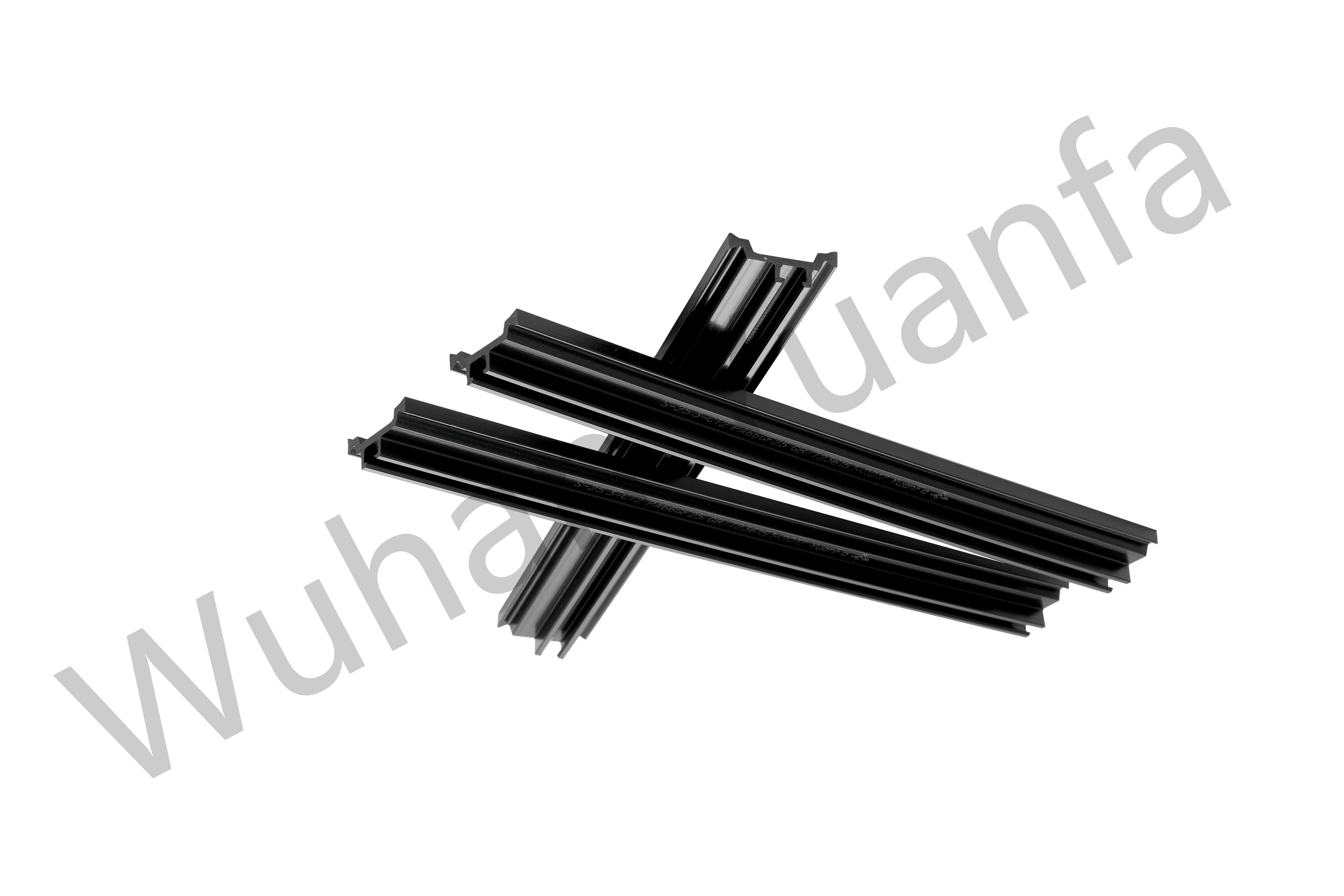
Precision matters immensely in deep-cavity systems. Dimensional tolerance represents the first critical checkpoint. The 35.3mm width must remain exact across the entire extrusion batch. Wall thickness deviations cause major assembly headaches. An oversized strip jams during insertion into the aluminum profile cavity. An undersized strip rattles loosely. Seamless insertion requires deviations no larger than ±0.05mm. Strict dimensional control prevents production line bottlenecks. It ensures the strip anchors perfectly prior to the rolling process.
Mechanical strength targets dictate composite safety. Transverse tensile strength and shear strength are non-negotiable metrics. Heavy triple-glazed insulated glass units (IGUs) impose massive weight onto the frame. The thermal break carries a significant portion of this load. Baseline mechanical targets must align with international standards. You need robust shear resistance to prevent frame twisting under wind pressure. Relying on an untested aluminum frame insulation strip invites structural failure.
Energy code compliance translates directly to product marketability. Organizations like NFRC or Passive House Institute require verifiable data. Integrating a high-performance hollow strip directly impacts final certification sheets. It yields verifiable U-value reductions. A robust procurement strategy demands technical data sheets proving these metrics.
Performance Metric | Acceptable Baseline Target | Engineering Implication |
|---|---|---|
Dimensional Tolerance (Width) | ±0.05 mm | Ensures smooth insertion without jamming or loose fitting. |
Transverse Tensile Strength | > 60 N/mm | Supports heavy triple-glazed IGUs without snapping. |
Characteristic Shear Strength | > 24 N/mm | Maintains composite frame rigidity under severe wind loads. |
Heat Deflection Temperature | ≥ 240 °C | Prevents deformation during standard powder coating ovens. |
Perfect materials fail under poor assembly practices. Knurling requirements demand strict attention. You cannot rely on friction alone to hold the composite together. The aluminum profile requires precise knurling depths. Specially designed cutting wheels carve micro-teeth into the aluminum cavity. These teeth bite into the polyamide dovetail during the final rolling stage. Insufficient knurling depth causes the thermal break to slip. Excessive depth weakens the aluminum wall. You must calibrate knurling tools daily for optimal mechanical locking.
Rolling pressure calibration poses a specific challenge for hollow strips. Solid strips withstand immense blunt force. Hollow chambers do not. Calculating the exact rolling pressure requires finesse. You must achieve high shear strength without crushing the internal chamber. Operators must use specialized rolling wheels. These wheels distribute pressure evenly across the strip's structural nodes. Improper machine calibration leads to micro-cracking. Micro-cracks remain invisible initially but propagate rapidly under environmental stress.
In-house testing protocols safeguard your manufacturing quality. We recommend implementing rigorous shear testing immediately following the rolling and curing processes. Do not wait for end-product failures. Pull random samples from each production shift. Test them on a calibrated shear-testing rig. Verify the composite structural integrity matches the theoretical baseline. This proactive testing protocol identifies machine drift early. It prevents defective frames from ever reaching the construction site.
Supplier selection defines your production stability. Tooling and extrusion expertise separate top-tier vendors from commodity traders. You must evaluate suppliers based on their engineering capabilities. Can they produce highly specific wall thicknesses? Can they design customized multi-cavity variations of the 35.3mm profile? Elite vendors own sophisticated die-making equipment. They assist your engineering team in optimizing the internal web structure of the strip. This customization ensures perfect compatibility with your unique aluminum extrusions.
Batch-to-batch consistency protects your brand reputation. Variations in polyamide mixing cause unpredictable field failures. You must demand transparency from your vendors. Request statistical process control (SPC) data for every shipment. Ask for raw material origin certificates. Ensure they source base nylon and glass fibers from reputable global chemical suppliers. Consistent extrusion temperatures and cooling rates during manufacturing dictate the final molecular structure. QA documentation proves the vendor controls these variables tightly.
Supply chain resilience keeps your factory running. Evaluate production lead times critically. Assess their minimum order quantities (MOQs) to ensure alignment with your inventory strategies. Global shipping reliability matters deeply for continuous operations. Ask potential partners about their extrusion line capacity. A vendor running multiple parallel lines absorbs demand spikes better. Resilient suppliers provide technical support alongside reliable deliveries. They act as extensions of your own engineering department.
Selecting the optimal 35.3mm thermal strip requires careful evaluation. You must balance advanced thermal geometry with strict material adherence. The hollow profile significantly reduces convection, but it demands precise assembly calibration. A genuine 25% glass fiber reinforced polyamide matrix remains absolutely essential for structural safety. Substandard materials or improper rolling pressures compromise the entire window system.
Your engineering and procurement teams must take proactive steps. Request detailed dimensional drawings from potential suppliers immediately. Ask for physical samples of their hollow profiles. Subject these samples to rigorous compatibility testing with your specific aluminum dies. Always review the technical data sheets (TDS) to verify transverse tensile strength and thermal stability. By implementing these strict evaluation standards, you ensure your next-generation framing systems exceed the most demanding global energy codes.
A: A hollow 35.3mm strip yields measurably lower thermal conductivity compared to a solid mass of PA66. The internal air pocket acts as a thermal buffer. It traps stagnant air, which disrupts convective heat transfer. This geometry prevents extreme temperatures from bridging the gap, resulting in significantly lower U-values for the final frame.
A: Yes. Genuine PA66 GF25 maintains strict structural integrity through standard 200°C–250°C curing ovens. The glass fiber reinforcement prevents melting or severe deformation. However, you must avoid prolonged exposure beyond specified time limits, as excessive baking durations can eventually degrade the polyamide matrix.
A: You must use specialized rolling wheels designed specifically for hollow geometries. Precise pressure calibration is mandatory. The machine must apply enough force to secure the dovetail without exceeding the crush strength of the chamber walls. Always ensure the strip's engineered wall thickness matches your assembly machine's exact tolerances.


