

close
Choose Your Site
Global
Social Media

Author: Site Editor Publish Time: 2026-06-29 Origin: Site
Stringent global energy codes, such as ASHRAE 90.1 and LEED v4, now force architects to rethink building envelopes entirely. Facade engineers face immense pressure to address thermal bridging in highly conductive materials before breaking ground. Bare aluminum framing transfers heat rapidly across the building envelope. Left unchecked, this thermal highway leads to significant energy loss, heavily compromised HVAC efficiency, and severe interior condensation risks.
The integration of structural thermal breaks provides a reliable solution to this industry-wide challenge. You will discover how specifying the right insulation inserts fundamentally alters both the thermal and structural performance of modern facade systems. We guide engineering teams through critical decision-stage criteria to ensure optimal specification. By the end, you will understand how proper implementation secures code compliance and protects valuable building assets.
Thermal Performance: Properly specified polyamide thermal breaks can reduce the overall thermal transmittance (U-value) of aluminum curtain walls by up to 30-50%.
Structural Integrity: Glass-fiber-reinforced polyamide (typically PA66 GF25) shares a nearly identical Coefficient of Linear Thermal Expansion (CLTE) with aluminum, ensuring zero shear stress under extreme temperature fluctuations.
Risk Mitigation: High-quality profiles prevent interior surface condensation, protecting building assets from moisture damage and mold.
Evaluation Priority: Decision-makers must look beyond baseline material costs and evaluate dimensional tolerances, structural load capacities, and supplier-provided testing data.
Aluminum offers incredible durability and structural efficiency. However, it transfers heat rapidly. Building enclosures rely on massive aluminum grids to hold glazing units in place. Without proper intervention, curtain wall mullions and transoms become literal thermal highways. Winter heat escapes effortlessly to the outside. Summer heat pushes its way indoors. This constant thermal exchange forces mechanical systems to work continuously.
Common Mistake: Engineering teams sometimes overlook transom transition zones. They focus heavily on primary vertical mullions. Heat bypasses these isolated spots, lowering overall facade efficiency.
Thermal bridging creates a secondary, often more destructive issue. Cold exterior temperatures travel through the solid aluminum frame. The interior frame surface drops below the room's dew point. Warm, humid indoor air collides with this cold surface. Condensation immediately forms.
Failure to adequately isolate exterior and interior climates results in persistent condensation. Water accumulation damages interior finishes. It creates ideal conditions for toxic mold growth. Building inspectors quickly flag these failures. Failed compliance audits delay occupancy and force expensive retrofits. Prolonged moisture exposure also accelerates material degradation across the facade connections.
Subpar thermal performance drastically increases the building's lifetime operational carbon footprint. Modern environmental standards demand strict energy conservation. Excessive heat loss inflates HVAC operational expenditures year after year. Real estate developers face shrinking margins when utility demands remain high. Correcting thermal inefficiencies at the design stage is paramount. Upgrading mechanical systems later cannot fix a fundamentally flawed building envelope.
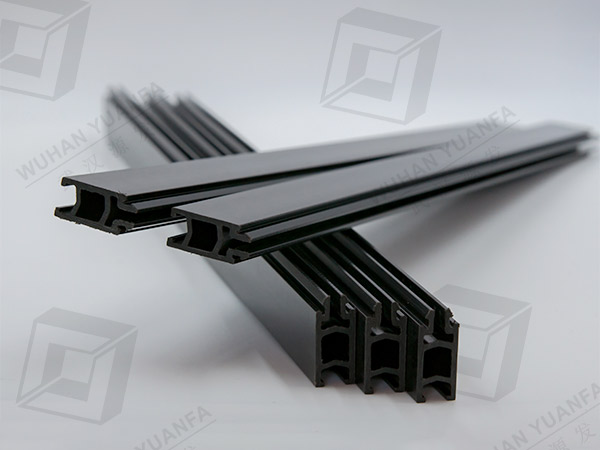
Integrating polyamide profiles for aluminum facade assemblies has become the industry standard for high-performance buildings. The shift away from legacy methods is driven by strict material science requirements.
Comparing modern polyamide structural inserts against traditional pour-and-debridge (P&D) polyurethane reveals stark differences. Legacy P&D methods involve pouring liquid polyurethane into an aluminum channel. The manufacturer then cuts the metal bottom to separate the halves. Polyurethane limits structural capacity. It cannot handle the extreme wind loads required for super-tall skyscrapers.
Polyamide offers superior structural integrity for high-wind-load curtain walls. Specifically, PA66 GF25 contains 25% fiberglass reinforcement. This composite acts as a true structural component. It transfers loads seamlessly between the exterior pressure plates and interior mullions.
Building facades experience brutal temperature swings. A dark aluminum frame can bake at 80°C in the summer sun. It can freeze at -30°C in winter. Materials expand and contract based on their specific physical properties. Understanding the physics of expansion is critical.
Because PA66 reinforced with 25% glass fiber expands and contracts at the exact same rate as aluminum, the structural composite remains fully intact. They share a nearly identical Coefficient of Linear Thermal Expansion. This synergy ensures zero shear stress buildup across decades of seasonal freeze-thaw cycles. The bond never weakens.
Curtain wall performance hinges on glazing transitions. Adopting polyamide pressure plates in lieu of traditional aluminum plates further optimizes the thermal barrier. Traditional systems use exterior aluminum pressure plates to lock the glass. These plates sit outside the primary thermal break. They act as cooling fins.
Polyamide pressure plates replace the exterior metal entirely. This eliminates the last remaining exterior metal exposure at the most vulnerable glazing transitions. It pushes the thermal boundary further out.
Engineers must critically analyze thermal insulation polyamide profiles before specifying them for commercial projects.
The U-factor measures how easily heat transfers through the curtain wall. Lower numbers represent better insulation. You calculate the thermal improvement contributed by the profile depth and hollow-chamber geometry.
Deep profiles create a wider barrier between the inside and outside. Manufacturers extrude complex hollow chambers within the strip. These empty pockets trap still air. Small internal fins disrupt convection loops inside the cavity. They also block radiant heat transfer.
Using CRF data validates that the profile will maintain interior surface temperatures above the dew point. Standardized testing places the assembled frame in a controlled climate chamber. Engineers measure the temperature difference between the interior and exterior environments.
A higher CRF means the frame resists sweating effectively. You must cross-reference local climate data against the frame's CRF rating. A hospital in a cold climate requires a much higher CRF than a warehouse in a mild climate.
The thermal break physically connects the exterior glass to the interior building structure. Analyzing the mechanical limits prevents catastrophic failures. Ensuring the profile can withstand the dead load of insulated glass units (IGUs) is essential. Triple-glazed IGUs weigh hundreds of pounds.
Dynamic wind loads place tremendous stress on the assembly. The polyamide profile must transfer these intense pushing and pulling forces without yielding. It acts as the backbone of the composite frame.
Structural and Thermal Property Comparison
Material Type | U-Factor Contribution | Shear Strength Capacity | Expansion Match with Aluminum |
|---|---|---|---|
PA66 GF25 Polyamide | Excellent (High Reduction) | Very High | Perfect Match |
Polyurethane (P&D) | Good | Moderate | Poor Match |
Bare Aluminum | None (High Conductivity) | Baseline | N/A |
Manufacturing aluminum and polyamide requires strict dimensional accuracy. Even sub-millimeter deviations can compromise the tight fit required for a stable aluminum-polyamide composite. The polyamide strip features dovetail locking feet. The aluminum extrusion features corresponding cavities.
If the aluminum cavity runs too wide, the strip fits loosely. If the polyamide foot runs too large, it will not slide in. High-quality suppliers monitor die wear obsessively.
Polyamide is hygroscopic. It absorbs moisture from the surrounding environment. Addressing the necessity of proper moisture conditioning by the manufacturer before the crimping and rolling process prevents material brittleness.
Freshly extruded PA66 is incredibly dry and inherently brittle. If an assembler crimps dry profiles, the locking feet will crack under pressure. Manufacturers must store the strips in controlled humidity chambers. The polymer absorbs a specific water percentage. It becomes tough, resilient, and ready for extreme mechanical compression.
The mechanical reality of assembly dictates the system's success. The quality of the knurling on the aluminum extrusion dictates the final shear strength of the system. Knurling wheels cut sharp teeth into the aluminum channel.
The precision of the rolling pressure locks everything together. Discs compress the aluminum over the polyamide foot.
The composite assembly process relies on four non-negotiable steps:
Knurling: Cutting precise, sharp teeth into the internal aluminum cavity.
Insertion: Sliding the conditioned polyamide profile smoothly into the channel.
Rolling/Crimping: Applying calculated, uniform pressure to fold the aluminum over the strip.
Shear Testing: Sampling the finished batch to verify the mechanical bond resists slippage.
Procurement teams hold the responsibility of choosing the right facade curtain wall thermal strip for their unique project demands.
Marketing claims cannot support a building's structural integrity. Procurement teams must demand rigorous, third-party-tested technical data. You should request independent U-value simulations and verifiable mechanical load testing reports.
Reputable suppliers publish comprehensive technical catalogues. These documents detail the moment of inertia, elasticity modules, and thermal conductivity values.
Best Practices for Supplier Evaluation:
Request recent AAMA TIR-A8 or EN 14024 certification reports.
Verify the exact glass-fiber content through material safety data sheets.
Confirm the supplier uses pure PA66 resin rather than recycled, degraded plastics.
Standard flat strips work well for basic storefronts. High-performance facades require complex solutions. Evaluating suppliers based on their capability to extrude complex, multi-cavity thermal strips separates top-tier vendors from basic manufacturers.
Projects tailored to specific project depths demand customized dies. Acoustic requirements often dictate specialized internal baffle shapes within the profile. Ask suppliers about their in-house tooling capabilities and typical lead times for custom geometries.
Assessing the manufacturer's quality control standards prevents field failures. Ask how they manage lot traceability. Every thermal strip should feature a laser-printed production code. If a shear test fails on the assembly floor, you must isolate the exact production batch immediately.
Examine their ability to scale production for large commercial facade projects. Massive skyscrapers require millions of linear feet of material. Late deliveries derail the entire glazing schedule.
Upgrading the building envelope defines modern architectural success. By deploying engineered polyamide profiles, developers immediately secure enhanced thermal performance.
While integrating advanced polyamide profiles marginally increases upfront material costs, the long-term ROI realized through energy savings, compliance achievement, and structural longevity is undeniable.
Verify supplier technical catalogues against your project's specific wind-load and baseline U-value targets before finalizing the shortlisting phase.
Audit the assembly partner's knurling and moisture conditioning procedures to guarantee the mechanical shear strength matches the design specifications.
Demand transparent, third-party testing documentation for every custom geometry extruded for your facade.
A: Details the expected durability, noting that high-grade PA66 GF25 typically matches or exceeds the lifespan of the aluminum facade itself (50+ years) when correctly conditioned and assembled. It withstands decades of thermal cycling without mechanical degradation.
A: Explains the extrusion capabilities of polyamide, confirming that dies can be custom-tooled for specific structural and thermal cavity requirements, though this impacts lead times. Manufacturers can create multi-chambered, angled, or oversized strips for unique glazing conditions.
A: Addresses material behavior under heat. Clarifies that while polyamide is a polymer, when encapsulated within an aluminum curtain wall assembly, it must be evaluated as part of the total system’s fire propagation and smoke development testing (e.g., NFPA 285). The surrounding aluminum largely dictates the fire response.


