

close
Choose Your Site
Global
Social Media

Author: Site Editor Publish Time: 2026-08-28 Origin: Site
Large curtain walls often need deeper aluminum sections, heavier glazing support, and stronger control of conductive heat flow through the frame. Wide Polyamide Profiles are used where a greater thermal separation is part of the engineered solution. By increasing the distance between interior and exterior aluminum components, the design can reduce a principal heat-conduction route through the frame. That benefit is real, but it has a companion question: how will the separated aluminum halves transfer load and retain the required composite stiffness? The answer depends on the complete member, not simply on width.
A wider thermal break can increase the insulation depth between aluminum sections.
Width is only one thermal variable; cavities, geometry, glazing, metal bypasses, and installation interfaces also influence the final result.
In large curtain walls, the thermal break may be part of the load-transfer path between aluminum halves, so stiffness and connection behavior must be reviewed.
The correct width is selected from an engineered frame section and verified assembly, not from a “wider is always better” rule.
Large-format glazed facades expose framing to higher wind actions, longer spans, and often heavier insulating glass units than modest window openings. Mullions and transoms must control deflection while their exterior and interior aluminum portions are thermally separated. As performance targets become more demanding, the insulation zone may become deeper; meanwhile, the aluminum member still needs to function as a coordinated structural component.
The thermal break is not asked to carry all facade loads independently. Nevertheless, it can be central to how the separated aluminum sections work together. Its geometry and mechanical engagement influence composite behavior. That means an increase in width should prompt a parallel structural review. Engineers may adjust aluminum geometry, wall thickness, reinforcement strategy, or profile features to meet the required balance.
Heat conduction through a simple layer can be expressed in plain text as R = thickness / thermal conductivity. That relationship helps explain why a greater insulating separation can be useful. In a real curtain wall, however, the thermal route is not a single flat layer. Heat can pass through aluminum walls, screws, pressure plates, cavities, glass edges, and connections. Therefore, the formula is a concept, not a project calculation.
Wide Polyamide Profiles can give the system designer more room to create an insulating zone and, in some sections, to organize cavities or ribs. The objective is to reduce the frame’s conductive bridge while preserving the practical functions of the cross-section. A profile width should be chosen in combination with the aluminum design, not after it.
When the gap between aluminum halves becomes wider, the composite member must still resist relative movement under the design loads. The rolling engagement, profile leg shape, glass-fiber-reinforced material, and aluminum knurling all contribute. A wider distance may improve the thermal route while increasing the importance of shear transfer and deflection control. The member’s effective structural behavior should be evaluated by the system designer using the applicable project assumptions.
This trade-off is why broad statements such as “use the widest strip available” are unreliable. A narrow profile might be adequate for a conventional frame with moderate thermal targets. A wide profile might be necessary for a high-performance, deep facade system. Between those cases are many combinations of glazing weight, span, wind pressure, finish, orientation, and target frame performance.
Design question | Why width matters | What else must be considered |
Required insulation depth | Width increases the separation between aluminum sections | Frame geometry, cavity design, glazing, and metal bypasses |
Mullion structural behavior | A wider separation changes composite load transfer | Aluminum section, knurling, profile legs, rolling quality, and load case |
Glass support and drainage | Deep sections must still preserve functional spaces | Setting blocks, gaskets, weeps, pressure plates, and tolerances |
Fabrication | Larger profiles require consistent handling and engagement | Feed path, cutting, rolling setup, inspection, and packaging |
Visual and cost objectives | More depth can alter system architecture | Sightlines, procurement, testing, and project-specific value |
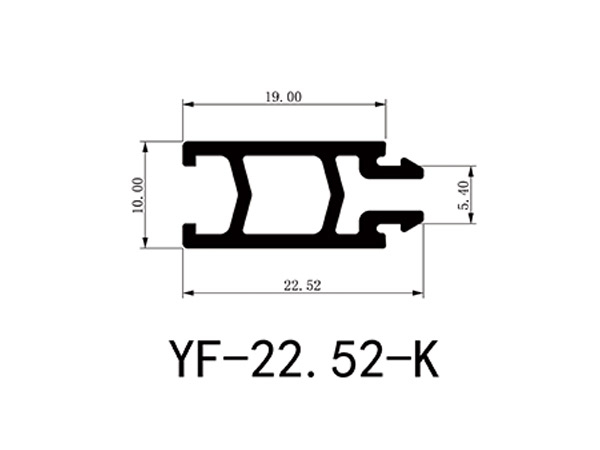
The body of a wide thermal-break profile may be solid or may include cavities, ribs, or other features. These features can help define the insulating zone and provide the stiffness or functional surfaces required by the aluminum system. But complex geometry introduces production and inspection needs. Thin walls or long ribs may be more sensitive to damage; hollow sections need to retain their intended shape; and the rolling process must engage only the designed legs without distorting neighboring features.
Profile labels do not resolve these issues. A 35.3 mm K1 or a 44 mm CT1 can be meaningful only in relation to the drawing it was designed for. Yuanfa’s 35.3 mm hollow K1 thermal strip illustrates how width, profile family, and cavity design appear together in a product definition; it should not be read as a universal replacement for another system’s part.
Start by determining the required whole-system performance, then isolate the frame contribution that the thermal break must support. Use the approved aluminum section to identify the available groove positions and the desired insulation depth. Next, evaluate the structural role of the member under project loads and expected movements. Only then compare widths and geometries that fit the actual system.
Ask for a precise cross-section, tolerances at the engagement legs, material description, and recommended fabrication process. Confirm whether the profile is intended for straight lengths, how it should be stored, and how it will be inspected before rolling. Build a representative sample with the intended aluminum, knurling, roller settings, and finish sequence. Where project requirements call for it, validate the resulting facade or frame through the appropriate tests and engineering assessment.
Do not treat a profile-width figure as an isolated thermal rating. Do not transfer a wide strip from one aluminum system to another without checking the grooves. Do not assume that a nominally rigid material will compensate for inadequate aluminum geometry. And do not overlook local bridges such as pressure-plate details or fasteners just because the central thermal break is wide.
Wuhan Yuanfa New Materials Co., Ltd. provides wide profile options for facade applications. A useful inquiry includes the system section, facade type, intended width, required material, finish sequence, and acceptance criteria. That gives Yuanfa and the project team the information needed to discuss a profile that fits the actual application.
Establish the performance objective in assembly terms. Is the project seeking to improve frame thermal behavior, manage a difficult glass edge, respond to a local requirement, or balance several aims? The answer influences the insulation depth and the areas of the frame that deserve the closest attention. A wider central break cannot correct a bypass through an unrelated metal connection.
Then define the structural case: glass configuration, member span, support conditions, design wind action, anticipated movement, and allowable deflection. The facade-system designer can determine how the interior and exterior aluminum portions are expected to work together. This makes the profile discussion concrete: its legs and body are part of a known composite section rather than a generic insulation product.
Plan the fabrication trial with production-representative aluminum, knurling, roller settings, profile lengths, and finish sequence. Inspect the rolled member for engagement and straightness, then confirm that glazing and drainage parts still fit. Large projects need the same result across many members, not one successful sample. Any proposed change in width, profile family, formulation, aluminum groove, or rolling method should trigger the same compatibility review as a new selection.
Wide Polyamide Profiles are used in large curtain wall systems because greater separation between aluminum halves can support the thermal design of deep, high-performance frames. Their value is inseparable from the mechanical problem they create: the completed aluminum-polyamide member must still transfer loads and maintain its intended geometry. Choose width through system calculations, compatible profile geometry, controlled fabrication, and complete-assembly verification rather than by a maximum-width rule.
They can support a longer insulating path, but the final thermal result also depends on the entire frame, glazing, cavities, pressure plates, fasteners, and installation details.
They are particularly relevant to large facade systems, but a wide profile may also be used in another aluminum system when its engineered cross-section requires that insulation depth.
It changes the composite structural challenge. The aluminum section, profile geometry, mechanical engagement, and project load case must be evaluated together to maintain required performance.
There is no universal best width. It is determined by the approved aluminum system, target thermal performance, structural requirements, fabrication process, and project verification plan.
No. Its legs, body, and functional features must match the intended aluminum groove configuration and rolling process.


