

close
Choose Your Site
Global
Social Media

Author: Site Editor Publish Time: 2026-08-24 Origin: Site
High-rise facades face more than a simple indoor-versus-outdoor temperature difference. They experience solar heating, nighttime cooling, wind pressure, wind-driven rain, humidity, building movement, cleaning exposure, and repeated thermal cycles across large elevations. Polyamide Profiles work inside the aluminum frame, where they help create the thermal break and mechanical connection between interior and exterior sections. Their weather resistance matters because their condition, fit, and long-term dimensional stability can influence the composite frame and the functional zones around it. A durable facade needs a coordinated system, not a weather-resistant strip in isolation.
In high-rise work, weather exposure is expressed through cycles, gradients, pressure, and interfaces—not merely “outdoor use.”
Polyamide Profiles must remain compatible with aluminum movement, mechanical engagement, drainage, seals, and the assembly process.
UV, moisture, heat, chemicals, and wind-driven water should be considered in the context of the profile’s actual location and enclosure design.
Assembly quality and whole-system testing are as important as material selection for keeping a facade weather-resistant.
Tall buildings can develop substantial differences in solar exposure between elevations and between shaded and unshaded areas. A dark exterior frame may heat differently from an interior section, and the temperature of glass, aluminum, and adjacent cavities can change at different rates. Wind pressure also varies with height and building geometry. The thermal break has to remain engaged while the aluminum system responds to these recurring conditions.
Weather resistance therefore includes resistance to the consequences of environmental action. It means maintaining the intended dimensions and mechanical interface through thermal cycling, preserving the thermal separation without opening unintended gaps, and avoiding damage that could compromise neighboring seals or drainage. It does not mean the polyamide alone makes a curtain wall watertight. Water performance depends on pressure-equalized design, gaskets, joints, weeps, glazing details, fabrication, and installation.
Aluminum changes dimension with temperature. The thermal-break profile does too, but the objective is to use a material system whose movement behavior can be managed within the composite member. Glass-fiber-reinforced PA66 is common in this application partly because its thermal behavior can be closer to aluminum than many unreinforced plastics. That reduces, rather than eliminates, the differential movement challenge.
At high elevations, designers should consider the expected temperature range, orientation, frame color, solar intensity, member length, restraint locations, and the way individual modules connect. A profile is not an isolated specimen: it is rolled into aluminum, often adjacent to cavities and seals. If the design allows excessive movement or deformation at a critical interface, gaskets may lose their intended compression, drainage paths may be affected, or the visual alignment of facade components can change.
Polyamides are not selected on the assumption that they never interact with moisture. Instead, responsible design recognizes material conditioning and uses a defined grade, geometry, storage method, and assembly process. The relevant concern for a facade is whether the profile remains fit for purpose inside its protected or semi-protected zone and whether water-management details prevent standing water or unintended pathways through the frame.
Polyamide Profiles are generally installed within the aluminum assembly rather than exposed as a broad exterior surface. Even so, profile ends, cut sections, open cavities, and interfaces can be affected by fabrication practice. Keep packaging dry and clean, prevent physical damage to legs and ribs, and follow the approved process for storage and rolling. These details are less visible than a facade cap, but they can influence repeatable assembly.
Exposure or condition | What to assess | Design or procurement response |
Solar heating and cooling cycles | Movement of the composite member and seal compatibility | Review temperature range, member length, colors, restraints, and system calculations |
Wind-driven rain | Integrity of drainage and pressure-equalization routes | Preserve designed weeps, cavities, end dams, and gasket interfaces |
Humidity and site storage | Condition before rolling and installation | Define storage, handling, inspection, and sample-assembly practices |
Cleaning or construction residues | Compatibility of adjacent materials and process sequence | Confirm allowable exposure and remove residues under approved maintenance methods |
High wind pressure | Composite-frame deflection and engagement | Evaluate the completed member and system for the project load case |
Claims about UV resistance should be tied to the actual exposure. A profile enclosed inside aluminum and glazing channels has a different exposure history from a polymer part continuously exposed on the outer face. Some profile formulations include features intended to support durability, but the facade designer should still understand whether any profile surface is directly exposed, whether cap or gasket details shield it, and whether the system creates heat accumulation in a cavity.
Heat resistance should likewise be assessed with the production and service environments separated. A material may be suitable for a defined coating sequence, but that does not automatically validate any oven temperature or dwell time. In service, hot climates and dark finishes may increase local temperatures, while cold climates may increase contraction and condensation risks. The system specification should establish the relevant conditions rather than use a single generic temperature claim.
The correct profile geometry supports durable weather performance indirectly by allowing the aluminum system to retain its intended geometry. If rolling damage, poor groove engagement, or unstable dimensions weaken the composite connection, the issue can show up later in seals, drainage, or frame alignment. This is why profile selection must include the actual aluminum cross-section and the rolling method.
For facade applications, a profile from the verified facade thermal-break range may be relevant only where its specific shape and width correspond to the aluminum system. Do not substitute it solely because a general product description mentions weather performance. Confirm the project drawing, profile location, mechanical role, and verification requirements first.
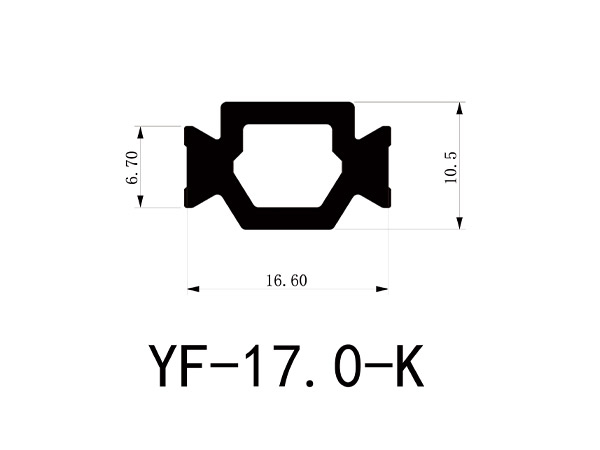
Material data, dimensional inspection, and assembly trials address three different risks. Material information confirms the starting basis; dimensional checks confirm the profile can fit; and trial rolling confirms that the aluminum and profile work together. For a high-rise facade, system-level evaluation must then address structural, air, water, and thermal performance according to the project criteria. A passing result in one area should not be presented as evidence for every other area.
Yuanfa’s facade product category provides a starting point for matching profile families to aluminum systems. Wuhan Yuanfa New Materials Co., Ltd. should receive the intended use, section drawing, and required validation route so that profile discussion stays tied to a real facade detail rather than an abstract material claim.
Weather-resilience decisions should begin before procurement. Identify each elevation’s solar exposure, relevant temperature range, wind-pressure zones, facade movement joints, and interfaces with adjoining materials. A shaded elevation and a sun-facing corner may not experience the same thermal history. That does not automatically mean different profiles are required, but it does mean the facade should be designed using realistic boundary conditions.
During fabrication, protect the profile features that affect fit. Check that rolling produces uniform engagement, that no legs or ribs are crushed, and that designed cavities and drainage paths remain open. At assembly, inspect gaskets, fasteners, pressure plates, and end details as part of the thermal-break zone rather than as unrelated follow-on work. A continuity issue at a joint can undo the benefit of careful profile selection.
Operation and maintenance should focus on the serviceable facade components: keep drainage routes clear, maintain seals according to system guidance, and avoid unapproved cleaners or repairs around adjacent materials. If a facade shows persistent condensation, water entry, or unusual movement, investigate the complete enclosure detail. Glass edges, blocked weeps, sealing, installation, and thermal bridges elsewhere in the section can each be contributors. This whole-system view is important in high-rise work, where access and remediation can be difficult.
Weather resistance matters for Polyamide Profiles in high-rise facades because the profiles operate within a composite aluminum system exposed to thermal cycles, wind, moisture management demands, and construction processes. Their role is to preserve thermal separation and mechanical compatibility, while the full curtain-wall design controls water, air, structural, and glazing performance. The practical route is to select a verified profile geometry, protect it through handling and fabrication, and validate the finished system for the project’s environmental conditions.
They are normally incorporated within the aluminum frame assembly, but their exact exposure depends on the system cross-section, ends, cavities, caps, and glazing details.
Yes. Movement in the frame and its interfaces can affect seal and gasket behavior, which is why material compatibility and system movement must be considered together.
No. Watertightness is a whole-system outcome involving drainage, pressure equalization, gaskets, joints, glass, fabrication, and installation.
Follow the supplier’s handling guidance and keep material protected from contamination, physical damage, and unsuitable storage conditions that could affect consistent assembly.
Verify the profile drawing and material, inspect dimensions, conduct representative rolling trials, and complete the relevant system-level evaluations for structure, air, water, and thermal performance.


