

close
Choose Your Site
Global
Social Media

Author: Site Editor Publish Time: 2026-08-31 Origin: Site
Facade and window systems both use Polyamide Profiles to thermally separate aluminum components, but the profile requirements can be very different. A window frame may prioritize sash movement, hardware integration, drainage, and manageable opening sizes. A facade member may need to coordinate large glass units, high wind pressures, long mullion spans, pressure-glazing details, and module interfaces. Both are thermal-break applications; neither should be treated as a generic strip application. The profile must match the aluminum section and the job the finished frame is designed to perform.
The thermal purpose is shared, but facade and window profiles differ in their system context and functional constraints.
Facade profiles often work within deeper members and may be more central to composite structural behavior.
Window profiles often need to accommodate moving sashes, hardware, drainage, and weather seals in compact cross-sections.
Compatibility is confirmed by the actual aluminum drawing, profile geometry, fabrication method, and performance requirements.
In both windows and facades, the basic principle is the same. Interior and exterior aluminum portions are separated by a low-conductivity polyamide element so heat does not travel directly through a continuous metal frame. The profile is mechanically integrated with the aluminum, most often through defined grooves and rolling. Its geometry must therefore serve a thermal purpose and a joining purpose simultaneously.
The final thermal result is not a property of the profile alone. It depends on frame depth, insulation-zone configuration, glazing, edge-of-glass detail, pressure plates or beads, fasteners, gaskets, and installation. The same is true for weather performance: the thermal break supports the architecture of the frame, but drainage, pressure equalization, joint design, fabrication, and installation determine whether the completed assembly manages air and water as intended.
Curtain walls and large facade systems can use tall mullions and deep transoms to support wide or heavy glass units and resist wind action. The thermally broken member may have to act as a composite section across a substantial separation between interior and exterior aluminum parts. This places strong emphasis on profile geometry, mechanical engagement, and the ability of the completed section to meet structural and deflection requirements.
Facade cross-sections may also incorporate pressure plates, cover caps, drainage cavities, insulation pockets, anchors, and unit-joint interfaces. A Polyamide Profile can be a main structural thermal break, a strut, or a specialized insert in a local heat-flow path. The component is selected within a layered system of functions, not simply for its nominal material.
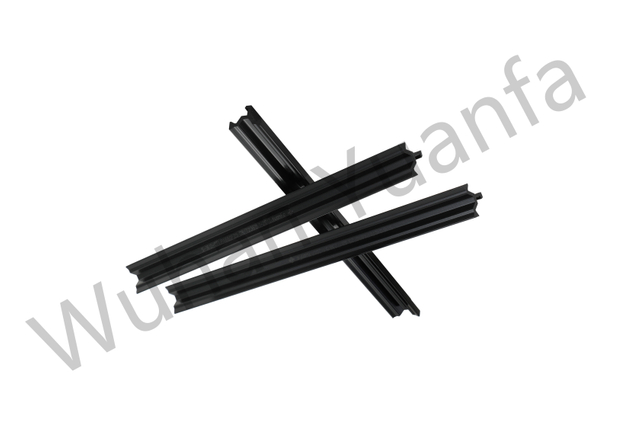
Window frames and sashes typically have a different set of priorities. Operable systems require clearance for hinges, locks, handles, sliding rollers, or tilt-and-turn hardware. The frame must retain glass, compress gaskets, direct water to weeps, and allow movement without binding. Thermal breaks may be narrower than facade versions, although width should never be assumed from product category alone.
The interaction between frame and sash is especially important. A window can have a high-quality thermal-break material yet perform poorly if the system has incorrect gasket compression, blocked drainage, poor corner fabrication, or incompatible hardware. Polyamide insulating profiles for aluminum doors and windows are therefore defined by their fit with a specific window-system section and intended opening configuration.
Design factor | Facade-focused profile context | Window-focused profile context |
Typical member role | Mullions, transoms, pressure-glazed zones, and perimeter interfaces | Frames, sashes, sliding tracks, opening and fixed-light systems |
Structural emphasis | Composite behavior under facade wind and glass loads can be central | Local frame/sash stiffness and hardware compatibility are often prominent |
Geometry | May be deeper, wider, or include specialized ribs and cavities | Often compact and coordinated with moving parts, seals, and drainage |
Glazing interface | Can include pressure plates, caps, setting blocks, and module joints | Can include beads, sash pockets, glazing gaskets, and operable clearances |
Fabrication check | Rolling plus facade-system assembly and test requirements | Rolling plus corner, hardware, sash operation, and water-management checks |
PA66 GF25 may be used across both categories, but a common material designation does not make two profiles interchangeable. The fiber-reinforced polyamide supports a stable thermal-break role, while the aluminum system determines the exact cross-section, leg geometry, width, and locking arrangement. A window K-type profile might not fit a facade mullion groove, and a wide facade profile might obstruct a window’s hardware or drainage spaces.
This distinction matters for procurement. A request that simply says “PA66 GF25 thermal break” leaves too much open. A better request identifies the product application, aluminum-system drawing, profile cross-section, desired material, cut length or supply form, rolling process, surface-treatment sequence, and acceptance criteria. It also identifies whether the project needs sample assembly, dimensional documentation, or system-level validation.
Both windows and facades may use wider thermal breaks to increase insulation depth. In a compact window, however, extra width can affect sash depth, sightline, hardware space, and drainage layout. In a facade, it can affect composite structural behavior, pressure-plate architecture, and module geometry. The same thermal objective therefore leads to different practical limits.
The decision should begin with the desired system performance rather than a preferred strip width. Determine the frame’s thermal target, then evaluate how glass, spacer, aluminum walls, cavities, and the thermal break work together. Assess structural and fabrication requirements in parallel. A profile that gives an attractive theoretical thermal route but cannot be rolled consistently or fit the intended functional zones is not an appropriate design.
First, separate the words “facade” and “window” from the actual system information. Obtain the section drawing and locate every thermal-break groove. Second, identify each profile’s role and the aluminum halves it connects. Third, compare the profile drawing—not only its width or family name—with the groove dimensions, knurling, rolling direction, and adjacent cavities. Fourth, confirm the proposed fabrication sequence, especially if coating or other finishing happens after assembly.
Then make a representative assembly. Check the rolled engagement, straightness, appearance, functional clearances, and interfaces with seals and glass-retention components. For windows, include opening operation and drainage. For facades, include the relevant member behavior and system performance requirements. Yuanfa supplies both window/door and facade profile categories, so Wuhan Yuanfa New Materials Co., Ltd. can discuss alternatives more accurately when the inquiry includes the actual aluminum section.
Place the approved window and facade cross-sections side by side and trace the heat path from exterior aluminum to interior aluminum. Mark every Polyamide Profile and every remaining metal connection, such as a pressure plate, fastener, reinforcing insert, or hardware part. This shows why the same profile width can have a different effect in an operable window and in a curtain wall.
Next trace the functional paths. In a window, follow water from the glazing pocket to the weep, then review gasket compression and the clearance needed for sash and hardware movement. In a facade, follow the glass-retention method, pressure-equalization cavities, vertical and horizontal drainage, module joints, and anchors. The profile must not interfere with any of these paths. A part suited to a deep fixed mullion can be impractical in an opening sash even with the same PA66 GF25 material designation.
Set acceptance checks accordingly. Windows need smooth operation, gasket compression, corner quality, glazing fit, drainage, and relevant air/water evaluation. Facades need rolled composite-member quality, glass-retention interfaces, member alignment, drainage continuity, and the structural and enclosure checks required for the system. These outcomes belong to the complete product, while the profile supplier supports component selection.
Facade and window Polyamide Profiles share the goal of separating conductive aluminum, but their geometry is driven by different system demands. Facade profiles may need to support deep composite mullions, pressure-glazing architecture, and large-load conditions; window profiles often work around compact frame/sash, hardware, seal, and drainage requirements. Select by the approved cross-section and completed assembly, not by material designation or category name alone. Yuanfa’s separate product categories reflect this distinction and provide a practical starting point for system-specific selection.
Only if the exact profile is compatible with the window’s aluminum grooves, functional clearances, rolling process, and performance requirements. Category labels alone do not establish compatibility.
No. Facade systems often need deeper sections, but the correct width depends on the specific aluminum design and thermal, structural, and functional targets.
Operable windows must provide accurate spaces and fixing conditions for hinges, locks, rollers, and other hardware while preserving seals and drainage.
Facade mullions and transoms may experience large spans and wind loads, making the behavior of the completed thermally broken composite section especially important.
Provide the approved aluminum cross-section, intended function, material requirement, exact profile geometry, groove and rolling details, finishing sequence, and applicable verification requirements.


