

close
Choose Your Site
Global
Social Media

Author: Site Editor Publish Time: 2026-07-14 Origin: Site
Escalating global energy efficiency standards continually push window manufacturers toward engineering perfection. Passive House certifications and strict local building codes require window producers to drastically lower frame thermal transmittance. We typically measure this performance as Uf values. Traditional solid thermal breaks are finally reaching their physical limits. You cannot continuously expand frame depth to impractical sizes just to reduce heat transfer. Bulky frames compromise architectural aesthetics and increase material weight unnecessarily. Fortunately, modern material engineering provides a much smarter workaround. Transitioning to hollow geometries using glass-fiber-reinforced polyamide offers a scalable, robust path to optimize the thermal barrier. This transition isolates the interior climate without requiring massive frame overhauls. This comprehensive guide outlines the structural, thermal, and procurement considerations for seamlessly integrating these advanced profiles into your existing aluminum frame designs.
Thermal Optimization: Hollow internal cavities trap inert air, disrupting convection and lowering overall thermal conductivity compared to solid profiles.
Material Symmetry: The 25% glass fiber reinforcement (GF25) ensures the polyamide expands and contracts at the exact rate as aluminum, preserving structural integrity across temperature extremes.
Condensation Control: Proper implementation aligns the thermal break with the vertical isotherm line, effectively mitigating interior condensation risks.
Sourcing Criticality: Success relies heavily on a supplier's extrusion precision, as hollow profiles require stricter dimensional tolerances to withstand the mechanical stress of assembly.
Solid strips conduct heat continuously across their polymer mass. A hollow polyamide profile behaves entirely differently. It utilizes multiple internal air chambers strategically extruded into the shape. These small cavities trap inert air inside the frame. Trapped still air acts as an incredibly effective secondary insulator. It completely breaks the direct path of thermal bridging between the exterior and interior aluminum extrusions. This smart design minimizes harmful convection currents looping inside the frame structure. It also drastically cuts down radiation heat transfer moving across the barrier. The air pockets absorb and dissipate thermal energy efficiently.
Next, we must examine the vertical isotherm line. Controlling this invisible boundary remains a crucial engineering challenge. Window designers must align the frame’s isotherm line perfectly with the glass glazing unit. Utilizing hollow geometries makes this precise alignment possible. You can shift the thermal break center easily by adjusting cavity widths. This keeps the interior aluminum shell much warmer. It creates a seamless thermal boundary spanning the entire window unit. A well-aligned isotherm line prevents cold spots from forming along the window edges.
What about the actual impact on overall U-Values? You should expect significant performance leaps. Switching from standard solid strips to multi-cavity hollow designs improves Uf values substantially. Frame transmittance drops often range between 15% to 25% depending on cavity complexity. A wider internal cavity yields better heat isolation for the entire window (Uw). This transition easily supports complex architectural demands. It avoids the need for bulky, oversized profile additions that ruin sleek sightlines.
Why do engineers insist specifically on PA66 infused with 25% glass fiber? Basic physics dictates the absolute need for material symmetry. Aluminum alloys possess a very specific coefficient of linear thermal expansion (CLTE). Pure plastic expands much too rapidly under intense heat. By adding exactly 25% glass fiber, the PA66 matrix perfectly mirrors the aluminum expansion rate. They expand and contract perfectly together as one unit. This synchronized movement prevents sheer failure during scorching summers or freezing winters. Anything less than 25% causes warping. Anything more makes the profile too brittle.
Many professionals initially doubt the structural strength of hollow shapes. Thinner internal walls might seem inherently fragile at first glance. However, the GF25 matrix maintains incredible tensile and shear strength. The multi-directional glass fibers reinforce the polymer structure dynamically during the extrusion process. They create a rigid internal lattice. This means even complex multi-cavity hollow designs handle extreme wind loads effectively. They meet structural safety demands easily without buckling under pressure.
Long-term material durability also matters immensely. Constant UV exposure weakens standard commercial plastics quickly. Severe temperature fluctuations degrade cheap polymers over just a few seasons. PA66 GF25 withstands these harsh environmental stressors effortlessly. It resists structural fatigue over decades of continuous use. They endure cyclical structural loads originating from heavy triple-glazing setups. Your frames will maintain their structural integrity long into the future, guaranteeing lasting performance.
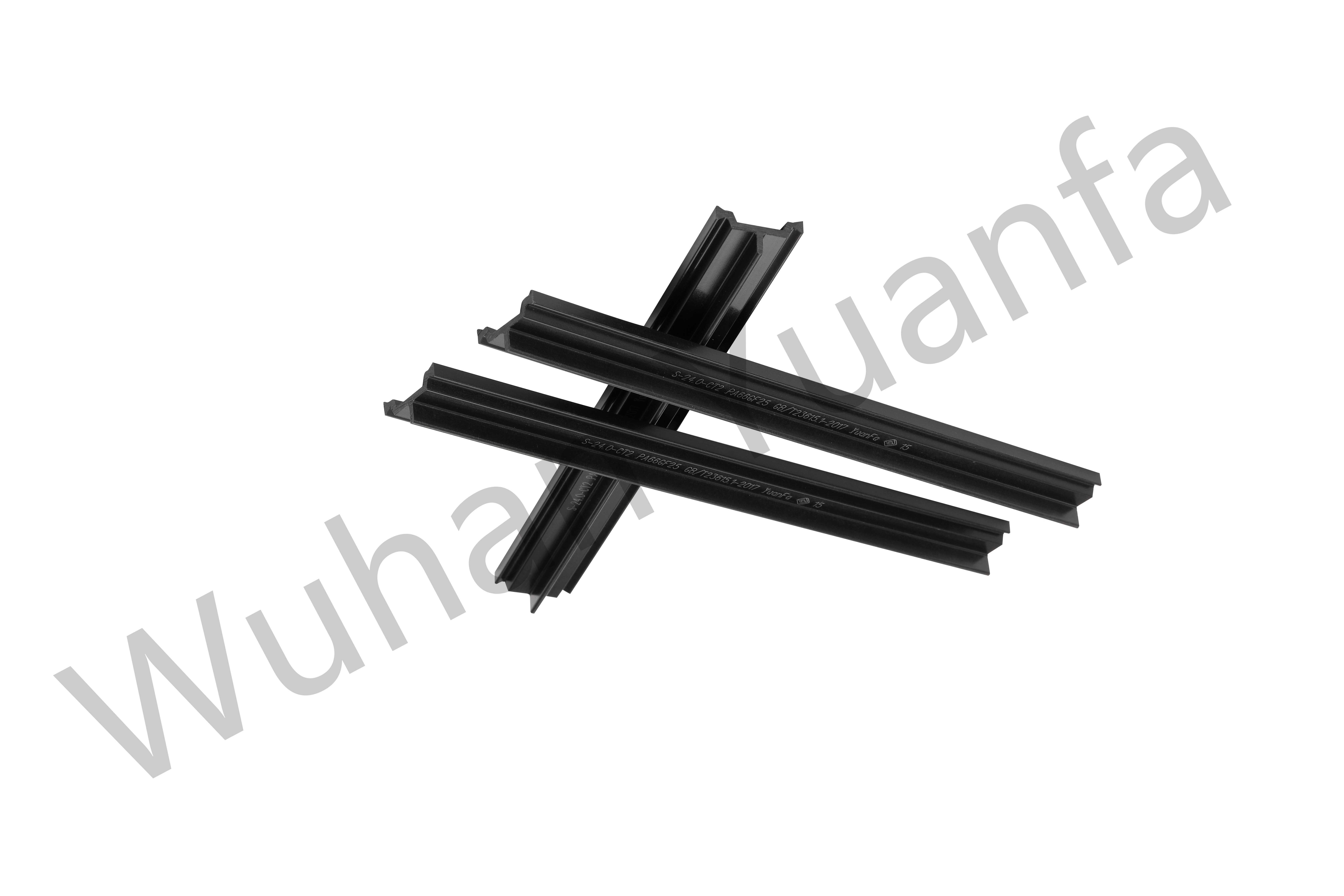
Precision manufacturing guarantees a secure, lasting assembly fit. A genuine low-conductivity thermal strip demands a remarkably strict dimensional variance. Usually, this means controlling tolerances to within ±0.05mm. Loose tolerances cause slipping during the window assembly. Overly tight tolerances prevent the knurled aluminum from gripping the strip correctly. This precise fit ensures an airtight, secure seal during the rolling process. Poor dimensional control leads directly to leaky frames.
Extrusion consistency represents another critical evaluation factor. Uneven extrusion creates alternating thick and thin spots along the profile length. Thin spots inside hollow chambers become dangerous structural weak points. They lead directly to premature mechanical failure when rolling pressure applies. High-quality manufacturing ensures absolutely uniform wall thickness across every single internal chamber. You must inspect these cross-sections meticulously.
Always evaluate your extrusion suppliers using recognized global benchmarks. DIN EN 14024 serves as the ultimate gold standard globally. It specifically governs metal profiles utilizing thermal barriers. This standard mandates rigorous testing for structural strength and thermal cycling over 1000 hours. Verify these specific metrics thoroughly before finalizing any procurement decisions.
Performance Metric | Solid PA66 GF25 Profile | Hollow PA66 GF25 Profile | Primary Benefit of Hollow Design |
|---|---|---|---|
Thermal Transmittance (Uf) | Standard baseline | 15% - 25% Reduction | Trapped air disrupts thermal convection drastically. |
Weight per Meter | Heavier mass | Lighter material usage | Easier handling and optimized logistics. |
Extrusion Tolerance | Standard (±0.1mm) | Ultra-Strict (±0.05mm) | Requires superior machinery, ensuring premium quality. |
Crimping Sensitivity | Highly forgiving | Requires precise calibration | Prevents inward collapse of internal cavities. |
Assembly processes pose distinct, highly specific manufacturing risks. Rolling machines crimp the knurled aluminum firmly around the polyamide strip. Applying too much rolling pressure easily cracks the hollow walls. Conversely, applying too little pressure severely compromises the overall shear strength of the window frame. You must calibrate your assembly machinery precisely to find the perfect middle ground. Regular shear testing during production runs is mandatory.
Standard rolling wheels often fail spectacularly in these hollow scenarios. You need specific knurling and rolling wheel configurations. They must tailor directly to hollow geometries to prevent damage. I-type, C-type, or complex multi-cavity shapes require dedicated nylon support blocks during the crimping phase. Proper tooling calibration stops the profile from collapsing inwards. It ensures the hollow chambers remain perfectly intact and structurally sound.
Moisture management logistics require strict, unwavering attention. PA66 is naturally a highly hygroscopic material. It actively absorbs moisture from the surrounding ambient air. This moisture acts as a beneficial plasticizer for the polymer. Over-drying the material makes the strips dangerously brittle. High humidity environments swell them beyond acceptable assembly tolerances. Store them in climate-controlled zones prior to assembly.
Maintain your warehouse humidity levels strictly between 45% and 60%.
Keep all thermal strips securely covered to avoid direct dust and moisture settling.
Condition the profiles at room temperature for at least 24 hours before crimping.
Monitor the ambient temperature near the rolling machinery during winter months.
Assess the manufacturer's true technical capacity before signing contracts. Can they reliably produce complex, custom multi-chamber profiles at scale? Look closely for micro-fractures in their initial sample cuts. High-end extrusion requires advanced, highly controlled water cooling mechanisms. Poor cooling causes severe internal stress and hidden cracks. A reliable partner utilizing a true PA66 GF25 hollow thermal strip will consistently showcase smooth, flaw-free internal chambers under a microscope.
Never trust a simple visual inspection alone. Request exact batch testing reports directly from the supplier. Demand transverse tensile strength test results. Ask specifically for shear tests performed both before and after intense thermal aging. These detailed QA reports validate the DIN EN 14024 compliance claims. They prove the manufacturer actually meets the rigorous engineering claims they advertise.
Establish clear expectations for custom prototyping early in the relationship. Custom proprietary window frames need entirely unique extrusion dies. Initial sample testing usually takes several weeks to complete properly. CAD simulations must precede the physical die cutting. Confirm these standard B2B lead times upfront to avoid scheduling conflicts.
Request initial material property certificates verifying the 25% glass fiber content.
Review the supplier's internal dimensional inspection logs for historical consistency.
Order a short trial run to test machinery compatibility on your rolling line.
Conduct in-house shear testing on the finalized aluminum-polyamide assembly before mass production.
Meeting increasingly strict U-value requirements demands intelligent engineering innovation. Adopting hollow PA66 GF25 strips remains a proven, highly effective method for manufacturers. They easily tackle modern energy efficiency challenges without sacrificing structural integrity. This holds true provided the initial extrusion quality remains completely uncompromised. You must prioritize dimensional accuracy and material integrity above all else.
Take immediate, actionable steps to upgrade your manufacturing process today. Audit your current frame Uf values rigorously against upcoming building codes. Identify exactly where thermal bridging occurs most frequently in your designs. Then, request comprehensive technical data sheets or structural test samples from highly qualified extrusion partners. Upgrading your thermal barrier is the fastest route to premium energy certification.
A: A hollow polyamide profile typically improves the frame thermal transmittance (Uf value) by 15% to 25% compared to standard solid strips. The exact improvement depends heavily on the total frame depth, the number of internal cavities, and the overall width of the thermal break zone utilized.
A: No. When extruded correctly using a 25% glass fiber reinforced matrix, the hollow design easily meets all standard load-bearing requirements. However, rolling machine calibration requires much stricter tolerances to prevent crushing the delicate hollow walls during the assembly process.
A: A wider, low-conductivity thermal break aligns the frame’s internal temperature gradient directly with the vertical isotherm line of the glass. This alignment keeps the interior aluminum surface temperature well above the room's dew point, effectively preventing condensation from forming inside.
A: Standard B2B procurement baselines usually require an MOQ ranging from 5,000 to 10,000 meters for custom designs. Lead times for custom extrusion die creation, CAD validation, and initial sample testing typically range from three to five weeks, depending on design complexity.


