

close
Choose Your Site
Global
Social Media

Author: Site Editor Publish Time: 2026-03-24 Origin: Site
A well-designed building façade is rarely noticed by the people who use the building every day. Offices stay comfortable throughout the seasons, there are no cold drafts near the windows, the aluminum frames do not sweat with condensation, and indoor temperatures remain stable without excessive energy consumption. When these conditions are achieved, occupants rarely think about the engineering behind the façade. One key component responsible for this stability is the Thermal Insulation Polyamide Profiles for Facades, which creates an effective thermal break inside aluminum curtain wall systems. By separating interior and exterior aluminum sections, these engineered polyamide profiles allow façade structures to maintain their strength while dramatically improving insulation performance, interior comfort, and long-term reliability.
Architectural aluminum has become one of the most widely used materials in modern façades due to its structural strength, corrosion resistance, and design flexibility. However, aluminum also conducts heat extremely efficiently. Without proper thermal separation, façade frames can act as thermal bridges that allow outdoor temperatures to pass directly through the structure. Polyamide insulation profiles solve this challenge by introducing a high-performance insulating connector between aluminum components. This technology enables curtain wall systems to meet demanding building energy standards while maintaining the sleek architectural appearance that aluminum façades are known for.
Understanding the advantages and practical benefits of polyamide insulation profiles helps architects, engineers, and developers make better decisions when designing façade systems that balance performance, durability, and occupant comfort.
One of the most significant advantages of polyamide insulation profiles is their ability to improve thermal performance without altering the architectural aesthetics of the façade.
Architects often prefer aluminum curtain wall systems because the material allows for slim framing around large glass panels. This design creates a modern visual appearance while maximizing natural light.
Thermal insulation polyamide profiles allow aluminum frames to maintain their structural role while improving insulation performance. Because the polyamide component is integrated inside the aluminum profile, the exterior appearance of the façade remains unchanged.
From the outside, the curtain wall looks identical whether a thermal break is present or not. The real difference occurs inside the aluminum profile structure.
Polyamide insulation profiles interrupt the direct metal path that normally conducts heat between indoor and outdoor environments. This interruption slows down the transfer of thermal energy through the frame and improves the overall insulation performance of the façade.
Although the thermal break is hidden inside the frame, building owners quickly notice the practical benefits.
Lower heat transfer through façade frames means indoor temperatures remain more stable. Heating and cooling systems do not need to compensate for excessive energy loss through the building envelope. Over time, this reduction in energy demand contributes to lower operating costs and improved comfort within the building.
Condensation is one of the most common problems encountered in aluminum façade systems that lack effective thermal separation.
Condensation occurs when warm indoor air contacts a surface that is colder than the dew point temperature. Aluminum frames without thermal breaks can easily reach low temperatures during winter conditions because the metal directly conducts outdoor cold into the interior side of the frame.
When this happens, moisture from indoor air condenses on the surface of the aluminum, leading to water droplets forming along the frame edges.
Thermal insulation polyamide profiles help prevent this situation by reducing heat transfer through the aluminum structure. Because the polyamide material has low thermal conductivity, the interior aluminum surface remains warmer.
When the interior surface temperature stays above the dew point, condensation becomes far less likely to occur.
Condensation on façade frames may seem like a minor inconvenience, but it can cause long-term issues. Persistent moisture can damage surrounding finishes, promote mold growth, and reduce the lifespan of certain building materials.
By improving condensation resistance, polyamide thermal break profiles contribute to a more durable façade system and a healthier indoor environment.
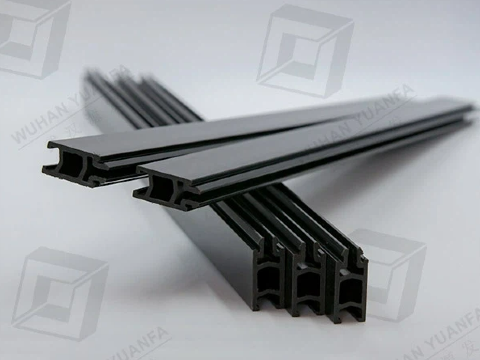
Polyamide insulation profiles are not merely insulating materials inserted into the aluminum frame. They are structural elements that must support mechanical loads within the curtain wall system.
Curtain wall systems must withstand wind loads, glass weight, and structural movement caused by temperature changes or building movement. The polyamide profile acts as the connecting element that transfers loads between the interior and exterior aluminum sections.
High-quality reinforced polyamide materials ensure that this connection remains strong throughout the life of the building.
Many polyamide insulation profiles used in architectural systems include glass fiber reinforcement. The glass fibers enhance the material’s mechanical properties, providing greater rigidity and resistance to deformation.
This reinforcement ensures that the polyamide profile maintains its structural performance even under demanding environmental conditions.
Uniform extrusion quality is critical for thermal break profiles. Consistent geometry allows aluminum fabricators to assemble curtain wall profiles efficiently and accurately.
When insulation profiles maintain precise dimensions, the assembly process becomes smoother, which improves production efficiency and ensures reliable thermal break performance.
Polyamide Profile Feature | What It Improves | Where It Matters Most | What to Confirm in Specifications |
Reinforced polyamide material | Structural strength | Large curtain wall frames | Mechanical strength rating |
Thermal break geometry | Reduced heat transfer | High-performance façades | Thermal conductivity data |
Dimensional stability | Reliable assembly | Aluminum profile fabrication | Dimensional tolerance |
Moisture resistance | Condensation control | Humid climates | Environmental durability |
Buildings experience continuous temperature changes throughout their lifespan. Materials expand and contract as the surrounding environment warms and cools.
Different materials expand at different rates when exposed to temperature changes. Polyamide insulation profiles are engineered to remain compatible with aluminum expansion behavior.
This compatibility allows the thermal break structure to maintain stability even during repeated thermal cycles.
Façade systems installed in various climates must tolerate both high summer temperatures and cold winter conditions. Polyamide insulation profiles maintain their structural integrity across this wide temperature range.
This stability ensures that the thermal break continues functioning effectively year after year.
Like many engineering materials, polyamide components perform best when stored and handled correctly before installation. Proper storage conditions help maintain dimensional consistency and prevent unnecessary moisture absorption.
Maintaining stable conditions during storage and transportation helps ensure that insulation profiles perform as expected when integrated into aluminum curtain wall systems.
One of the most important advantages of polyamide insulation profiles is their flexibility in façade system design.
Different façade systems require different levels of thermal performance. By adjusting the width and geometry of the polyamide profile, engineers can modify the insulation capability of the aluminum frame.
This flexibility allows façade designers to meet specific energy efficiency targets.
Some façade systems are designed for standard thermal performance, while others require higher levels of insulation for energy-efficient buildings. Polyamide thermal break profiles can be integrated into multiple system configurations to meet these varying requirements.
The selection of profile dimensions and material reinforcement allows designers to adapt curtain wall systems to different climate conditions and performance standards.
Choosing the appropriate polyamide insulation profile is part of the overall façade engineering strategy. The correct profile design ensures that the curtain wall system achieves its intended insulation performance without compromising structural reliability.
Wuhan Yuanfa New Materials Co., Ltd. specializes in the development and production of polyamide insulation strips and profiles used in aluminum façade systems, doors, and windows. Since focusing on building energy conservation technologies in 2003, the company has continuously improved its manufacturing processes and technical capabilities.
With advanced extrusion equipment and strong research collaboration with universities in Wuhan, Wuhan Yuanfa has developed polyamide insulation products widely used in aluminum architectural profiles. The company currently maintains an annual production capacity of approximately 200 million meters of polyamide insulation strips, supplying reliable thermal break components for modern façade systems.
In addition, the company has participated in the drafting of national and industry standards related to polyamide insulation materials for aluminum building profiles. This involvement reflects the company’s dedication to quality, innovation, and long-term industry development.
The performance of a modern building façade depends not only on glass technology or structural design but also on the thermal behavior of the aluminum frame itself. A Thermal Insulation Polyamide Profiles for Facades solution enables aluminum curtain wall systems to maintain structural strength while significantly improving insulation performance, condensation resistance, and indoor comfort. By interrupting the conductive heat path inside the aluminum structure, these engineered profiles help reduce energy consumption and create a more stable indoor environment.
Wuhan Yuanfa New Materials Co., Ltd. provides high-quality polyamide insulation profiles designed for aluminum façade systems, supporting architects and developers in creating energy-efficient buildings. If your project requires reliable thermal break components for curtain wall systems, our technical team is ready to assist. Contact us today to learn more about our polyamide thermal barrier performance solutions and explore how our products can support advanced façade engineering.
Thermal insulation polyamide profiles reduce heat transfer through aluminum frames, improve condensation resistance, enhance indoor comfort, and support energy-efficient building design.
No. Reinforced polyamide profiles are designed to maintain strong structural connections between aluminum sections while also providing thermal insulation.
Yes. By improving the thermal performance of curtain wall frames, these profiles help reduce heat loss in winter and heat gain in summer, which lowers energy demand for heating and cooling systems.
Polyamide thermal break technology can be used in many aluminum façade systems, including curtain walls, window walls, and other aluminum architectural structures that require improved thermal insulation.


