

close
Choose Your Site
Global
Social Media

Author: Site Editor Publish Time: 2026-07-01 Origin: Site
Commercial building codes and ESG mandates have made thermal bridging in aluminum facades a critical compliance risk, not just an energy inefficiency. Today, designing energy-efficient structures requires eliminating thermal highways across building envelopes. While aluminum provides necessary structural integrity and striking aesthetics, its highly conductive nature demands specialized interruption. Without proper thermal breaks, framing systems rapidly transfer heat and cold. This leads to severe condensation, excessive carbon emissions, and wasted energy.
PA66 GF25 (Polyamide 66 reinforced with 25% glass fiber) has emerged as the structural and thermal benchmark to solve this widespread issue. It bridges the critical gap between high-strength structural demands and stringent energy codes. This guide outlines how you can effectively evaluate, specify, and source these advanced profiles for large-scale facade projects. You will learn how to navigate material science, supplier selection, and assembly processes to ensure long-term building durability.
PA66 GF25 offers a Coefficient of Linear Thermal Expansion (CLTE) virtually identical to aluminum, eliminating shear stress during extreme temperature fluctuations.
Integrating specific polyamide profiles for aluminum facade systems directly dictates the final U-value (thermal transmittance) and LEED/BREEAM certification viability.
Evaluating profile manufacturers requires strict scrutiny of dimensional tolerances, moisture conditioning processes, and structural load testing.
Transitioning to wide insulating strips for facades allows for Passive House-level performance without compromising wind load resistance.
Unbroken aluminum facades act as massive thermal highways across your building envelope. They allow outdoor temperatures to easily bypass insulated glass units. This rapid heat transfer inflates HVAC operational costs dramatically during extreme weather. Worse, it causes localized interior condensation along the window frames. Condensation eventually leads to hidden structural degradation. It also encourages harmful mold growth, creating serious indoor air quality liabilities for property managers.
Modern energy standards heavily regulate building envelopes today. Frameworks like ASHRAE 90.1 and the European Green Deal enforce strict U-factor limits. Standard double glazing units combined with basic thermal breaks simply cannot meet these aggressive targets. Building owners now face strict financial penalties. They also risk losing prestigious green building certifications like LEED or BREEAM if they ignore thermal bridging.
Facade engineers must establish clear success criteria to solve this modern challenge. The chosen thermal break must deliver incredibly low thermal conductivity. We measure this insulation capacity as a Lambda value. Simultaneously, the component must maintain immense tensile strength. Modern commercial designs often feature heavy triple-glazing elements. They also face extreme, dynamic wind loads on high-rise structures. The hidden thermal barrier must carry these immense physical loads safely for decades.
Engineers widely consider Polyamide 66 superior to standard plastics for facade applications. It boasts exceptional mechanical strength under continuous stress. It also maintains a remarkably high heat distortion temperature. This specific heat resistance proves crucial during the facade manufacturing phase. Aluminum extrusions usually require oven-baked powder coating to achieve their final finish. This intense baking process destroys weaker plastics instantly. Furthermore, Polyamide 66 offers excellent chemical resistance. It stands up to harsh industrial environments, urban pollution, and aggressive facade cleaning agents.
However, pure polyamide alone cannot solve the structural facade problem. Pure plastic expands and contracts at a very different rate than metal. When you add exactly 25% glass fiber, you change the physical dynamics completely. You align the plastic's Coefficient of Linear Thermal Expansion (CLTE) perfectly with the surrounding aluminum framing.
Evidence-based claim: This deliberate synchronization prevents the structural composite from warping under the hot summer sun. It guarantees the frame will not lose its shear strength over a typical 30-to-50-year building lifespan.
When you specify certified polyamide thermal break profiles, you mandate this precise material composition. Unverified generic plastics often alter the fiber ratio to cut costs. This deceptive practice introduces hidden structural risks and eventual joint failures into the facade assembly.
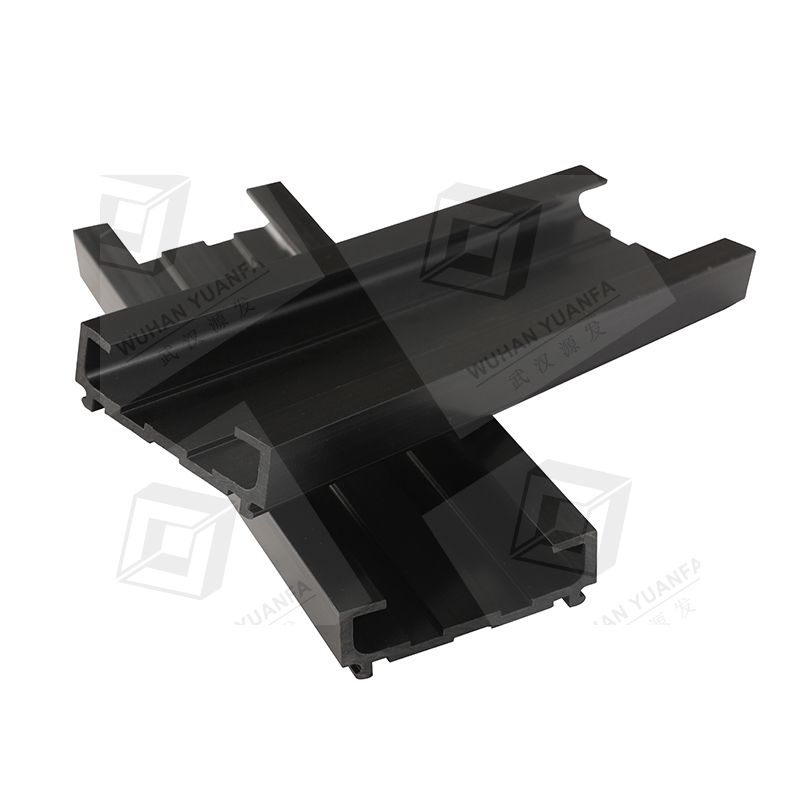
Engineers must evaluate several intricate design factors when specifying these components. The exact geometry of the plastic directly impacts both thermal and structural performance in the final assembly.
Increasing the width of the profile immediately lowers the overall U-value. You can implement the strategic use of wide insulating strips for facades to achieve this. Modern designs scale these components from 30mm up to 50mm or beyond. To maximize efficiency, manufacturers combine these wide strips with multi-cavity geometries. They often include integrated low-density foam. These internal cavities physically disrupt convection currents circulating inside the hollow frame.
Facade assembly relies heavily on millimeter-precision knurling and rolling techniques. Poor extrusion tolerances inevitably lead to loose physical fits. Even a fraction of a millimeter variance compromises the structural composite significantly. You must insist on tight dimensional tolerances during the initial procurement phase. Otherwise, the aluminum and plastic will never lock together properly.
Finally, focus your attention on Uf-value optimization. Look closely for profiles engineered with specific thermal flags. You should also seek out hollow chambers designed specifically to bounce thermal energy. These intricate designs actively minimize radiant heat transfer across the solid barrier, pushing insulation performance higher.
Even the best materials carry practical implementation realities. You must understand how moisture processing and legacy alternatives impact your final project outcome.
Transparent assumption: The moisture conditioning reality surprises many new engineers. PA66 is naturally hygroscopic, meaning it constantly absorbs moisture from the ambient air. Profiles must undergo proper moisture conditioning post-extrusion in controlled environments. They absolutely need this step to reach their optimal toughness before factory assembly. If workers attempt to roll unconditioned profiles, the overly dry plastic risks severe brittleness. It will likely crack during the aggressive knurling process.
How does this advanced composite compare to legacy alternatives like PVC and Polyurethane (PU)? You can review the structural and thermal differences below.
Material Type | Thermal Performance | Structural Strength Capability | Powder Coating Heat Resistance |
|---|---|---|---|
PA66 GF25 | Highly efficient (Very low Lambda) | Exceptional (High-rise capable) | Passes easily (>200°C safe) |
Standard PVC | Moderate efficiency | Low (Degrades under continuous stress) | Fails (Melts in curing ovens) |
Polyurethane (PU) | Highly efficient | Moderate (Inferior for heavy loads) | Variable based on curing |
As our comparison shows, PVC might seem cheaper initially. However, it lacks the necessary heat resistance for oven-baked powder coating. It also degrades quickly under persistent UV exposure and temperature stress. Polyurethane offers good thermal properties via the traditional pour-and-debridge method. Yet, it consistently delivers inferior structural strength for high-rise, heavy-load facade applications.
You also face specific physical design limitations. Implementing wider thermal barriers requires much deeper aluminum systems. This architectural shift increases the total wall thickness. Ultimately, it drives up total aluminum tonnage requirements, altering your structural volume calculations.
Selecting the right manufacturing partner actively mitigates downstream project risks. Follow these sequential steps when vetting potential suppliers for your next commercial build:
Audit Certifications and Testing Data: Always require third-party validated technical data sheets (TDS) from every vendor. These official documents must clearly show tensile strength limits. They should also detail shear strength before and after thermal cycling tests. Never accept estimated U-value calculations; demand exact lab-verified numbers.
Assess Customization Capabilities: A premium extrusion manufacturer can co-develop custom profile geometries with your engineering team. You might need unique C-shapes, robust T-shapes, or complex hollow chambers. They must tailor these designs specifically for your proprietary aluminum systems.
Evaluate Supply Chain and Scalability: Assess the vendor's total extrusion capacity before signing contracts. Look for advanced quality control mechanisms on the factory floor. Examples include in-line laser measurement systems. These automated tools ensure absolute dimensional consistency across thousands of meters of profile.
You cannot afford supply bottlenecks during peak construction phases. Partnering with a highly scalable supplier guarantees your project stays strictly on schedule while maintaining quality.
Selecting PA66 GF25 extends far beyond a simple material procurement choice. It represents a critical structural and environmental compliance decision for modern architecture. When you integrate high-quality polyamide profiles for aluminum facade components, you effectively future-proof the building envelope. This strategic move protects your assets against rapidly shifting climate regulations and extreme weather events.
Take these actionable next steps to secure your commercial facade performance:
Audit your current facade system U-values with your engineering team to identify immediate compliance gaps.
Request properly conditioned material samples from certified extrusion partners to test physical tolerances.
Conduct rigorous shear-stress testing on localized aluminum mock-ups to verify long-term structural integrity.
Update your procurement specifications to explicitly require exactly 25% glass fiber content.
By rigorously evaluating your thermal break strategy today, you ensure lasting structural performance, occupant safety, and maximum energy efficiency.
A: PA66 GF25 withstands typical powder coating baking temperatures, which often reach up to 200°C (392°F) for short durations. It accomplishes this without melting or losing its dimensional stability. This impressive heat resistance allows manufacturers to fully pre-assemble the aluminum and profile composite before sending it through the coating ovens.
A: If engineered correctly with PA66 GF25, they do not compromise wind load resistance. The high tensile strength of the glass-fiber reinforced matrix ensures robust structural integrity. You simply must ensure that the aluminum rolling and knurling process meets strict industry standards to lock the wide profile securely in place.
A: When shielded from direct UV exposure, which is standard practice inside an aluminum extrusion cavity, these profiles offer exceptional longevity. PA66 GF25 matches the intended design life of the entire facade system. In commercial applications, this lifespan typically exceeds 40 to 50 years without any structural degradation.
A: Deviating from exactly 25% alters the thermal expansion rate of the plastic. If a manufacturer uses 15% or 35% glass fiber, the profile will expand and contract at a different speed than the surrounding aluminum. This misalignment inevitably leads to structural shear failures under extreme weather cycling.


