

close
Choose Your Site
Global
Social Media

Author: Site Editor Publish Time: 2026-08-10 Origin: Site
Polyamide Profiles in thermally broken aluminum frames must do two jobs that pull in different directions: reduce the direct heat path through metal while remaining reliable within a mechanically assembled profile. PA66 GF25 is commonly used because it combines a PA66 polyamide matrix with 25 percent glass-fiber reinforcement, producing a material suited to demanding extrusion geometries and composite aluminum sections. It is not a shortcut to guaranteed facade performance, however. The exact compound, conditioning, profile geometry, processing method, and system test plan still decide whether a particular application works as intended.
PA66 GF25 identifies polyamide 66 reinforced with 25 percent glass fiber by material designation.
Glass-fiber reinforcement supports stiffness and dimensional stability that plain, unreinforced plastics may not provide in structural thermal-break roles.
Similar thermal movement behavior to aluminum is valuable, but it does not eliminate the need to assess the complete frame.
Material designation alone is insufficient; confirm the grade, extrusion consistency, dimensions, and assembly compatibility.
PA66 is an engineering polyamide with useful strength and heat resistance characteristics for extrusion applications. Adding glass fiber changes the balance of properties. In a thermal-break profile, the reinforcement helps the material resist deformation and carry the demands imposed by mechanical locking and service loads. It also affects processing behavior and anisotropy, which is why material choice and extrusion design must be evaluated together rather than as separate procurement items.
The phrase GF25 should be read precisely: it signals 25 percent glass fiber in the nominated compound. It is not a performance class by itself. Two products described broadly as PA66 GF25 may still differ in resin source, additives, moisture condition, fiber characteristics, extrusion control, geometry, and inspection regime. A purchasing specification should therefore define the required material evidence and critical dimensions instead of relying only on a shorthand material name.
In aluminum thermal-break assemblies, the profile is retained in knurled or shaped grooves. During rolling, the aluminum is mechanically deformed around profile features to form a composite section. A material with sufficient stiffness and stable shape supports consistent engagement; a material that is too flexible or dimensionally unstable can complicate that process. This is a principal reason PA66 GF25 has become familiar in Polyamide Profiles for windows, doors, and facades.
Aluminum offers structural efficiency and design flexibility, but it is thermally conductive. The insulating profile divides the frame into interior and exterior components. The assembled system must tolerate daily and seasonal temperature movement without creating excessive stress at the mechanical connection. Glass-fiber-reinforced PA66 is often selected because its expansion behavior can be closer to that of aluminum than many other plastics, which helps designers manage differential movement.
“Closer” does not mean “identical” under every condition. Temperature range, moisture condition, profile orientation, fiber alignment, geometry, and restraint all influence real movement. The responsible approach is to use material behavior as an input to system engineering, then verify the finished thermally broken section under the requirements applicable to the project.
The thermal contribution also needs context. PA66 GF25 is a lower-conductivity barrier compared with the aluminum it separates, but the overall thermal result depends on insulation depth, cavities, neighboring metal paths, glazing, spacers, fasteners, and installation. A frame cannot be ranked responsibly by the strip material alone.
Polyamide extrusion is a controlled process, not merely a way to make a black strip. The profile cross-section may include narrow legs, locking teeth, ribs, hollow chambers, or flags. These features must remain within the dimensional window required by the aluminum system. Consistency across a production run matters because even a well-designed profile can be difficult to roll if its legs vary or the cross-section distorts.
Moisture management is another practical consideration. Polyamides interact with moisture, and their state can affect processing and mechanical behavior. It is better to specify storage, handling, and production controls appropriate to the compound and application than to assume a profile will perform the same way after any storage condition. Fabricators should also coordinate cutting, feeding, rolling, and inspection with the supplier’s product guidance.
What to verify | Why it matters | Useful evidence |
Compound designation | Confirms the requested PA66 GF25 material basis | Material declaration and agreed specification |
Cross-section dimensions | Controls fit in aluminum grooves and rolling behavior | Approved drawing and batch inspection record |
Profile appearance | Can reveal handling or extrusion defects | Incoming inspection criteria |
Conditioning and storage | Affects processing consistency | Handling instructions and site controls |
Finished composite behavior | Determines actual system suitability | Applicable assembly tests and engineering review |
Architectural aluminum is often surface-finished through processes that introduce heat or chemical exposure. The fabricator must decide whether the thermal break is inserted before or after a particular treatment. PA66 GF25 may be chosen in part because it can support common production sequences better than less heat-resistant plastics, but it is still essential to confirm the actual time-temperature cycle and chemical environment rather than relying on a generic claim.
For example, coating conditions involve more than a single oven set point: exposure time, section mass, color, air flow, fixtures, and cooling practice can change the real thermal history. Anodizing and other treatments may require a different assembly sequence. The aluminum-system supplier, coating provider, and profile manufacturer should agree on the sequence before production samples are approved.
Yuanfa lists PA66 GF25 insulating profiles among products used for aluminum window, door, facade, and curtain wall applications. That product context is useful for procurement discussions, but an approved project specification should still establish the exact geometry and test criteria.
The material cannot compensate for an unsuitable aluminum design, damaged knurling, poor rolling setup, or missing drainage strategy. It cannot make an undersized mullion adequate for wind load, and it does not define a whole-window or whole-facade U-value. It also should not be used as a shorthand for compliance with a project’s local requirements. Material qualification, assembly testing, and system engineering are separate controls.
A good buyer avoids two opposite errors. The first is buying only on price and accepting an unspecified “nylon strip.” The second is assuming that naming PA66 GF25 removes all design risk. Better procurement asks for a defined material, an approved profile drawing, stable dimensional controls, traceable lots where required, and a verification route suited to the actual aluminum system.
Begin with the aluminum-system cross-section and required insulation depth. Next, determine the profile family needed for the grooves and functional zones. A conventional K-type arrangement may be appropriate for one geometry, while CT or Y arrangements may be necessary when groove placement, ribs, or locking requirements change. The primary question is fit and function, not which profile name appears more advanced.
Then assess the assembly sequence and test plan. If the system will be used in a large facade, the thermal break may participate in a critical composite member; that calls for review of load transfer and deflection as well as insulation. For windows and doors, hardware pockets, drainage and sash/frame interfaces add different constraints. Wuhan Yuanfa New Materials Co., Ltd. supplies several profile geometries, so a buyer should submit the actual section drawing and intended application rather than choose a profile only by width.
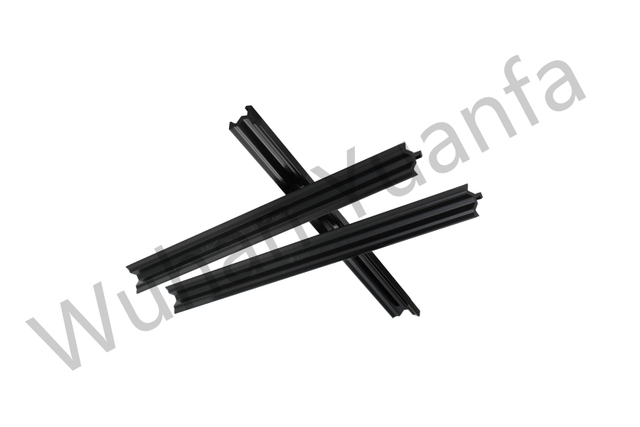
An acceptance plan should link incoming checks to the risks in the finished assembly. Start with the approved material designation and profile drawing. Then measure the features that control insertion and rolling, including locking legs, tooth spacing, web thickness, ribs, and cavities. A batch can be close to a nominal width but still cause a fabrication problem if one critical feature is out of tolerance.
Visual inspection has a practical role too. Surface contamination, damaged legs, distorted sections, poor cutting, or packaging damage can interfere with handling and rolling even when the resin basis is correct. Keep profiles protected from contamination and physical damage, and preserve identification of different shapes and lots where traceability is required. An unapproved substitute should never be mixed into a controlled production run simply because its material description sounds similar.
The decisive component check is a representative composite assembly. Use the intended aluminum, knurling, rolling direction, settings, and finishing sequence, then inspect the result before moving to full frame fabrication. Keep profile acceptance separate from system acceptance: a conforming PA66 GF25 component does not by itself demonstrate air, water, structural, acoustic, or thermal performance of the completed building element.
PA66 GF25 is common in Polyamide Profiles because it combines the insulating role of polyamide with glass-fiber reinforcement that supports stable, mechanically engaged thermal-break sections. Its value lies in how it works within an engineered aluminum system—not in the label alone. Sensible selection includes compound confirmation, dimensional control, compatible processing, and complete-assembly verification. Yuanfa’s PA66 GF25 product range can support conversations about thermally broken aluminum profiles, while final suitability should always be decided against the approved system cross-section and project requirements.
It denotes polyamide 66 reinforced with 25 percent glass fiber. The designation identifies a material family, while the full product specification should define the actual compound and profile requirements.
Glass fiber can improve stiffness and dimensional stability, which are important where the profile is mechanically engaged into aluminum and contributes to composite frame behavior.
No. Thermal-break technologies and materials vary, but selection should be made for the required system geometry, fabrication sequence, structural behavior, and project performance targets.
No. The final value depends on the complete frame or facade design, including aluminum geometry, insulation depth, glazing, edge details, and installation conditions.
The correct sequence depends on the aluminum finish, actual treatment conditions, and approved system process. Confirm it with the relevant material and system providers before production.


