

close
Choose Your Site
Global
Social Media

Author: Site Editor Publish Time: 2026-08-03 Origin: Site
In commercial fenestration manufacturing, the stakes always remain incredibly high. A single compromised aluminum extrusion can trigger cascading project failures and severe structural liability. You cannot view knurling as a mere preliminary step in production. Instead, it serves as the foundational mechanical process dictating the structural integrity of the entire thermal breaking workflow. Without precise knurling, even the highest-grade materials will fail under stress. Understanding these exact knurling mechanics is critical for production managers and procurement teams alike. You will learn how to evaluate automated assembly lines and troubleshoot shear test failures rapidly. We will also show you exactly how to optimize production yields for long-term manufacturing success.
Knurling creates the essential mechanical "teeth" required to lock the polyamide thermal break into the aluminum cavity, preventing longitudinal slippage.
The precision of the knurling process directly dictates whether the finished composite profile will pass industry-standard longitudinal shear and transverse tensile tests.
Choosing between a 2-step and 3-step thermal breaking production line hinges on your required throughput, profile complexity, and floor space.
Evaluating knurling machinery requires focusing on tooling durability, CNC precision, and the consistency of the knurl depth across varying aluminum alloys.
Aluminum and polyamide possess drastically different coefficients of thermal expansion. Aluminum expands and contracts significantly as temperatures fluctuate across seasons. Polyamide remains far more stable under those same environmental conditions. Without mechanical intervention, this thermal stress quickly causes the strip to shear against the smooth aluminum walls. The joint will eventually loosen. Structural failure becomes inevitable when relying solely on friction between flat surfaces.
Knurling solves this physics problem by creating a necessary mechanical bite. During production, a specialized knurling wheel drives into the extrusion cavity. It displaces the aluminum material forcefully. This action forms sharp, microscopic teeth along the insertion channel. These teeth act as aggressive gripping points. They prevent the inserted strip from sliding longitudinally.
Knurling does not work in isolation. It operates in perfect synergy with the final crimping stage. The crimping machine applies immense lateral pressure to the aluminum profile. This pressure forces the polyamide thermal break directly into the newly formed knurled teeth. The teeth bite deeply into the plastic strip. This combination creates a permanent, unified structural composite. You achieve a solid bond capable of transferring wind loads effectively.
This mechanical lock ensures compliance with stringent architectural guidelines. Organizations like the American Architectural Manufacturers Association (AAMA) set strict structural performance standards. Guidelines such as AAMA TIR-A8 demand high shear strength for composite thermal barrier framing systems. Proper knurling guarantees you meet these rigorous industry safety benchmarks consistently.
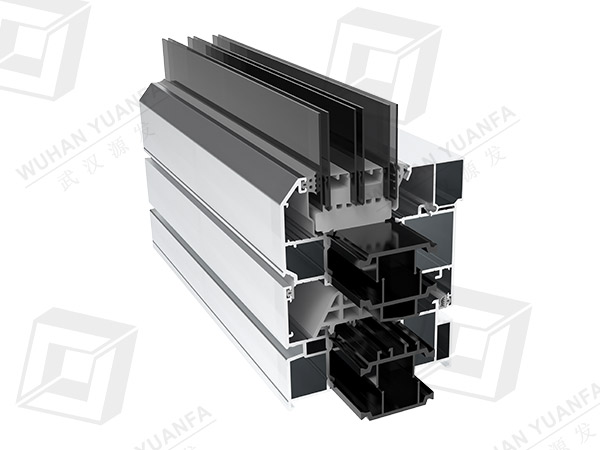
You must measure knurling success through verifiable metrics rather than visual guesswork. Depth and pitch precision define a proper knurl. The teeth must reach a specific depth to penetrate the polyamide strip effectively. However, cutting too deeply compromises the structural wall thickness of the aluminum extrusion. You must calibrate the machinery to achieve this delicate balance perfectly.
Consistency across profile lengths stands out as another crucial requirement. You need uniform knurling from end to end. Intermittent skipping or shallow knurling creates dangerous weak points. These weak points remain highly susceptible to stress fractures during installation. If the knurling wheel chatters or loses pressure, the resulting grip becomes completely unreliable.
Material variables also dictate your production approach. Aluminum alloys vary significantly in hardness. For example, a 6060 alloy behaves differently than a 6063 alloy. The temper designation (such as T5 or T6) further alters the material yield strength. You must adjust the downward pressure and tooling configuration accordingly. Harder alloys require higher pressure to achieve consistent tooth geometry. Failing to adjust settings for different alloys leads to immediate quality control failures.
Best Practice: Implement a digital gauge system to measure tooth depth immediately after the knurling station.
Common Mistake: Using the exact same machine pressure settings for different aluminum alloy tempers.
Best Practice: Conduct a visual inspection of the first five meters of every new extrusion batch.
Manufacturers generally choose between two distinct production architectures. The traditional 3-step method divides the process into distinct phases. First, an independent machine knurls the aluminum cavity. Next, operators manually or semi-automatically insert the thermal break strip. Finally, a separate rolling machine crimps the assembly. This modular approach offers high flexibility for complex profiles. It also allows easier troubleshooting at individual stations when mechanical issues arise.
Conversely, the streamlined 2-step method consolidates the workflow. It integrates knurling and strip feeding into a single, continuous machine operation. A secondary rolling machine then finalizes the crimp. This streamlined approach reduces required floor space significantly. It lowers direct labor costs by removing manual handling steps. It also maintains tighter alignment tolerances since the profile never leaves the guiding track between knurling and insertion.
Buyers need a pragmatic decision framework when selecting machinery. High-volume, standard-profile manufacturers benefit most from 2-step automated lines. The speed and labor savings justify the upfront equipment investment. Custom operations handling highly variable profiles may require the modularity of 3-step setups. If you change profile geometries multiple times per shift, the 3-step method offers faster changeover times.
Feature | 3-Step Method | 2-Step Method |
|---|---|---|
Process Flow | Knurl -> Manual Insert -> Crimp | Knurl & Insert -> Crimp |
Floor Space Required | High | Low to Moderate |
Labor Intensity | High (requires manual handling) | Low (automated feeding) |
Changeover Speed | Fast (highly modular) | Slower (requires complex setup) |
Ideal Production Fit | Custom, variable batch sizes | High-volume, standardized batches |
Failing to prioritize the knurling process yields immediate and severe business impacts. The most direct consequence involves destructive test failures. Quality control teams perform longitudinal shear testing and transverse tensile testing regularly. If the knurling teeth lack sufficient depth or sharpness, the composite profile will fail these tests. You will have to scrap entire production batches. Scrapped materials destroy your profit margins instantly.
In-field failures represent an even more catastrophic risk. Poor knurling often leads to structural delamination after installation. The polyamide strip detaches from the aluminum under high wind loads. Extreme temperature fluctuations accelerate this separation process. When the composite fails in the field, the building loses its intended thermal barrier. This results in massive energy inefficiencies and potential structural safety hazards.
Tooling neglect drives the majority of these hidden costs. Production teams sometimes run worn knurling wheels far past their intended lifespan. Worn wheels produce rounded teeth instead of sharp ones. Rounded teeth completely fail to grip the plastic strip during the crimping phase. The resulting assembly might look fine visually, but it possesses zero structural integrity. You must prioritize strict maintenance schedules to avoid these silent, expensive failures.
When you scale your fenestration manufacturing, equipment selection becomes paramount. You need reliable machinery capable of maintaining tight tolerances across continuous shifts. Evaluating knurling machinery requires a focused approach on durability and digital control.
CNC-Controlled Adjustment Axes: Look for machines offering precise, programmable axis adjustments. This eliminates manual crank errors and ensures repeatable depth settings across different profile geometries.
Robust Spindle Bearings: The knurling process exerts immense side loads on the machine spindles. You must source equipment featuring heavy-duty bearings to prevent spindle deflection during operation.
Automated Strip Feeders: For high-volume environments, ensure the machinery includes synchronized feeding mechanisms. This prevents strip stretching or buckling prior to the crimping stage.
Digital Pressure Monitoring: Select machinery that displays real-time downward pressure metrics. This allows operators to spot tooling wear before it causes batch failures.
Tooling lifespan requires careful operational tracking. You must insist on high-grade steel knurling discs. Standard steel discs dull quickly against harder aluminum alloys. Track operational hours diligently for every machine. Schedule preventive replacement of knurling wheels before they exhibit visible wear. Waiting until teeth look blunt guarantees that you have already produced compromised extrusions.
Quality control integration remains the final pillar of successful implementation. We recommend establishing a strict pilot run protocol. Run a short batch and perform immediate destructive shear testing at the start of every single shift. You must also mandate this testing protocol whenever operators change profile geometries. Catching a calibration error during a pilot run saves thousands of dollars in wasted aluminum and polyamide.
Knurling stands as the non-negotiable variable in producing structurally sound, thermally broken aluminum profiles. You cannot achieve an acceptable mechanical lock without precise, consistent tooth formation inside the extrusion cavity. Every downstream process relies entirely on this initial foundational step. Substandard knurling guarantees structural failure, regardless of your material quality.
Decision-makers must take immediate action to safeguard their production lines. Audit your current shear test pass rates today to identify hidden vulnerabilities. Assess your tooling wear and implement mandatory replacement schedules based on operational hours. When shortlisting new thermal break machinery, demand verifiable throughput data. Always request sample processing using your specific profile designs to validate the equipment's true capabilities.
A: No. Skipping knurling eliminates the mechanical lock entirely. Without knurled teeth, the connection relies only on friction. This results in a profile that will inevitably fail structural shear tests and slip under thermal stress.
A: Depth depends directly on the specific profile wall thickness and the polyamide strip design. It must be calibrated carefully to ensure sufficient penetration during crimping without weakening the extrusion. Adherence to your system supplier specifications remains strictly required.
A: Replacement intervals depend heavily on your production volume and specific alloy hardness. Regular visual inspection of the teeth and routine daily shear testing serve as the most reliable indicators of tool wear.


