

close
Choose Your Site
Global
Social Media

Author: Site Editor Publish Time: 2026-08-28 Origin: Site
Modern fenestration systems face a fundamental engineering tension. Architects demand maximum thermal efficiency for sustainable building designs. They also require uncompromised structural integrity for large-scale aluminum frames. You cannot easily achieve both goals using traditional metal alone. Base polyamide, commonly known as nylon, acts as an excellent insulator. However, raw nylon lacks the mechanical rigidity necessary for heavy structural applications. It cannot independently support the weight of commercial window frames or resist heavy wind loads.
This article examines the empirical role of glass fiber integration in fenestration polymers. We will detail how this specific reinforcement transforms a standard polymer. You will learn how it creates a structurally viable Polyamide Profile. We will explore how these advanced composites endure high mechanical loads. We will also uncover their ability to withstand extreme temperature fluctuations without compromising the structural envelope.
Dimensional Stability: Glass fibers align the thermal expansion coefficient of the polyamide profile with that of aluminum, preventing shear stress and warping.
Structural Integrity: Reinforcement (typically 25% glass fiber) increases tensile strength by up to 300% compared to unreinforced nylon.
Thermal Barrier Efficiency: A Reinforced Thermal Insulation Profile maintains strict thermal breaks without sacrificing the load-bearing capacity of the assembly.
Compliance & Longevity: Proper glass fiber orientation is critical for meeting international building standards (e.g., EN 14024, AAMA) and ensuring multi-decade durability.
Engineers consistently evaluate polymers for structural thermal breaks. Pure PA66 exhibits significant baseline limitations in heavy-duty applications. Raw polyamide absorbs moisture rapidly from its environment. It undergoes thermal deformation when exposed to elevated temperatures. Furthermore, pure nylon remains highly susceptible to polymer creep. Creep refers to the slow, continuous deformation of a material under constant physical stress. Heavy glass panes impose immense sustained loads on window frames. Unreinforced nylon slowly stretches and distorts under this constant pressure. You cannot rely on it to maintain tight facade tolerances.
Glass fiber reinforcement fundamentally alters this chemical and physical reality. Manufacturers inject micro-glass fibers into the raw nylon base during production. They typically maintain a strict 25% volume ratio, known as PA66 GF25. These micro-fibers distribute themselves throughout the polymer chains. They interlock to create a rigid internal matrix. This glass skeleton bears the mechanical stress instead of the weaker plastic molecules. The matrix restricts the natural movement of the polymer chains. It prevents plastic deformation and structural sagging.
This internal matrix triggers measurable shifts in tensile and flexural performance. The load-bearing capacity of the composite material increases dramatically.
Tensile Strength: Reinforcement improves tensile strength by nearly 300% over unreinforced variants.
Flexural Modulus: The material gains immense stiffness, resisting bending under heavy wind loads.
Yield Strength: The profile requires significantly higher force before it permanently deforms.
Creep Resistance: The glass skeleton effectively halts long-term polymer stretching under sustained weight.
These mechanical upgrades make the material suitable for commercial skyscrapers. The frames stay perfectly aligned despite extreme external pressures. They securely hold heavy triple-glazed units without bending.
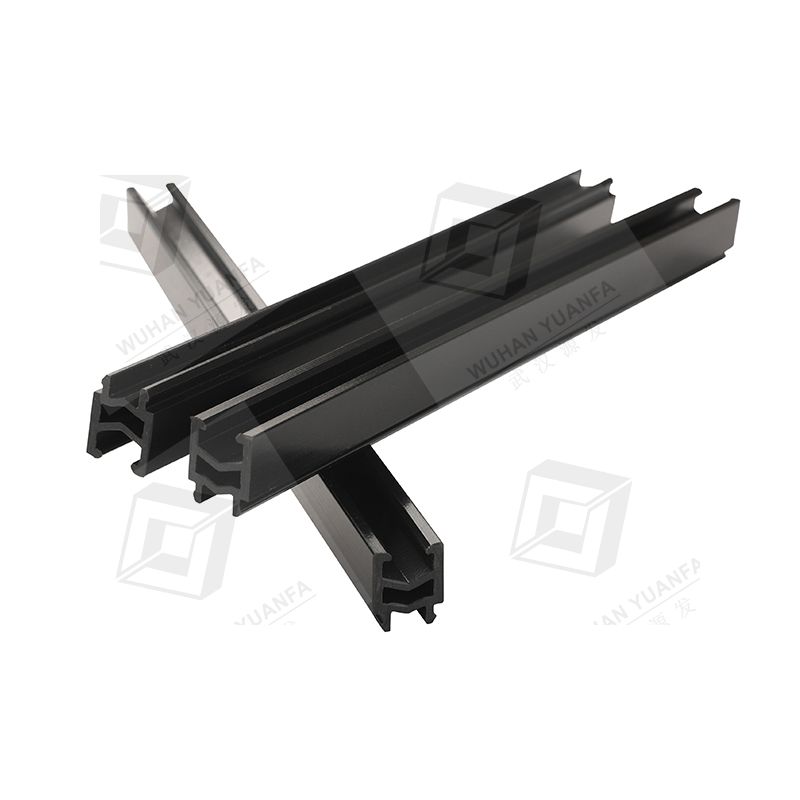
Thermal management requires precise material synchronization. The composite assembly acts as a bridge between interior and exterior environments. You must balance mechanical stiffness with thermal resistance.
The Coefficient of Linear Thermal Expansion (CLTE) dictates how a material reacts to heat. Metals and plastics expand at drastically different rates. Aluminum expands significantly when heated by the summer sun. Pure nylon expands at a much faster rate than aluminum. This mismatch creates severe shear stress along the joint. The plastic attempts to outpace the metal during thermal expansion. This tears the composite assembly apart over time.
Adding glass fibers solves this critical engineering problem. The stiff fibers restrict the natural expansion of the nylon base. They lower the CLTE of the polymer to match the surrounding aluminum structure. This perfect alignment prevents joint failure. The plastic and metal expand and contract in unison. This synchrony preserves the mechanical lock of the assembled frame.
Table 1: Material Coefficient of Linear Thermal Expansion (CLTE) Comparison
Material Type | Approximate CLTE Value (10^-6 /K) | Compatibility with Aluminum |
|---|---|---|
Aluminum Alloy | 23.0 | Baseline standard |
Pure PA66 (Unreinforced) | 80.0 - 100.0 | Poor (High shear stress risk) |
PA66 GF25 (25% Glass Fiber) | 20.0 - 30.0 | Excellent (Perfect alignment) |
Buildings experience extreme indoor-outdoor temperature differentials daily. The exterior face of a window frame might freeze in winter. Meanwhile, the interior face stays warm. This temperature gap causes the aluminum to behave differently on each side. The natural result is bimetallic bending, where the frame physically bows outward or inward. The intense stiffness of the glass fibers actively resists this bowing effect. The reinforced strip holds the inner and outer metal extrusions rigidly in place. It forces the frame to remain straight and true.
Engineers often worry about the thermal conductivity of glass. Glass conducts heat faster than raw plastic. However, the addition of glass fiber does not significantly degrade the insulation value. The micro-fibers remain isolated within the polymer matrix. They do not form a continuous conductive path. The overall U-value remains extremely low. A Reinforced Thermal Insulation Profile easily maintains strict thermal breaks. It achieves high insulation metrics without sacrificing load-bearing capacity.
Procurement teams must evaluate various materials for thermal break applications. You need to shortlist materials based on performance data rather than initial assumptions.
Polyvinyl Chloride (PVC) often appears as a cheaper alternative to polyamide. However, PVC fails entirely in high-temperature manufacturing environments. Window manufacturers frequently assemble thermal breaks before the powder coating process. Powder coating ovens typically operate around 200°C. PVC softens, melts, or distorts at these temperatures. Glass-filled polyamide easily survives 200°C environments without losing dimensional stability. Furthermore, PVC lacks the baseline shear strength required for large commercial facades.
Polyurethane (PUR) pour-and-debridge systems represent another market alternative. Manufacturers pour liquid PUR into an aluminum channel. The liquid cures into a solid barrier. Manufacturers then cut away the temporary aluminum bridge. This process involves complex manufacturing trade-offs. Polyamide offers superior material consistency compared to poured liquids. The solid polyamide strip utilizes a mechanical lock in standard extrusion setups. You simply roll it into the knurled aluminum cavity. This provides a measurable, predictable shear strength that poured systems sometimes struggle to guarantee.
Specifying unreinforced plastics introduces massive operational risks. Unreinforced polymers shrink over time as they age. They develop micro-cracks under repeated wind loads. This shrinkage breaks the tight mechanical seal between the plastic and the metal. The entire structural thermal break system eventually compromises. Structural integrity fails, and water infiltration becomes inevitable.
Follow these steps when evaluating structural thermal break materials:
Verify the material can withstand 200°C powder coating temperatures.
Check the CLTE value to ensure alignment with the host metal.
Review the shear strength data for mechanical roll-in assembly.
Assess long-term creep resistance under sustained glass loads.
The theoretical benefits of glass fibers depend entirely on manufacturing execution. Poor manufacturing processes negate the structural advantages of the composite.
Fiber orientation matters immensely during the extrusion process. Extrusion forces the molten plastic through a shaped die. High-quality manufacturing ensures the glass fibers align longitudinally along the profile length. This specific orientation maximizes tensile strength. If fibers orient randomly, the material loses its structural advantage. Weak spots develop along the strip. Longitudinal alignment guarantees uniform load distribution across the entire assembly.
Tooling wear presents a significant production reality. Glass fibers act as highly abrasive materials. They scrape against the steel dies during extrusion. This friction wears down standard tooling rapidly. Extruding high-quality profiles requires specialized, hardened steel tooling. This impacts vendor selection. Premium manufacturers invest in durable dies to maintain tight dimensional tolerances. Cheaper vendors might use worn dies, resulting in warped or improperly sized profiles.
Moisture conditioning serves as a critical technical requirement. Freshly extruded glass-filled polyamide is extremely dry. In this state, the material is brittle and rigid. You cannot immediately crimp or roll this dry profile into an aluminum frame. It will shatter under the pressure of the rolling discs. Post-extrusion, the polyamide must absorb a specific baseline of moisture. Manufacturers place the profiles in specialized humidity chambers. The polymer naturally absorbs this moisture. The water molecules act as a plasticizer. They optimize the material's toughness. This conditioning prevents brittleness and ensures smooth assembly.
Engineering and procurement teams need an actionable decision framework. Evaluating vendors requires looking past marketing claims and focusing on empirical data.
You must establish verifiable fiber content. Always request comprehensive material data sheets (MDS) from potential vendors. The MDS should explicitly state the glass fiber ratio. You want to see a standard ratio of 25% ± 2%. Ratios dipping below 23% compromise the mechanical stiffness. Ratios exceeding 27% make the material excessively brittle. Exact formulations guarantee predictable performance during the final window assembly.
Compliance and certification remain non-negotiable elements. Highlight the necessity of standard testing documentation during your vendor audits. You should look for compliance with EN 14024 standards. This standard specifically dictates the performance criteria for thermal barrier profiles. In North America, look for localized AAMA standards. These certifications prove the material passes rigorous stress, temperature, and aging evaluations.
Prioritize vendors who willingly provide extensive Quality Assurance (QA) testing data. Do not accept estimated figures. Request exact dimensional tolerance reports to ensure the profiles fit your aluminum extrusions perfectly. Review their shear strength testing results. Finally, ask for aging cycle results. Accelerated aging tests demonstrate how the material behaves after decades of extreme weather exposure.
Table 2: Key Vendor Audit Metrics
Evaluation Category | Acceptable Standard | Required Documentation |
|---|---|---|
Glass Fiber Content | 25% ± 2% | Material Data Sheet (MDS) |
Standard Compliance | EN 14024 / AAMA equivalent | Third-party Laboratory Certificate |
Dimensional Tolerance | Strict adherence to CAD profiles | Batch QA Inspection Reports |
Glass fiber integration fundamentally changes fenestration engineering. It is not merely a supplementary additive. It acts as the core structural enabler for modern thermal breaks. The interlocking fiber matrix transforms soft nylon into a rigid, reliable structural component. It aligns thermal expansion rates, prevents bimetallic bending, and resists polymer creep. These material properties make the modern reinforced profile entirely viable for commercial and residential applications.
Your next step involves auditing your current material specifications. Review your existing profiles for appropriate glass fiber ratios and moisture conditioning practices. Request exact tolerance samples from your vendors to perform independent shear strength tests. Finally, consult directly with a structural material engineer. They can help you calculate the specific mechanical load requirements for your upcoming facade projects.
A: The industry standard stands firmly at 25% by volume (PA66 GF25). This specific ratio provides the perfect balance of tensile strength and elasticity. Going below 25% reduces the necessary structural stiffness. Pushing the ratio higher than 25% creates diminishing returns. It makes the polymer excessively brittle and prone to shattering during assembly.
A: No, it does not significantly compromise insulation. While raw glass conducts heat faster than plastic, the micro-fibers remain isolated inside the polymer matrix. They do not form a continuous path for heat transfer. The thermal bridging effect remains entirely negligible compared to the massive structural gains.
A: Polyamide is naturally hygroscopic. It readily absorbs water from the air. Manufacturers use moisture conditioning as a planned part of the production process. The absorbed moisture acts as a natural plasticizer. It enhances the impact resistance of the profile, preventing it from snapping or cracking during the mechanical knurling process.
A: Yes, they exhibit excellent high-temperature stability. They routinely survive powder coating baking ovens operating up to 200°C without melting or distorting. This extraordinary thermal stability sets them apart from cheaper alternatives like PVC, which fails entirely under such extreme manufacturing temperatures.


