

close
Choose Your Site
Global
Social Media

Author: Site Editor Publish Time: 2026-08-28 Origin: Site
Modern fenestration and facade designs demand exceptional performance from every structural component. Engineers face a relentless balancing act in high-rise applications. They must achieve extreme thermal insulation without ever compromising essential load-bearing capacity. A major hurdle in this process is the "bi-metal effect," frequently referred to as thermal bowing. This phenomenon occurs when significant temperature differentials develop between the interior and exterior aluminum extrusions. One side of the frame expands rapidly in the heat while the cold interior side contracts, creating immense structural tension. In this article, you will learn how precise material engineering mitigates these destructive forces. We will explore why a Polyamide Profile serves as much more than a basic thermal barrier. You will discover exactly how this innovative solution functions as a critical structural component engineered to guarantee precise dimensional stability under severe environmental stress.
Coefficient Matching: High-quality polyamide (specifically PA66 GF25) shares a nearly identical Coefficient of Linear Thermal Expansion (CLTE) with aluminum, preventing shear stress and frame warping.
Structural Integrity: Unlike pour-and-debridge alternatives, mechanically rolled polyamide acts as a load-transmitting composite, sustaining high wind and structural loads.
Specification Imperatives: Verifiable glass fiber orientation, shear strength testing, and proper moisture conditioning are non-negotiable for guaranteeing long-term dimensional stability.
Assembly Readiness: Polyamide profiles easily withstand the 200°C+ temperatures required for post-assembly powder coating.
Aluminum acts as a highly conductive metal. It responds rapidly to environmental temperature shifts. When you build a modern facade, you expose the exterior face to extreme weather. Winter storms plunge exterior surfaces well below freezing. Meanwhile, interior building systems heat the inner aluminum sections to comfortable room temperatures. This massive temperature delta forces the two connected aluminum halves to behave differently.
The exterior section attempts to shrink. The interior section attempts to expand. Because a thermal break connects these two halves, the varying expansion rates create immense shear stress across the central axis. We call this phenomenon the bi-metal effect. If the thermal barrier cannot handle this differential stress, the entire window frame bends or bows toward the warmer side. You see this vividly in tall curtain walls where even a millimeter of deflection multiplies over large vertical spans.
Failing to account for thermal bowing introduces severe performance and safety risks. When aluminum profiles warp, they drag the entire window assembly out of alignment. You will quickly encounter systemic failures.
Hardware Binding: Locking mechanisms jam. Users cannot open or close operable windows easily. This creates immediate safety concerns during emergency egress situations.
Seal Failure: Rubber gaskets rely on constant, even pressure. When the frame bows, it pulls away from the glass. Gaskets lose compression, rendering the system vulnerable.
Water Ingress: Once seals fail, rain penetrates the building envelope. Moisture travels through the frame cavities, causing internal damage to building finishes.
Compromised Structural Integrity: In high-rise applications, wind loads magnify thermal stress. A bowed frame loses its rated wind pressure resistance. The glass panes may suffer edge damage or catastrophic blowout under extreme gusts.
Common Mistake: Many design teams calculate wind load capacities but ignore thermal bowing stress during the initial design phase. Always evaluate both forces simultaneously.
Historically, manufacturers tried inserting standard, unreinforced plastics to block heat transfer. These legacy insulators failed dramatically. Pure plastics feature massive thermal expansion rates compared to metals. They expand wildly when heated and shrink drastically when cooled. Over multiple tension and compression cycles, rigid insulators fracture. They cannot sustain the dynamic shifting of the aluminum halves. Ultimately, they snap under shear stress or slip out of their mechanical tracks, leading to immediate structural collapse of the composite frame.
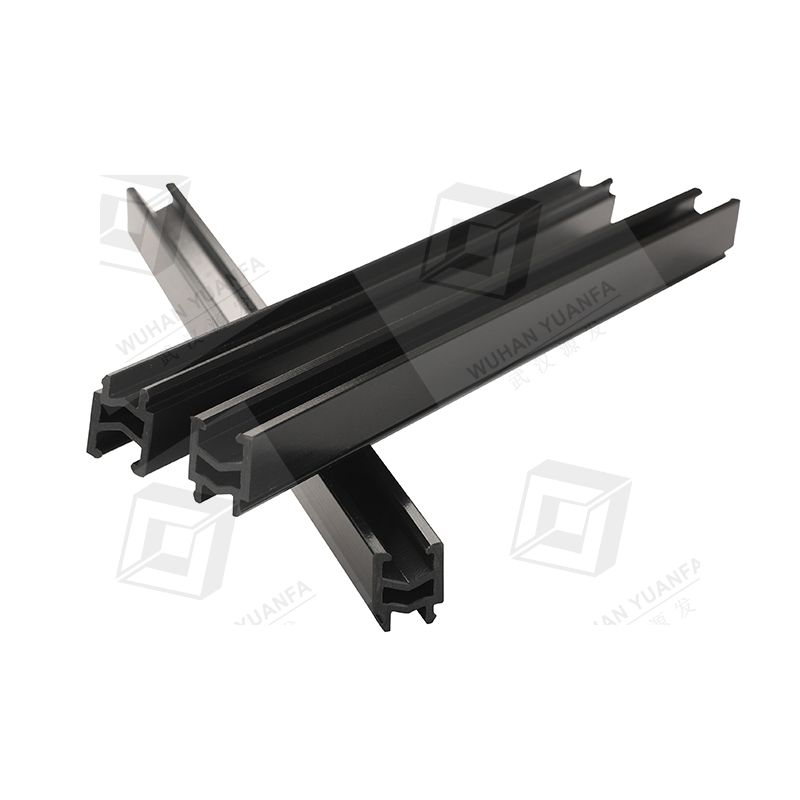
To eliminate the bi-metal effect, material scientists had to find an insulator that moves synchronously with aluminum. The science relies entirely on the Coefficient of Linear Thermal Expansion (CLTE). This metric defines how much a material expands for every degree of temperature increase.
Aluminum expands at roughly 23x10⁻⁶/K. When engineers specify a proper polyamide material, they achieve near-perfect harmony. Specially formulated PA66 GF25 expands at a heavily matched 20-30x10⁻⁶/K. Because their CLTE values mirror one another, the aluminum and the polyamide expand and contract as a unified structure. They do not fight each other. This chemical synergy prevents the aggressive shear stress that causes frame warping.
Standard polyamide (nylon) alone remains too flexible and expansive for structural applications. To solve this, manufacturers inject microscopic glass fibers into the polymer base. The industry standard requires precisely 25% glass fiber reinforcement by weight. Hence, we use the designation PA66 GF25.
When you select a premium Reinforced Thermal Insulation Profile, you leverage advanced extrusion technology. High-quality manufacturing aligns these glass fibers multi-directionally within the matrix. If fibers only face one direction, the plastic might resist lateral stretch but fail longitudinally. Multi-directional glass fibers lock the polymer chain in place. They prevent lateral and longitudinal shrinkage perfectly. This gives the profile rigid structural stability similar to the metal it supports.
A well-engineered profile does more than block heat. It functions as a dynamic shock absorber. When wind hits a skyscraper facade, the exterior aluminum pushes inward. The internal mechanical locks transfer this kinetic energy directly into the polyamide strip. Because of the glass fiber web, the profile absorbs and distributes mechanical stress evenly. It prevents the aluminum extrusions from slipping or tearing at the connection points. You get a composite beam that flexes just enough to survive heavy impact, but remains rigid enough to hold heavy triple-glazing.
The industry uses two primary methods to create thermal breaks: polyamide strips and polyurethane (PU) pour-and-debridge systems. Their approaches differ fundamentally.
PU systems rely on a chemical bond. Manufacturers pour liquid polyurethane into an aluminum channel. Once it cures, they mill away the bottom metal bridge. The entire structural integrity depends on the liquid sticking securely to the aluminum cavity. Over decades of thermal cycling, this chemical adhesion degrades.
Polyamide uses a robust mechanical connection. Technicians cut microscopic teeth into the aluminum cavities—a process called knurling. They insert the rigid strip. Finally, heavy rolling machines crimp the aluminum down, biting fiercely into the polyamide. This mechanical interlock forms an unbreakable composite strut.
When evaluating structural longevity, load-bearing capacity dictates your choice. Polyamide profiles handle intense structural loads vastly better than PU over a 30-year lifecycle. Modern building codes require heavy triple-glazing to meet energy standards. These massive glass units exert constant downward pressure on the bottom frame members. Mechanical rolling traps the polyamide strip tightly, refusing to yield. PU channels, relying solely on chemical friction, often experience micro-slippage under heavy dead loads. Polyamide ensures your frames stay square and structurally sound.
Processing temperatures severely restrict PU. Polyurethane degrades rapidly under high-temperature baking. If you use a pour-and-debridge system, you must paint or powder coat your aluminum extrusions before inserting the thermal break. This dual-step process increases manufacturing complexity.
Polyamide boasts an exceptionally high melting point. Assembly lines can knurl, insert, and roll the composite frame first. Then, they send the fully assembled system through a powder coating oven at 200°C. The profile easily withstands the baking cycle. This allows for uniform finishes across the entire window frame and guarantees significantly tighter dimensional tolerances.
Structural Insulator Comparison Chart
Feature | Polyamide (PA66 GF25) | Polyurethane (PU Pour-and-Debridge) |
|---|---|---|
Connection Type | Mechanical Interlock (Knurled & Rolled) | Chemical Adhesion |
Thermal Stability | Matches Aluminum (CLTE aligned) | Varies, susceptible to extreme shifts |
Powder Coating | Post-assembly capable (withstands 200°C) | Requires pre-coating (degrades in ovens) |
Long-term Load Bearing | Excellent for heavy triple-glazing | Moderate, prone to shear degradation |
Never compromise on material purity. Some suppliers try to cut corners by utilizing recycled or off-spec nylon. Recycled nylon contains impurities and fractured polymer chains. These defects compromise the tensile strength of the final profile. Furthermore, impurities cause unpredictable thermal expansion rates. You lose the crucial CLTE matching effect. Always demand 100% virgin PA66 resin combined with pristine glass fibers. Purity ensures predictability.
The profile must never tear laterally under intense wind pressure. Engineers rely on baseline metrics established by global authorities. You should look for compliance with European EN 14024 or North American AAMA TIR-A8 standards. These rigorous protocols test the composite assembly before and after extreme thermal aging. They verify the transverse tensile strength remains intact even after decades of exposure. If a profile lacks these certifications, you risk catastrophic failure on high-rise facades.
Precision matters intensely during the rolling process. Extrusion dies must produce strips with incredibly tight dimensional tolerances. The industry gold standard requires tolerances between ±0.05mm and ±0.1mm. If the strip arrives slightly too thin, the rolling machine will fail to grip it securely. The resulting composite will exhibit dangerous shear slippage. Conversely, if the strip is too thick, forcing it into the aluminum cavity causes micro-fractures in the plastic. Strict tolerances ensure a flawless mechanical bite.
Best Practice: Always request exact specification sheets detailing extrusion tolerances before approving a new supplier. Small deviations create massive assembly line bottlenecks.
Polyamide possesses an inherent hygroscopic nature. It naturally absorbs moisture from the atmosphere. Directly out of the extrusion die, nylon is bone dry. In this state, it is rigid but dangerously brittle. If you attempt to crimp dry profiles into an aluminum frame, the teeth will crack the plastic.
To solve this, manufacturers must properly moisture-condition the strips at the factory. They utilize controlled steam chambers or water baths to infuse the polymer with approximately 2% to 3% moisture. This precise hydration changes the molecular structure. It increases impact resistance and flexibility. Achieving this exact equilibrium is critical. It guarantees final toughness and dimensional stability well before the product reaches the assembly line.
Even the highest quality profile will fail if your machinery calibration is off. The mechanical lock requires flawless execution on the aluminum side. First, the knurling wheels must cut sharp, deep teeth into the aluminum cavity walls. Dull knurling wheels create shallow grooves that cannot grip the plastic.
Next, the rolling machine must apply consistent, immense pressure to crimp the metal over the strip. Inconsistent machine pressure leads to loose pockets. Loose pockets allow the thermal break to slide independently from the aluminum under wind load. Routine calibration of both knurling and rolling machines remains non-negotiable for system stability.
Trust but verify. You cannot judge a mechanical composite visually. Assembly lines must incorporate mandatory in-house push-out and shear testing protocols. After rolling a batch of frames, technicians should cut a small sample section. They place this section in a hydraulic press and measure exactly how much force is required to push the aluminum off the strip.
This push-out test confirms the structural integrity of the composite immediately. If the test fails, engineers can halt production and adjust machinery before compromised frames reach the job site. Implementing strict shear testing workflows protects your reputation and prevents costly onsite replacements.
True dimensional stability in thermal break systems relies on a flawless combination of exact material science and rigorous mechanical assembly. You cannot achieve modern structural demands with inferior plastics or uncalibrated machinery. The precise engineering of PA66 GF25 ensures your window and facade systems survive decades of thermal stress and wind pressure. It syncs perfectly with aluminum's expansion rates, preventing the destructive bi-metal effect.
Decision-makers, procurement officers, and structural engineers must remain vigilant. Demand comprehensive technical data sheets detailing CLTE values, glass fiber dispersion, and aging test results before shortlisting any supplier. Never accept vague claims regarding tensile strength.
Take proactive steps today. Request physical samples and compliance certificates from your partners. Conduct internal shear and thermal cycling tests to validate their performance. By prioritizing verified structural data over initial convenience, you guarantee a facade that performs safely and flawlessly for generations.
A: Once properly moisture-conditioned and mechanically locked into the aluminum cavity, long-term dimensional changes are completely negligible. Because it utilizes precise glass fiber reinforcement, the profile mirrors the natural thermal behavior of the aluminum itself. It will not shrink or degrade unpredictably over its lifespan.
A: Yes. You can safely powder coat fully assembled composite frames. PA66 GF25 withstands standard baking cycles, handling temperatures up to 200°C for 20 to 30 minutes. It retains its structural integrity and dimensional stability without melting or warping during the curing process.
A: Standard PA66 completely lacks the 25% glass fiber reinforcement. Without glass fibers, the raw nylon remains far too flexible and prone to extreme thermal expansion. It cannot support heavy dead loads or resist lateral shear stress, making it totally unsuitable for structural load-bearing fenestration systems.
A: Dry polyamide straight from extrusion is brittle and snaps under pressure. Controlled moisture absorption, typically around 2-3%, completely changes its physical properties. This hydration vastly increases impact resistance and essential flexibility. You absolutely need this toughness to survive the intense pressure of the mechanical crimping process.


