

close
Choose Your Site
Global
Social Media

Author: Site Editor Publish Time: 2026-08-28 Origin: Site
Large-scale aluminum facades constantly face extreme dynamic wind loads. They also endure sudden seismic shifts and dramatic daily temperature fluctuations. These monumental building envelopes demand robust, uncompromising engineering. Modern facade engineers must achieve strict thermal insulation targets. However, they cannot compromise the core structural integrity of the entire curtain wall system. Balancing stringent U-value regulations against heavy physical load demands remains a persistent, high-stakes challenge.
A properly engineered Polyamide Profile bridges this complex gap effectively. It acts as both a reliable thermal isolator and a critical load-bearing structural component. This guide outlines the exact mechanical evaluation criteria you need today. You will learn how to safely specify thermal break profiles for demanding commercial-scale projects.
A standard polyamide thermal break strip is insufficient for large facades; reinforced PA66 GF25 (25% glass fiber) is the required baseline.
Coefficient of Linear Thermal Expansion (CLTE) must closely match aluminum to prevent shear failure during extreme temperature cycles.
Transverse tensile strength and shear strength are the primary indicators of a profile's ability to support heavy double- or triple-glazed units.
Procurement decisions must rely on third-party mechanical testing data (e.g., EN 14024) rather than generic manufacturer claims.
You must view the thermal break as a structural bridge. It never functions merely as an insulation filler. Evaluators often overlook this critical reality during the design phase. The profile connects the interior and exterior aluminum frames. It must hold these two halves together under immense physical stress. If you treat it only as a thermal barrier, you risk the entire assembly.
Building sway forces constant, unpredictable movement across the envelope. Wind pressure pulls and pushes aggressively on the exterior glass. You cannot ignore these dynamic load realities. Architectural double- or triple-glazed units weigh hundreds of kilograms. They transfer this massive weight directly onto the thermal break assembly. The profile absorbs these dynamic and static loads constantly. It must resist these forces without yielding or snapping.
Specifying subpar profiles introduces severe, costly risks. We see compromised weather sealing frequently in failing systems. Structural deflection can permanently warp the aluminum frame. When frames warp, air and water penetrate the building envelope easily. In worst-case scenarios, catastrophic facade failure occurs. Glass panels can detach entirely from the mounting structure. You must prioritize mechanical integrity alongside thermal efficiency to ensure safety.
Engineers must evaluate four specific mechanical properties before approving any profile. These metrics ensure the structural composite behaves predictably over decades.
Transverse tensile strength defines the maximum stress the profile can withstand. This stress applies perpendicular to the extrusion direction. Negative wind loads create powerful suction on the building exterior. This suction attempts to pull the outer aluminum frame away from the inner frame.
You need strict minimum baseline values to prevent the aluminum halves from pulling apart. Typically, robust systems demand transverse tensile strengths exceeding 80 N/mm². High-rise applications often require even higher baseline figures. Testing must verify these parameters under both ambient and extreme temperature conditions.
Longitudinal shear strength measures the capacity to resist sliding forces. These forces occur between the aluminum extrusions and the polyamide strut. Wind loads and thermal expansion push the inner and outer frames in opposite directions. The profile must lock them together firmly.
You must establish required parameters to ensure composite action remains intact. Composite action keeps the facade rigid and stable. If the shear strength fails, the frames slide independently. This slippage destroys the structural rigidity of the curtain wall. It also ruins the precise alignment required for effective weather sealing.
The Coefficient of Linear Thermal Expansion determines how materials change size. It measures the rate at which the material expands and contracts. Temperature changes drive these dimensional fluctuations daily. Sunlight heats the exterior, while HVAC systems cool the interior.
The polyamide’s CLTE must align precisely with the aluminum frame. Aluminum has a CLTE of approximately 2.1 to 2.4 × 10⁻⁵ K⁻¹. The thermal break must match this range closely. If the rates differ significantly, internal stress fracturing occurs quickly. Mismatched expansion also causes severe bi-metallic bowing. Bowing compromises the structural integrity and aesthetic lines of the facade.
Creep resistance defines the material's ability to resist permanent deformation. Sustained mechanical and thermal loads cause materials to slowly stretch or compress. Over time, heavy glass panels exert continuous downward pressure. The material must not permanently yield to this constant weight.
You must assess 10-year and 20-year simulated aging data carefully. Accelerated aging tests verify lifecycle stability. They expose the material to sustained high temperatures and mechanical stress. Without proven creep resistance, a Polyamide Thermal Break Strip will eventually deform. This deformation leads to loose joints and inevitable system failure.
Table: Core Mechanical Properties and Evaluation Focus
Mechanical Property | Primary Function | Evaluation Metric Focus |
|---|---|---|
Transverse Tensile Strength | Prevents frame separation | Resistance to negative wind loads |
Longitudinal Shear Strength | Maintains facade rigidity | Resistance to sliding forces |
CLTE Alignment | Prevents bi-metallic bowing | Match aluminum (approx. 2.1 - 2.4 × 10⁻⁵ K⁻¹) |
Long-Term Creep Resistance | Ensures lifecycle stability | Performance under 10-20 year aging simulation |
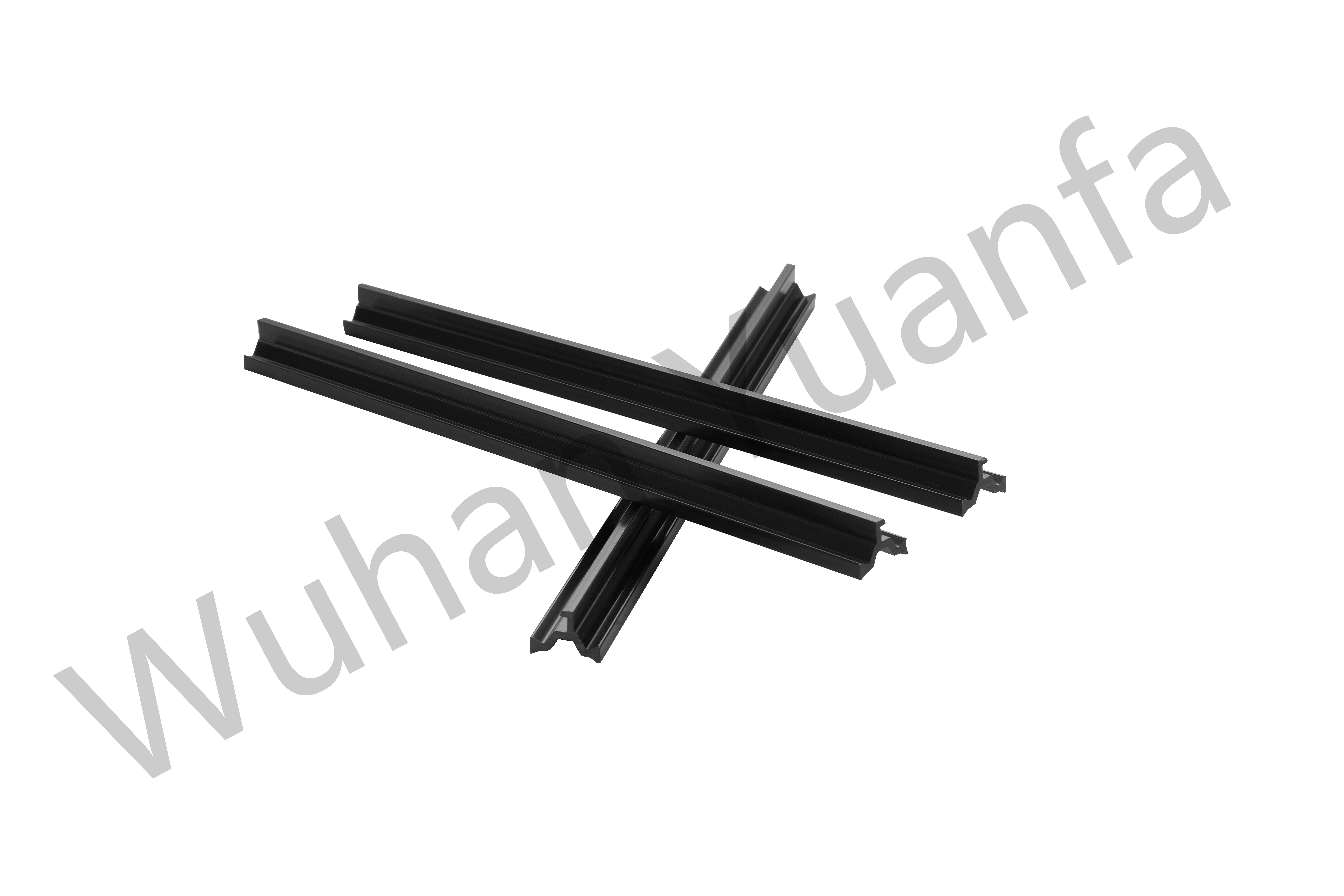
Standard polyamides lack the necessary rigidity for commercial facades. They flex too easily under heavy loads. Glass-fiber-reinforced variants solve this structural deficiency. We frame this solution category by comparing basic plastics against engineered composites. Facade engineers exclusively specify reinforced materials for large-scale applications.
The industry standard relies heavily on PA66 GF25. This designation means Polyamide 66 reinforced with 25% glass fiber. The material science behind PA66 GF25 is crucial. The nylon base provides essential elasticity and thermal resistance. The 25% glass fiber volume adds critical structural rigidity. This precise ratio balances flexibility with immense load-bearing capacity perfectly.
Fiber orientation matters just as much as the overall fiber volume. The extrusion process dictates the direction of these microscopic glass fibers. Poor manufacturing leaves fibers pointing randomly. Expert extrusion aligns them intentionally.
Proper Longitudinal Alignment: Fibers aligned with the extrusion path dramatically improve continuous shear resistance.
Transverse Dispersion: Strategic disruption of purely linear alignment ensures robust transverse tensile strength.
Uniform Expansion Control: Consistent fiber orientation guarantees the material expands evenly, mirroring the aluminum frame.
Mechanical properties rely heavily on assembly precision. The strongest profile fails if the factory assembly process is flawed. Knurling and rolling tolerances are absolutely critical here. The aluminum cavity must undergo sharp, precise knurling. The rolling machine must apply exact, calibrated pressure during assembly. Incorrect pressure crushes the profile or leaves the joint dangerously loose.
Polyamide naturally absorbs moisture from the surrounding environment. We must address these moisture absorption realities head-on. Dry polyamide is incredibly brittle and prone to shattering. Conditioned polyamide becomes tough and resilient. Moisture absorption directly affects dimensional stability. Manufacturers must condition profiles properly before shipping them to fabricators.
Cold weather introduces severe brittleness risks during the fabrication process. Sub-zero environments change the physical handling characteristics of the material. You must adapt handling and installation considerations accordingly. Impact forces easily cause micro-cracking when assembling facades in freezing temperatures. We recommend strictly controlling the factory climate during the rolling process.
Always verify knurling teeth sharpness before beginning a production run.
Calibrate rolling machine pressure dials daily to prevent joint crushing.
Store profiles in climate-controlled environments to maintain optimal moisture content.
Inspect rolled assemblies for micro-cracks before they leave the factory floor.
Procurement teams must demand verifiable compliance from every potential vendor. Generic marketing claims offer zero protection against catastrophic facade failures. You must request exhaustive testing documentation. Ensure this data aligns strictly with EN 14024 standards. Equivalent AAMA (American Architectural Manufacturers Association) standards also provide robust evaluation benchmarks. Only shortlist vendors who supply these reports willingly.
Quality assurance transparency separates premium manufacturers from unreliable suppliers. You need proof of continuous, ongoing quality control. Request hard data on batch-to-batch consistency testing. Reputable manufacturers perform continuous shear testing directly on the production line. They destroy samples daily to verify the rolling and material strength. Ask to review these internal quality logs.
Assess the vendor's custom extrusion capabilities early in the project. Modern architectural visions often require complex, bespoke facade designs. Vendors must demonstrate the ability to modify profile geometries safely. They must alter shapes without sacrificing baseline mechanical strength. A competent manufacturer will engineer internal web structures to reinforce custom designs. Verify their in-house engineering and tooling expertise before committing.
Evaluating a thermal break requires a strict focus on structural mechanics. Structural integrity dictates the overall safety of the system. Precise thermal alignment, specifically matching the CLTE, prevents catastrophic internal stresses. You must evaluate these profiles as load-bearing bridges first.
Take immediate action to secure your facade engineering process. Advise your procurement teams to request specific technical data sheets (TDS) today. Always demand physical samples for internal visual and mechanical evaluation. Finally, secure verifiable third-party test reports before moving into the expensive prototyping phase.
A: A high-rise facade typically requires a transverse tensile strength exceeding 80 N/mm². However, objective baseline figures depend heavily on context. Extreme wind loads, corner zones, and heavy triple-glazing demand higher thresholds. Engineers must calculate project-specific negative wind pressures to determine the exact required baseline. Standard EN 14024 testing validates if the profile meets these specific engineering requirements.
A: Moisture transforms PA66 GF25 from a highly brittle state to a tough, resilient state. Freshly extruded polyamide is dry and prone to cracking under stress. Proper moisture conditioning increases impact resistance significantly. It ensures the profile can withstand the intense pressures of factory rolling and assembly. Conditioned profiles maintain optimal shear strength without fracturing during the knurling process.
A: Quality profiles resist significant degradation, but poor materials will fail. Long-term mechanical strength depends on creep resistance and thermal stability. Constant glass weight and temperature cycling cause inferior plastics to deform permanently. This deformation ruins shear strength. Evaluating accelerated aging tests (10 to 20-year simulations) during vendor selection guarantees the material will perform reliably over a 30-year lifespan.
A: Polyamide offers superior mechanical rigidity and exact precision tolerances compared to poured PU. Extruded polyamide strips allow for complex internal web geometries. These shapes support heavy loads better than solid PU blocks. Additionally, polyamide easily withstands the high temperatures of standard powder-coating ovens. PU systems often require separate coating processes, complicating manufacturing and increasing risks of assembly failure.


