

close
Choose Your Site
Global
Social Media

Author: Site Editor Publish Time: 2026-08-07 Origin: Site
Strip slippage is not merely a minor manufacturing nuisance. It acts as a critical failure point. It actively compromises the structural integrity of modern aluminum fenestration systems. Furthermore, slippage degrades the overall energy efficiency of the window or door. Creating a durable mechanical bond requires extreme precision. The aluminum profile and the insulating strip must withstand immense shear stress. They also endure heavy wind loads and constant thermal expansion over decades. The thermal breaking process depends entirely on this unyielding connection.
Resolving lateral movement demands a highly systematic diagnostic approach. You must evaluate machinery calibration carefully. You also need to inspect aluminum cavity preparation protocols. Finally, inspecting the exact dimensional tolerances of the polyamide thermal break itself is absolutely essential. We will explore how to identify root causes. You will learn to implement permanent fixes to ensure consistent product performance.
Strip slippage is typically caused by a failure in one of three areas: inadequate aluminum knurling, improper rolling/crimping pressure, or substandard material dimensions.
Inconsistent fiberglass distribution in low-quality polyamide strips can lead to warping, preventing a secure mechanical lock.
Correcting slippage requires establishing strict baseline metrics for shear strength testing (e.g., AAMA TIR-A8 or EN 14024 standards).
Evaluating a new strip supplier requires prioritizing dimensional stability, certified material composition (usually PA66 GF25), and rigorous QA documentation.
Assembly line failures disrupt your entire manufacturing schedule. When a strip slips during the rolling process, you immediately lose valuable raw materials. Operators must discard the damaged aluminum extrusions. Production lines halt while technicians attempt to recalibrate the machinery. These compounding costs quickly erode profit margins. In the field, undetected slippage causes even more severe problems. Windows may fail to operate correctly. Frames can distort under heavy wind loads. This leads to expensive warranty claims and damages your brand reputation.
Beyond material waste, compromised shear strength introduces massive compliance risks. Building codes mandate specific structural performance metrics. Regulatory bodies require fenestration products to pass rigorous testing. If the mechanical lock between the aluminum and the plastic fails, the entire assembly fails structural testing. Failing these tests puts the manufacturer at severe liability risk. Engineers design these profiles assuming a composite structural action. Slippage destroys this composite action.
To eliminate these risks, you must clearly define success. A successful integration meets several non-negotiable criteria:
Consistently high shear test results exceeding regional standards.
Absolute zero lateral movement during post-assembly handling.
Optimized U-values achieved without sacrificing structural load capacities.
Seamless alignment at corner joints during final frame assembly.
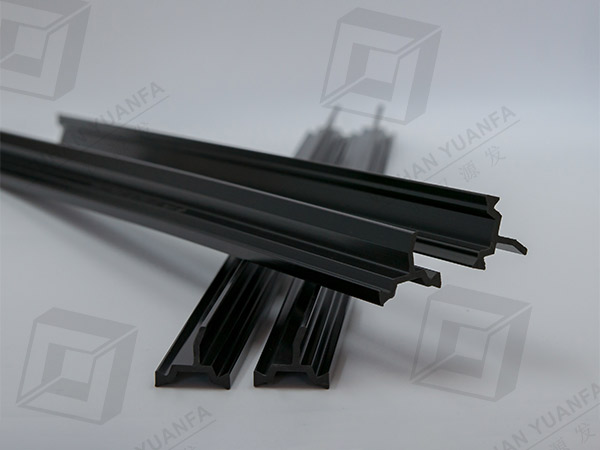
The mechanical lock relies primarily on the knurling process. Knurling creates crucial "teeth" inside the aluminum cavity. These tiny metal ridges physically bite into the polyamide material. When the machine crimps the aluminum, the teeth embed themselves into the plastic dovetail. This interaction provides the necessary shear strength to hold the assembly together. Without proper knurling, the smooth aluminum surface simply slides against the smooth plastic.
Implementation realities often reveal several common failure points. Machine operators frequently encounter issues originating from the knurling station.
Too shallow or dull: Worn knurling wheels fail to cut deep enough into the aluminum. The resulting teeth lack the necessary height to grip the strip, causing immediate lateral slip.
Too deep or sharp: Aggressive knurling creates sharp, jagged edges. These can fracture the aluminum cavity wall. They might also tear the polyamide dovetail entirely during insertion.
Inconsistent knurling wheels: Uneven wear on machinery leads to inconsistent grip. One end of the profile might hold tightly while the other end slides freely.
Before blaming the insert material, you should conduct a rigorous machine audit. We recommend inspecting knurling wheels daily for visible wear. Operators should verify tooth depth against industry tolerances using precise gauges. Establishing a routine maintenance schedule prevents these mechanical failures. Always ensure the knurling teeth remain uniform across the entire extrusion length.
The final stage of assembly requires precise machine calibration. Rolling machinery applies continuous pressure to collapse the aluminum over the strip's dovetail. This process secures the thermal break permanently. The applied force must remain perfectly uniform. Any fluctuation in pressure compromises the final mechanical bond. The machinery consists of several rolling discs. Each disc gradually bends the aluminum cavity inward.
Pressure inconsistencies frequently cause sudden slippage. Insufficient pressure fails to lock the strip into place. The aluminum cavity remains too open. As a result, the strip slides effortlessly out of alignment. Conversely, excessive pressure creates entirely different problems. Over-crimping warps the entire aluminum profile. It can also crush the polyamide dovetail, destroying its structural integrity. Extreme pressure often causes micro-fractures in the plastic, leading to delayed failure in the field.
A major vulnerability lies in improper machine setup. Many facilities attempt to use a "one-size-fits-all" pressure setting. This approach is highly dangerous. Different profile geometries require unique calibration settings. Varying strip sizes demand specific rolling disc adjustments. Operators must adjust vertical and horizontal pressure parameters for every new batch. Failure to adapt settings guarantees inconsistent shear strength. We strongly advise creating a detailed calibration log for every specific profile design.
Even perfectly calibrated machines cannot secure irregularly shaped materials. Material quality dictates the success of the assembly process. You must shift your focus to the polyamide strip itself. Dimensional consistency is paramount. If the strip dimensions fluctuate, the knurling teeth cannot engage uniformly. A high-quality profile requires a perfectly matched insert.
Cheap manufacturing processes routinely produce dimensional inconsistencies. Budget suppliers often struggle to maintain exact widths. Malformed dovetail edges represent a significant problem. If the dovetail angle varies, it fails to fill the aluminum cavity correctly. A loose fit guarantees slippage. When the plastic is too narrow, the crimping wheels cannot reach it. When it is too wide, insertion becomes impossible. Tight manufacturing tolerances separate premium products from failures.
The chemical composition plays a massive role in structural stability. Industry standards mandate PA66 GF25 material. This denotes polyamide 66 reinforced by 25% glass fiber. The glass fiber provides vital compressive strength. It allows the plastic to withstand the aggressive crimping process. If the manufacturer uses poorly distributed fiberglass, weak spots develop. If the overall fiberglass content drops below 25%, the strip becomes too soft. Soft strips compress excessively under pressure, leading to instant slippage.
Quality Metric | Premium PA66 GF25 Strip | Substandard Strip |
|---|---|---|
Dimensional Tolerance | Strictly +/- 0.05mm variance | Highly variable, often +/- 0.2mm |
Fiberglass Distribution | Uniformly dispersed throughout matrix | Clumped fibers, creating weak zones |
Dovetail Geometry | Sharp, precise angles matching cavity | Rounded or asymmetrical edges |
Compressive Strength | Resists rolling pressure without crushing | Deforms or micro-fractures easily |
Diagnosing slippage is only the first step. You must ultimately transition to selecting a high-quality solution provider. Evaluating a new supplier requires a structured framework. Procurement teams often look only at unit prices. This shortsighted strategy inevitably causes expensive manufacturing bottlenecks. You need to assess potential partners across several key decision dimensions.
Manufacturing Tolerances: Demand documented proof of tight dimensional tolerances. A reliable supplier should guarantee variance no greater than +/- 0.05mm. Ask to see their internal quality control procedures.
Material Certification: Look for independently verified testing. Suppliers must provide data on tensile strength. They should also supply heat deflection temperature metrics. Genuine PA66 GF25 behaves predictably under stress.
Technical Support: A trustworthy vendor does more than sell raw materials. They offer valuable process consulting. Excellent suppliers help you calibrate your knurling and crimping machines. They partner with you to resolve assembly issues.
Approach new vendors through a skeptical lens. Beware of suppliers offering significantly below-market pricing. Cheap materials always carry hidden costs. You should immediately disqualify vendors who refuse to provide batch-specific QA reports. Lack of independent lab testing represents another massive red flag. If a supplier cannot prove their material composition, they are likely cutting corners on fiberglass content. Always demand transparency before signing purchase agreements.
You must take immediate action to stabilize your assembly line. Start by isolating your current inventory. Do not continue using suspect materials. Conduct pull and shear tests on recent production batches immediately. Compare these results against your baseline metrics. This testing helps identify if the failure is systemic across the whole line or localized to one machine. Review your daily calibration logs to rule out mechanical drift.
When evaluating a new material source, always demand pilot testing. Request comprehensive sample batches from the prospective supplier. Run these samples through your existing knurling and rolling machines. Do not alter your standard settings initially. Measure the resulting shear strength carefully. Compare these numbers directly against required industry benchmarks. The new material must perform flawlessly before you approve bulk orders.
Finally, establish a long-term quality protocol. Implement mandatory, scheduled calibration checks for all machinery. Knurling wheels require weekly inspection. Rolling disc pressures need daily verification. Combine these mechanical checks alongside rigorous incoming material QA. Measure random samples from every new material delivery. Verify the dovetail dimensions before releasing the batch to the factory floor. Consistency requires constant vigilance.
Preventing assembly slippage remains a dual responsibility. You must maintain strict machinery calibration across both knurling and crimping stations. Simultaneously, you must source dimensionally flawless polyamide strips. One cannot succeed without the other. Perfect machine settings cannot fix poorly manufactured plastics. Conversely, premium plastics will fail if your knurling wheels are dull.
Compromising on material quality to save upfront costs is a dangerous strategy. It inevitably leads to exponential losses. Scrap rates increase, downtime multiplies, and structural tests fail. Investing in high-grade PA66 GF25 ensures long-term reliability. It protects your brand reputation and guarantees compliance with stringent building codes.
We encourage you to take proactive steps today. Request a technical consultation from a certified specialist. Ask for a comprehensive material sample kit to test in your own facility. Schedule a thorough process audit to identify hidden mechanical vulnerabilities. Securing your assembly process guarantees better products and happier clients.
A: Replacement frequency depends entirely on your run volume. However, visual inspections should occur daily. Physical measurement of tooth depth must be part of your weekly QA protocol. Worn knurling wheels remain the leading mechanical cause of slippage. Replace them immediately when tooth depth falls below minimum specified tolerances.
A: Polyamides are naturally hygroscopic. High-quality PA66 GF25 strips account for moisture conditioning during manufacturing. They remain stable. However, extreme dimensional changes from unconditioned or low-grade strips can marginally impact the mechanical lock. Always store materials in climate-controlled environments to minimize unexpected swelling or shrinkage.
A: Acceptable metrics point directly to specific regional standards. In North America, refer to AAMA TIR-A8. In Europe, follow EN 14024 guidelines. Requirements vary significantly based on the profile's specific structural application. Consistent baseline testing remains absolutely mandatory for all structural fenestration assemblies.
A: While polyurethane completely avoids mechanical slipping, it introduces different challenges. It carries chemical adhesion risks and potential material shrinkage. Polyurethane systems generally offer lower structural load capacities compared to properly crimped polyamide strips. Polyamide remains superior for heavy-duty, high-performance structural applications when correctly assembled.


