

close
Choose Your Site
Global
Social Media

Author: Site Editor Publish Time: 2026-03-19 Origin: Site
Glass and aluminum façades have become defining features of modern architecture. From office towers to shopping centers and residential high-rises, curtain wall systems deliver transparency, structural strength, and contemporary aesthetics. Yet behind the visual appeal lies a technical challenge. Aluminum is an excellent conductor of heat, which means large façade systems built entirely with metal can easily transfer outdoor temperatures into interior spaces. A Thermal Insulation Polyamide Profiles for Facades solution addresses this problem by interrupting the metal connection within aluminum façade structures. Instead of allowing heat to flow freely through the frame, polyamide profiles create a structural thermal break that separates the interior aluminum section from the exterior section. This engineered separation allows curtain wall and façade systems to maintain both structural performance and energy efficiency.
Modern façade engineering focuses not only on visual design but also on thermal comfort, building energy performance, and moisture control. Polyamide insulation profiles are widely used in aluminum curtain wall systems because they combine mechanical strength with low thermal conductivity. By integrating these profiles within aluminum façade frames, architects can achieve high-performance building envelopes without sacrificing the structural benefits of aluminum.
Understanding what these polyamide insulation profiles are and how they function within façade systems helps designers, developers, and contractors create buildings that meet both architectural and environmental performance goals.
Large building façades cover a significant portion of the building envelope. Unlike smaller windows or doors, curtain walls often extend across entire elevations. Because of their size and exposure, façade systems can strongly influence the energy performance of a building.
Curtain walls often include extensive glass panels supported by aluminum framing systems. The larger the exposed surface area, the greater the opportunity for heat exchange between indoor and outdoor environments.
Without thermal breaks inside the aluminum frame, heat can move easily through the metal structure. During winter, cold outdoor temperatures travel inward through the aluminum frame, lowering the temperature of interior surfaces. During summer, solar heat absorbed by the exterior aluminum frame can move indoors.
Polyamide insulation profiles help limit this heat movement by dividing the aluminum frame into thermally separated sections.
The perimeter zone of a building refers to the area close to exterior walls and façade systems. Occupants working near curtain wall façades may experience temperature discomfort if the frame conducts heat too efficiently.
Thermal insulation polyamide profiles reduce temperature differences between interior air and the inner surface of the façade frame. This helps maintain a more stable indoor environment and improves comfort for people occupying spaces near the building exterior.
Modern curtain wall systems often incorporate advanced glazing technologies designed to reduce heat transfer through glass. However, even when the glass performs well, the aluminum frame can still become a pathway for thermal bridging.
If the interior aluminum frame becomes too cold during winter conditions, moisture in the indoor air may condense on the frame surface. Polyamide thermal break profiles help maintain higher interior surface temperatures, which reduces the likelihood of condensation.
To understand their role in façade systems, it is helpful to examine how these insulation profiles are designed and integrated into aluminum curtain wall structures.
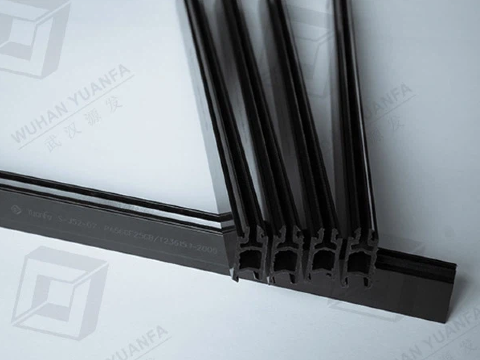
Polyamide insulation components used in architectural aluminum systems may appear in different shapes depending on their application. In façade systems, these components are often referred to as profiles rather than simple strips because they are engineered to match the geometry of the aluminum extrusion.
The profile shape allows the insulation component to interlock securely with the aluminum sections of the curtain wall frame. This ensures both mechanical stability and thermal separation.
The primary purpose of a thermal insulation polyamide profile is to separate the interior aluminum structure from the exterior aluminum structure.
Instead of a continuous aluminum path connecting the inside and outside of the building, the polyamide profile forms a non-metallic connection between the two sections. Because polyamide has much lower thermal conductivity than aluminum, heat transfer through the frame is significantly reduced.
This separation is known as a thermal break. It allows the aluminum façade system to maintain structural strength while improving thermal insulation performance.
Within curtain wall systems, polyamide profiles are typically installed between aluminum frame sections during the profile assembly process. The aluminum extrusions are designed with grooves that allow the insulation profile to be inserted and mechanically secured.
Once assembled, the aluminum sections and the polyamide insulation profile function as a unified structural component. The façade frame remains strong enough to support glass panels and withstand wind loads while providing improved thermal insulation.
The effectiveness of polyamide insulation profiles becomes clear when examining how they function within a complete curtain wall system.
Aluminum alone creates a direct pathway for heat transfer. Polyamide insulation profiles break this pathway by inserting a material with significantly lower thermal conductivity between the aluminum sections.
This interruption forces heat to travel through a more resistant path, which reduces the rate of energy transfer between indoor and outdoor environments.
Unlike foam insulation or sealant materials, polyamide profiles serve as structural connectors between aluminum sections. They must support mechanical loads while simultaneously providing thermal separation.
Reinforced polyamide materials are engineered to deliver both structural strength and thermal insulation performance. This dual function makes them ideal for façade applications where both properties are essential.
The benefits of polyamide thermal break profiles extend beyond technical specifications. Their presence in curtain wall systems leads to practical advantages for building owners and occupants.
Improved insulation reduces heating and cooling energy consumption. More stable interior surface temperatures improve occupant comfort. Reduced condensation risk protects building materials and finishes.
These outcomes demonstrate how a relatively small structural component can influence the overall performance of a building envelope.
Architects and engineers frequently encounter certain technical terms when evaluating curtain wall insulation performance. Understanding these terms helps clarify the role of polyamide insulation profiles.
U-value refers to the rate at which heat transfers through a building element. Lower U-values indicate better insulation performance.
In façade systems, both glass and frame components contribute to the overall U-value. Even when high-performance glass is used, the aluminum frame can still influence the final insulation performance of the system.
Thermal break profiles reduce heat transfer through the aluminum frame, helping improve the overall U-value of the façade.
A continuous thermal break refers to an uninterrupted insulating layer within the façade frame system. If gaps exist in the insulation path, heat can bypass the thermal barrier and reduce the effectiveness of the system.
Polyamide insulation profiles are designed to maintain a continuous separation between interior and exterior aluminum sections.
Condensation resistance measures how effectively a building element prevents moisture from forming on interior surfaces.
Because thermal break profiles help maintain warmer interior frame surfaces, they improve condensation resistance in curtain wall systems.
Term | Simple Explanation | What It Affects | Where Polyamide Profile Helps |
U-value | Measure of heat transfer through building element | Energy efficiency | Reduces heat transfer through frame |
Thermal bridge | Direct conductive path through metal | Indoor comfort and energy use | Breaks conductive aluminum path |
Continuous thermal break | Uninterrupted insulation layer | Overall insulation performance | Maintains separation between frame sections |
Condensation resistance | Ability to prevent surface moisture | Building durability and comfort | Keeps interior frame surfaces warmer |
Thermal insulation polyamide profiles are used in a wide variety of modern façade systems. Their role is particularly important in large commercial buildings where energy performance requirements are strict.
Curtain wall systems are commonly used in commercial buildings and high-rise structures. These systems consist of aluminum frames that support large glass panels across the building exterior.
Polyamide insulation profiles are integrated within the aluminum framing system to create thermally broken curtain wall assemblies.
Insulated glass units are frequently used in façade systems to improve glazing performance. However, the surrounding aluminum frame still requires thermal separation.
Polyamide insulation profiles ensure that the frame does not undermine the thermal performance achieved by the glazing system.
Many modern buildings must comply with energy efficiency regulations and sustainability standards. Thermal break technology plays a critical role in achieving these requirements.
Polyamide insulation profiles allow aluminum façade systems to meet demanding energy performance targets while maintaining architectural flexibility.
Wuhan Yuanfa New Materials Co., Ltd. focuses on the research and production of polyamide insulation strips and profiles used in aluminum doors, windows, and façade systems. Since 2003 the company has dedicated itself to building energy conservation technologies. Through cooperation with universities and continuous technical development, Wuhan Yuanfa has established advanced production capabilities and achieved an annual production capacity of 200 million meters of polyamide insulation strips.
The company has also participated in the drafting of important national and industry standards related to polyamide insulation strips used in aluminum building profiles. These contributions reflect the company’s commitment to product quality and technical advancement in the field of architectural insulation materials.
Large aluminum façade systems offer exceptional architectural possibilities, but they also require advanced thermal engineering to perform efficiently. A Thermal Insulation Polyamide Profiles for Facades solution enables aluminum curtain wall structures to achieve the necessary balance between structural strength and thermal insulation. By separating interior and exterior aluminum sections, these engineered profiles reduce heat transfer, improve condensation resistance, and enhance indoor comfort throughout the building.
Wuhan Yuanfa New Materials Co., Ltd. develops and manufactures high-quality polyamide insulation profiles specifically designed for aluminum façade systems. With advanced production technology and extensive experience in architectural thermal break materials, the company provides reliable solutions for curtain wall projects worldwide. If your façade design requires dependable insulation components, contact our team today to learn more about our polyamide thermal break facade solutions and discover how Wuhan Yuanfa products can support high-performance building envelopes.
Thermal insulation polyamide profiles are used to separate the interior and exterior aluminum sections of curtain wall frames. This separation reduces heat transfer through the aluminum structure and improves overall building insulation performance.
Polyamide materials provide strong mechanical performance while maintaining low thermal conductivity. This combination allows them to function as both structural connectors and insulation barriers in aluminum façade systems.
No. Reinforced polyamide profiles are designed to maintain the structural integrity of the aluminum frame while providing thermal insulation. They allow the curtain wall system to remain mechanically stable.
No. Polyamide insulation profiles are also widely used in aluminum windows and doors. Any aluminum building profile that requires improved thermal insulation can benefit from thermal break technology.


