

close
Choose Your Site
Global
Social Media

Author: Site Editor Publish Time: 2026-08-03 Origin: Site
Aluminum makes slender, durable facade frames, but it also carries heat readily from one side of the building envelope to the other. Polyamide Profiles solve that conflict by separating the indoor and outdoor aluminum sections while helping the assembled frame behave as one system. In facade work, they are not a decorative insert or a generic plastic spacer. Their geometry, material grade, fit with the aluminum grooves, and position in the load path affect heat flow, condensation risk, fabrication, and long-term performance. This article explains where they are used and how to specify them sensibly.
Polyamide Profiles create a continuous thermal break between interior and exterior aluminum members.
Facade applications can include mullions, transoms, pressure plates, structural struts, and perimeter frame components.
The correct profile must be selected with the complete facade system, glazing load, rolling process, drainage path, and thermal target in view.
A wider or more complex profile is not automatically the better choice; geometry and mechanical engagement still matter.
An aluminum mullion without a separating material forms a direct conductive route between outdoor and indoor surfaces. In a cooled building during hot weather, or a heated building during cold weather, that route increases frame heat transfer. It can also make the room-side metal surface much colder or warmer than the room air, which is a practical condensation and comfort concern. Glass specification alone cannot correct a highly conductive frame path.
Polyamide Profiles interrupt that route. The aluminum system is normally divided into an exterior extrusion and an interior extrusion. The polyamide element joins the two along engineered grooves, usually through a mechanical rolling process, creating a thermally broken composite. The purpose is not to make the frame carry no heat at all. It is to lengthen and lower-conductivity the principal path through the frame so the whole facade can be evaluated as a more balanced assembly.
The relevant performance language should also be kept clear. Frame thermal transmittance is commonly expressed as Uf, while an assembled window or glazed facade is assessed with glazing, edge details, and installation included. A lower frame heat-flow value is useful, but it does not replace system testing or project calculations. Air leakage, water management, glass edge conditions, and interfaces with anchors all remain part of facade performance.
In a unitized or stick-built facade, the thermal break normally runs continuously through the aluminum framing section. The exact cross-section changes by system designer and by function. Polyamide profiles for aluminum facades are therefore supplied in many shapes rather than as one interchangeable strip.
Vertical mullions resist wind-induced bending and transfer loads to the support structure. Horizontal transoms support glass edges, divide modules, and coordinate drainage. In both members, Polyamide Profiles separate the warm- and cold-side aluminum portions. Their engagement must suit the aluminum knurling and the rolling equipment so that the composite member maintains the intended shear transfer.
Some curtain walls use an exterior pressure plate to retain glass and gaskets. A nonmetallic pressure-plate or insulating element can reduce a local bridge that would otherwise bypass the main thermal break. The practical point is to view the pressure plate, screws, caps, seals, and thermal separator together. A high-performing central strip cannot compensate for a poorly resolved conductive path around it.
Thermally separated frames are also used around operable vents, entrance zones, and facade-to-window transitions. Here, profile choice must account for hardware pockets, gasket contact, weep routing, and assembly tolerances. A profile that fits a fixed facade mullion may not have the correct locking features for an opening frame.
Curtain wall insulation is a combined thermal and mechanical task. A suitable profile must take part in a composite framing section without cracking, slipping, distorting, or losing engagement under the conditions allowed for by the system design. This is why PA66 GF25 profiles are commonly considered for demanding thermal-break applications: the base polyamide is reinforced with glass fiber to improve rigidity and dimensional stability.
The material is only one half of the decision. Cross-sectional design changes several variables at once. A thin solid strip may offer straightforward mechanical engagement in a conventional groove. A wider profile can create a longer low-conductivity route, but the larger separation also changes the load transfer between aluminum halves. Hollow sections, ribs, flags, and multi-chamber details can manage air movement within the insulation zone and create functional surfaces, yet they must be compatible with the aluminum system and fabrication method.
Facade requirement | Profile-related question | Project consequence if overlooked |
|---|---|---|
Frame thermal target | What insulation depth and geometry are required by the system calculation? | A nominally wide strip may not deliver the expected assembly result. |
Structural action | How will glass weight, wind load, and composite shear be accommodated? | Excess movement can affect seals, alignment, or glass support details. |
Mechanical rolling | Do the profile legs and aluminum grooves match the rolling process? | Poor engagement can damage the strip or leave an inconsistent mechanical lock. |
Finishing sequence | Is the material suitable for the planned coating or assembly order? | The production sequence may need to change to protect materials and tolerances. |
Water management | Does the design preserve drainage cavities and gasket compression? | A thermally improved frame can still leak if functional zones are obstructed. |
Start with the system cross-section, not with a strip width alone. Identify the aluminum groove geometry, the role of each profile, whether the member is a mullion, transom, pressure plate, or opening-frame part, and the proposed glass configuration. Then review the structural and thermal calculations for the whole system. It is useful to ask whether the thermal break lies in the principal load path, whether there are metal bypasses at connectors, and whether the design includes special conditions such as tall spans, deep glazing pockets, or coastal exposure.
Next, confirm the profile material and dimensional controls with the extrusion supplier. For example, a project may need a particular leg shape, surface condition, coil or straight-length format, and cut-length requirement. Exact tolerances matter because the profile must enter the aluminum grooves consistently and pass through rolling equipment without crushing thin features or leaving gaps. Yuanfa presents both facade-focused profile families and specific widths, including a 22.52 mm facade insulation profile, but the system drawing—not a product name alone—should decide suitability.
Finally, validate the completed assembly. Thermal calculations, mechanical tests, coating trials, and water/air performance evaluation answer different questions. None should be treated as a substitute for the others. The specifier should also establish who is responsible for checking compatibility among the aluminum extruder, thermal-break supplier, rolling operation, gaskets, glazing method, and surface treatment sequence.
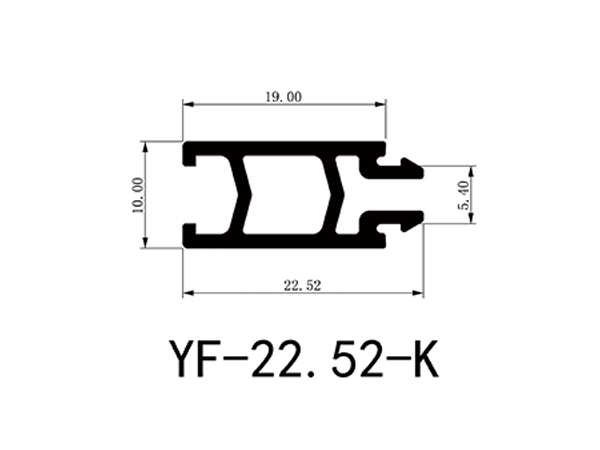
One mistake is treating all black insulating strips as equivalent. Color does not establish resin formulation, glass-fiber content, geometry, or production control. Another is choosing the maximum available width before considering the required composite stiffness. The third is evaluating an isolated profile value and assuming it predicts the final facade result. In reality, frame depth, glazing, metallic fasteners, pressure plates, installation interfaces, and workmanship can all influence performance.
It is also risky to copy a profile designation from a different aluminum system. K-type, CT, Y, and other shape labels describe a geometry family, not universal compatibility. A profile must match the actual groove, rolling method, and function of the system. Yuanfa can be considered as a product-context source for thermally broken aluminum systems, but project engineers should still approve the final cross-section and verification plan.
A useful submittal begins with the aluminum-system cross-section rather than a generic strip description. It should identify the interior and exterior aluminum halves, every groove that receives the thermal break, the rolling direction, glazing pockets, gaskets, pressure plates, and drainage paths. It should also distinguish a main mullion from a small local insert. Those distinctions keep a secondary insulating detail from being mistaken for a profile suitable for the principal structural member.
Material information should be paired with the dimensions that govern insertion and rolling. Overall width is useful, but leg spacing, locking-tooth geometry, web thickness, rib location, and hollow-chamber shape are often more consequential. Define the critical tolerances, the inspection method, and the response to a nonconforming batch before production begins. Visual checks for damaged legs, contamination, deformation, and inconsistent cutting also belong in the incoming inspection plan.
The fabrication plan should show the aluminum knurling, rolling equipment, roller settings, cut-length format, handling route, and finishing sequence. Build a representative thermally broken member with the intended materials and inspect engagement, straightness, clearance around seals and glazing components, and any distortion. If the project requires system testing, a production-representative assembly is more useful than a material coupon. This process makes the profile selection traceable and prevents a late substitution from changing the thermal and structural basis of the facade.
Polyamide Profiles are used in aluminum facades to create a continuous structural thermal break across framing members and related glazed zones. They help reduce conductive heat flow while allowing the aluminum halves to be mechanically connected into a functional composite profile. The best choice depends on more than material grade or width: profile geometry, mechanical engagement, load path, drainage, finishing, and complete-system verification all matter. For facade work, Wuhan Yuanfa New Materials Co., Ltd. offers a relevant facade-profile category, while the project team should select and validate the exact configuration against the engineered aluminum system.
No. They may be used in mullions, transoms, perimeter frames, opening systems, pressure-glazed zones, and other places where interior and exterior aluminum sections must be thermally separated.
No. They address conductive bridging inside the aluminum frame. Opaque-wall insulation, glazing selection, seal continuity, and installation details remain essential to envelope performance.
Glass fiber can improve the stiffness and dimensional stability required for a profile that is mechanically engaged with aluminum and may contribute to composite frame behavior.
Not always. Greater separation can help the thermal design, but the accompanying geometry and aluminum system must still provide appropriate mechanical performance and functional clearances.
Confirm the approved system drawing, profile cross-section, material requirement, groove and rolling compatibility, tolerances, length format, finishing sequence, and required assembly-level testing.


