

close
Choose Your Site
Global
Social Media

Author: Site Editor Publish Time: 2026-07-03 Origin: Site
Modern facade engineering faces a relentless core tension. Architects and engineers must meet increasingly stringent global energy codes. Simultaneously, they must maintain absolute structural integrity across massive, large-span curtain walls. Aluminum frames naturally conduct heat, creating severe energy leaks if left uninsulated. Therefore, selecting the correct thermal break material becomes a critical path decision. This single component governs project compliance, drives lifecycle energy performance, and ensures vital structural safety against high winds.
Minor specification errors here often cascade into catastrophic system failures down the line. We designed this guide to provide a rigorous evaluation framework for your next architectural project. You will discover how to evaluate mechanical shear capacity, moisture management, and thermal expansion rates. We also reveal how to specify high-performance geometric profiles without compromising mullion stiffness, ensuring your facade remains both highly efficient and structurally sound.
Polyamide 66 reinforced with 25% glass fiber (PA66 GF25) remains the industry benchmark due to its structural compatibility with aluminum.
Specifying the correct profile geometry directly dictates the achievable U-value (thermal transmittance) of the framing system.
Overlooking moisture management and linear thermal expansion rates during the specification phase can lead to system failure under high wind or thermal loads.
Proven extrusion precision and certified shear strength testing are non-negotiable criteria when shortlisting manufacturers.
The core problem in curtain wall design stems from the raw materials involved. Aluminum framing offers incredible strength-to-weight ratios and weather resistance. However, it also creates severe thermal bridges. Unbroken aluminum assemblies allow indoor heating to escape rapidly during winter. In summer, they transfer immense solar heat indoors. This thermal bridging leads to massive energy loss, interior condensation, and a complete failure to meet modern LEED, BREEAM, or passive house standards.
To overcome this, engineers integrate thermal breaks between the inner and outer aluminum extrusions. To meet strict success criteria, these barriers must execute two conflicting tasks flawlessly. First, they must isolate temperatures effectively. Second, they must transfer heavy mechanical loads seamlessly. These loads include intense wind pressures, the dead weight of heavy insulated glass units, and dynamic seismic forces.
When you specify energy-saving facade profiles, you face a harsh reality check. Chasing the absolute lowest U-value usually requires increasing the depth of the thermal break. Expanding this depth creates a longer lever arm between the aluminum halves. If you extend the break too far without structural compensation, you severely compromise the shear capacity and structural stiffness of the entire mullion or transom assembly. Balancing this trade-off defines successful facade engineering.
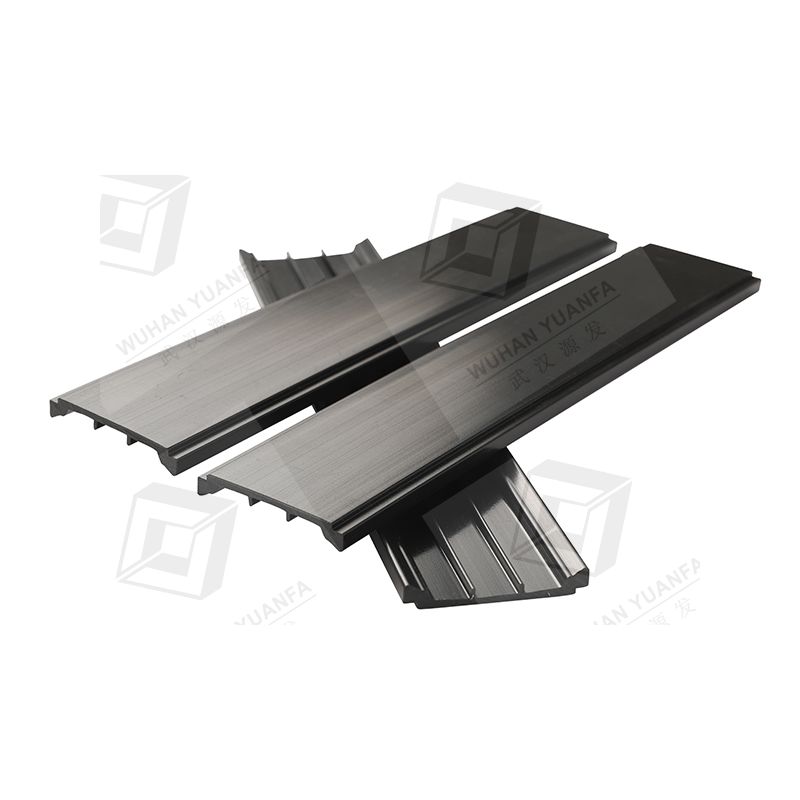
Engineers cannot rely on guesswork when evaluating thermal breaks. You must demand hard data to verify both structural and thermal capabilities. The performance of polyamide profiles for aluminum facade systems hinges on three non-negotiable technical metrics.
Curtain walls endure constant dynamic loading from wind gusts and building movement. The thermal break must hold the interior and exterior aluminum profiles together under immense stress. You must evaluate the longitudinal shear strength data of the polyamide both before and after extensive thermal cycling.
A reliable profile requires exceptionally high tensile strength. It must withstand continuous push-and-pull forces without developing micro-cracks. If the shear connection weakens, the inner and outer aluminum frames will operate independently. This separation destroys the system's structural moment of inertia, leading to dangerous deflection.
Best Practices: Always request shear strength test results conducted according to widely accepted standards, such as EN 14024. Verify that the tests include high-temperature conditioning phases.
Facades experience extreme temperature fluctuations. On a single winter day, the exterior face might freeze while the interior face remains at a comfortable room temperature. Different materials expand and contract at different rates when heated or cooled. If you use the wrong plastic, the thermal break will expand faster than the aluminum.
To prevent catastrophic failure, the coefficient of linear thermal expansion for the polyamide must closely match that of aluminum. PA66 GF25 closely mimics the expansion behavior of architectural aluminum alloys. This compatibility prevents bi-metallic bowing, structural warping, and the eventual degradation of the weather seals.
Common Mistakes: Using standard PVC or unreinforced plastics. These materials expand aggressively under solar heat, causing the facade to bend and breaking the structural silicone seals.
The ultimate goal is reducing the thermal transmittance (Uf-value) of the frame. Polyamide dimensions heavily influence this metric. Both the depth (the distance between aluminum profiles) and the internal shape dictate the thermal resistance.
You cannot evaluate this visually. Thermal simulations play a massive role in verifying manufacturer claims. Software platforms like THERM or Flixo map the isotherms across the curtain wall node. These programs reveal exactly how heat moves through the specific geometry of the selected profile, allowing you to optimize the extrusion design before tooling begins.
Thermal breaks come in various geometric configurations. Selecting the right internal shape for your polyamide insulation strips determines both the cost and the energy efficiency of the final curtain wall node. We categorize these shapes into three primary tiers of performance.
Basic commercial applications often utilize standard flat or C-shaped struts. These solid geometries provide straightforward structural connections.
Best for: Standard commercial applications with moderate thermal requirements, such as retail storefronts or standard office buildings in mild climates.
Pros: They are highly cost-effective, easy to extrude, and offer robust structural stability.
Cons: Their solid nature limits advanced energy efficiency. They conduct more heat than complex geometries and cannot meet ultra-low U-value targets.
To achieve strict energy codes, engineers turn to intricate geometries. These profiles feature internal walls that divide the thermal break into multiple small chambers.
Best for: High-performance skyscrapers, passive-house certified structures, or buildings located in extreme climates.
Pros: They trap dead air within the cavities. This disrupts internal convection currents, significantly lowering the overall U-values.
Cons: They require highly precise extrusion processes. The thin internal walls demand careful handling during fabrication to avoid crushing them in the crimping machine.
The highest tier of thermal breaks combines polyamide with secondary insulating materials. Manufacturers often insert polyurethane (PU) foam into the hollow chambers or apply low-emissivity (Low-E) foils to the profile's surface.
Best for: Net-zero energy buildings requiring the absolute minimum thermal transmittance.
Pros: Foam eliminates remaining convection, while Low-E foil reflects radiant heat back to the source, maximizing thermal resistance.
Cons: Implementation brings significant risks. Increased material costs can strain budgets. Furthermore, fusing foam with polyamide creates complexities in both fabrication and end-of-life recycling.
Use the following breakdown to match the profile geometry to your project requirements.
Feature | Standard Flat/C-Shape | Complex Multi-Cavity | Integrated Foam & Low-E |
|---|---|---|---|
Primary Mechanism | Basic thermal separation | Convection disruption | Convection & radiation blocking |
Thermal Efficiency | Moderate | High | Maximum |
Extrusion Difficulty | Low | High | Very High |
Structural Stiffness | Excellent | Good (Requires careful crimping) | Good |
Even the most meticulously designed profile can fail if you ignore real-world implementation risks. Specifiers must look beyond basic data sheets. You need to understand how the material behaves during manufacturing, in a fire, and over decades of weather exposure.
Polyamide is inherently hygroscopic. It absorbs moisture from the surrounding air. While this property gives the material its toughness, it creates severe risks during fabrication. If you store profiles improperly in humid environments before the crimping process, they will absorb water and expand dimensionally.
Once crimped into the aluminum frame, the material will eventually dry out and shrink to its original size. This delayed shrinkage loosens the mechanical bond inside the aluminum pocket. A loose bond destroys the shear transfer capacity. You must insist that fabricators store polyamide in dry, climate-controlled environments prior to assembly.
Fire safety demands rigorous attention in high-rise facade engineering. Polyamide PA66 GF25 melts at approximately 250°C. In a severe fire event, temperatures quickly exceed this threshold. If the thermal break melts entirely, the exterior aluminum components—such as heavy pressure plates or decorative caps—could detach and fall onto the street below.
You must evaluate how the curtain wall system design prevents premature mechanical collapse. Modern systems utilize stainless steel mechanical safety clips. These clips span across the thermal break. Even if the polyamide melts away, the steel clips hold the exterior assembly securely in place, ensuring safety for first responders and pedestrians.
Curtain walls must perform flawlessly for fifty years or more. Substandard plastics become brittle when exposed to relentless sunlight, moisture, and temperature swings. You must reject any thermal break system lacking verifiable accelerated weather testing data.
Demand reports showing performance after intense UV exposure, extreme humidity chambers, and aggressive freeze-thaw cycles. High-quality PA66 GF25 maintains its tensile strength and elasticity even after decades of accelerated aging, preventing the facade from developing dangerous micro-fractures.
Your facade will only perform as well as the factory that produces its components. Selecting a manufacturing partner requires a strict, evidence-based approach. Follow these four logical steps to qualify potential vendors.
Audit Extrusion Tolerances: Look for ISO-certified dimensional accuracy. High-performance curtain walls require tolerances as tight as ±0.05mm. Poor tolerances lead to loose fits within the aluminum pocket. If the strip fits loosely, the knurling and crimping process cannot create a secure lock, completely destroying the critical shear transfer.
Demand Material Certification: Insist on raw material transparency. The manufacturer must strictly use virgin PA66 GF25. You must avoid vendors who sneak in undocumented recycled content. Mixed recycled plastics introduce impurities that compromise structural predictability and weaken tensile strength.
Assess Technical Support and Customization: Standard profiles rarely solve complex architectural challenges. Assess the vendor's engineering bandwidth. They should readily provide project-specific profile designs. Furthermore, they must back these custom designs with validated thermal modeling data from software like Flixo.
Determine Next Steps for Validation: Never specify in bulk based on a catalog. Request standard physical samples immediately. Perform your own crimping and shear tests in the fabrication shop. Finally, demand third-party certified test reports from respected institutions like IFT Rosenheim (or a strict local equivalent) before signing the final specification contract.
Specifying polyamide profiles is a heavy structural decision, not just a thermal one. The material you choose holds massive glass units in place against hurricane-force winds while keeping freezing temperatures at bay. To ensure success, prioritize empirical testing over superficial data. Demand exact dimensional tolerances, and refuse to compromise on raw material quality for minor cost savings.
Your immediate next step should be to audit your current facade details. Verify that the U-values align with the structural shear requirements of your chosen profile depth. Reach out to prospective manufacturing partners, request their third-party aging test data, and ensure they can provide the rigorous thermal simulations your project demands.
A: When manufactured and installed correctly, PA66 GF25 thermal breaks typically match the lifespan of the building itself. Accelerated aging tests and decades of real-world application show they easily exceed 50 years of service life without significant structural or thermal degradation.
A: Increasing the depth improves insulation but creates a longer lever arm between the aluminum sections. Without proper geometric reinforcement or thicker profile walls, a deeper strip reduces the overall shear capacity and decreases the mullion's stiffness against wind loads.
A: Yes, PA66 GF25 profiles can withstand the high baking temperatures (around 200°C) of the powder-coating process. This allows fabricators to crimp the thermal break first and paint the entire assembly afterward, streamlining production and ensuring color uniformity.
A: PA66 GF25 has a thermal expansion coefficient nearly identical to aluminum, preventing structural warping. It also possesses vastly superior tensile strength and mechanical rigidity compared to PVC or poured polyurethane, making it the only safe choice for high-load structural applications.


