

close
Choose Your Site
Global
Social Media

Author: Site Editor Publish Time: 2026-08-05 Origin: Site
Modern aluminum window systems sit at the critical intersection of thermal performance and structural integrity. Manufacturers rely on precision engineering to produce composite profiles capable of withstanding extreme environmental loads. The manufacturing sequence involves knurling, insertion, and crimping. This rolling process acts as the definitive variable in composite profile durability. Properly executed, it guarantees long-term stability.
However, miscalibrated manufacturing equipment introduces severe engineering risks. Incorrect pressure settings compromise structural load capacities instantly. This failure chain leads to field breakdowns, strict compliance rejections, and extensive material waste. Production teams cannot afford such fabrication errors. Consistency remains paramount across every extrusion batch.
In this article, you will discover how rolling pressure directly influences shear strength. We explore the mechanical relationship between crimping forces and insulating strut integrity. You will learn to identify optimal pressure thresholds and implement standardized quality testing. Finally, we provide actionable strategies to evaluate equipment and secure highly reliable manufacturing partners.
Rolling pressure and shear strength share a non-linear relationship; exceeding the optimal pressure threshold permanently degrades the composite structure.
Under-pressurization leads to longitudinal slippage and compromised structural inertia, while over-pressurization induces micro-fractures in the insulating strut.
Evaluating a polyamide thermal break requires analyzing its glass-fiber orientation and yield point under specific knurling and rolling conditions.
Selecting a manufacturing partner or equipment requires verifying strict CNC pressure controls and in-house longitudinal shear testing capabilities (e.g., EN 14024 or AAMA standard compliance).
Understanding the physics of the crimping process is essential for extrusion engineers. During thermal breaking, machinery mechanically deforms the aluminum cavity to grip the insulating strut securely. Prior to rolling, specialized knurling wheels create sharp ridges along the aluminum pocket. When the rolling discs apply downward force, they compress the aluminum. This action drives the knurled teeth directly into the polyamide material, establishing a permanent mechanical interlock.
This interlocking process creates a specific shear strength curve. Strength does not increase indefinitely with more pressure. Instead, shear strength rises steadily as rolling pressure increases, up to the material's structural yield point. Once the machinery applies force beyond this critical threshold, the structural integrity sharply declines. The insulating material begins to crack, and the grip loosens.
We can map this non-linear relationship. The chart below illustrates the typical progression of shear strength relative to applied rolling pressure. Notice how strength peaks before rapidly deteriorating.
Applied Rolling Pressure (Bar) | Knurling Tooth Penetration (mm) | Resulting Shear Strength (N/mm) | Material Condition |
|---|---|---|---|
2.0 (Low) | 0.10 | 15 | Inadequate Lock |
4.0 (Moderate) | 0.25 | 35 | Stable Engagement |
6.0 (Optimal) | 0.40 | 60 | Maximum Yield Limit |
8.0 (Excessive) | 0.55 | 25 | Micro-fracturing Initiated |
10.0 (Severe) | 0.70 | 10 | Material Crushed |
To master this process, you must differentiate between shear stress and shear load. Shear stress defines the internal material resistance. It represents how well the polyamide and aluminum resist sliding against each other under tension. Shear load represents the external force applied to the finished composite profile. Common examples include wind loads pressing against a high-rise facade or the dead load of heavy triple-glazing. The internal shear stress capacity must always comfortably exceed the anticipated external shear loads.
Operators frequently assume tighter crimping universally yields stronger profiles. This misconception drives machinery over-calibration. Pushing beyond the optimal 6.0 Bar range (depending on specific profile geometry) destroys the internal matrix of the strut. You must rely on empirical testing rather than visual inspection to set disc parameters.
Factory floors face severe consequences when pressure calibration drifts. Even minor deviations create hidden defects. These defects compromise the final architectural application. Understanding these risks helps quality control teams intercept failing profiles before they ship.
When machines apply too little force, the aluminum fails to clamp the strut adequately. This creates slippage.
Mechanical Lock Failure: The knurled teeth barely scratch the surface of the strut. No true mechanical bond forms, leaving the assembly loose.
Loss of Composite Action: Proper composite action means the inner and outer aluminum extrusions behave as a single structural unit. Insufficient pressure breaks this synergy. The inner and outer frames begin acting independently.
Reduced Moment of Inertia: Without composite action, the profile's moment of inertia drops drastically. The window frame will deflect or bow under wind loads, potentially shattering the glass pane.
Over-pressurization presents an equally dangerous scenario. Machinery exerts crushing forces, destroying the raw materials.
Aluminum Cavity Deformation: The delicate aluminum walls surrounding the strut buckle or collapse inward. This ruins the geometric tolerance of the profile.
Stress Concentrations: High pressure creates intense focal points of stress. The teeth cut too deeply into the strut, acting as wedges.
Inducing Micro-fractures: The excessive force shatters the internal glass fibers within the strut. This creates micro-fractures. Under thermal cycling—expanding in summer and contracting in winter—these microscopic cracks propagate. The strut eventually undergoes brittle failure, splitting entirely.
Improper calibration also causes severe dimensional distortion. If the left and right rolling discs apply uneven pressure, the composite profile will warp. This creates bowing (curving along the length) or twisting (corkscrewing). Downstream fabrication suffers immensely. Miter saws cannot cut accurate 45-degree angles on twisted profiles. Glazing beads will not snap into warped frames. The entire assembly process grinds to a halt, generating massive scrap piles.
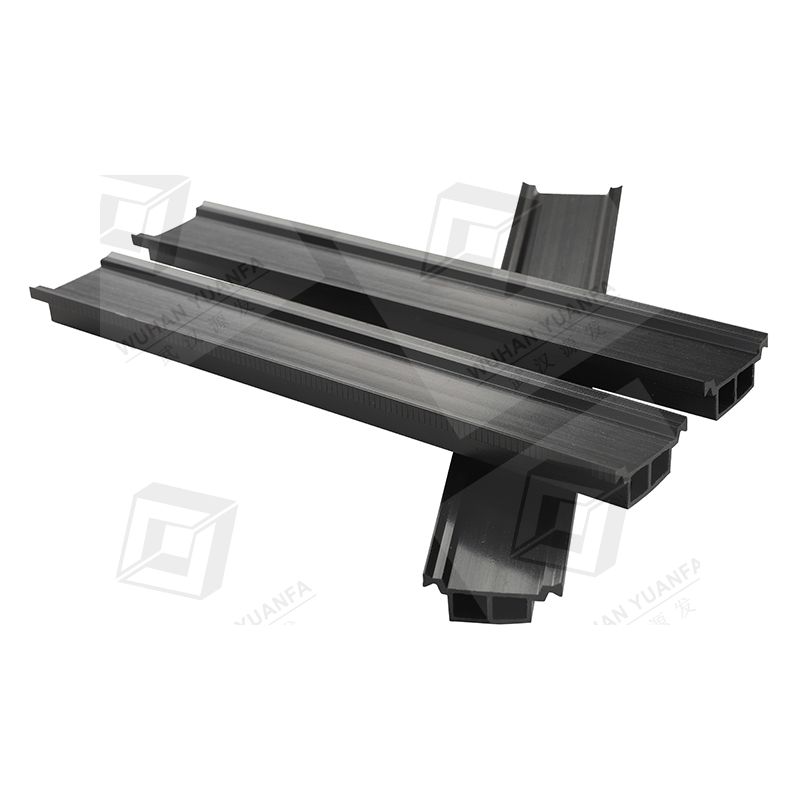
Material science dictates how composite profiles survive the manufacturing floor. Standard systems rely heavily on 25% glass-fiber reinforced polyamide, commonly denoted as PA66 GF25. You must evaluate how this specific material behaves under aggressive mechanical crimping to optimize your production lines.
PA66 GF25 possesses unique anisotropic properties. During the extrusion of a polyamide thermal break, the glass fibers align longitudinally along the length of the strut. This orientation provides immense tensile strength. However, the rolling discs apply compressive forces perpendicularly to these aligned fibers. If the rolling pressure is too aggressive, it crushes the fibers laterally. The matrix holding the glass shatters, and the material loses its structural elasticity.
Strut geometry significantly influences how the material absorbs and distributes rolling pressure. Engineers design struts in various shapes to balance thermal efficiency with mechanical strength.
Solid Struts: These designs feature a dense, continuous cross-section. They handle compressive rolling forces exceptionally well. The solid mass evenly distributes the crimping load. However, they transfer slightly more heat than hollow alternatives.
Hollow Chamber Struts: These intricate designs feature internal voids to trap air, boosting thermal insulation. However, hollow chambers are highly susceptible to crushing. Operators must calibrate rolling pressure with extreme precision. Too much force will collapse the internal chamber walls, destroying both the thermal and structural integrity.
Before finalizing manufacturing specifications, engineering teams must assess three core material properties:
Dimensional Stability: The strut must maintain exact width and thickness tolerances before and after the crimping process. Fluctuations lead to loose assemblies.
Elasticity Modulus: The material needs sufficient flexibility to withstand wind deflection without snapping. It must bend slightly and return to its original shape.
Compressive Strength: The strut must resist the vertical crushing force of the rolling discs while allowing the knurling teeth to penetrate just enough for a secure lock.
Assumptions have no place in structural engineering. To guarantee safety, manufacturers must implement mandatory testing protocols. These physical tests verify the exact shear strength achieved post-rolling. Passing these tests ensures the composite profile will perform predictably in the field.
Push-out testing measures the exact longitudinal force required to slide the thermal strut out of the aluminum cavity. Technicians cut a precise sample—typically 100mm in length. They place this sample into a specialized hydraulic testing rig. The machine pushes down directly on the strut while holding the aluminum frame stationary. The system records the peak force applied right before the strut slips. This test directly validates the effectiveness of the knurling and crimping synchronization.
While push-out testing measures longitudinal slip, transverse tensile testing evaluates lateral pull-apart strength. The machine grips the inner aluminum section and the outer aluminum section, pulling them in opposite directions. This test mimics the extreme negative wind pressures that try to rip a window frame apart during a hurricane. It confirms the knurled teeth have locked securely into the strut without causing internal micro-fractures.
To maintain regional and global compliance, facilities must integrate regular, batch-specific destructive testing. Two primary standards dictate these methodologies:
Testing Standard | Region / Authority | Primary Focus | Frequency Recommendation |
|---|---|---|---|
AAMA TIR-A8 | North America | Structural performance of composite thermal barrier framing systems. | Start of every shift and upon any die change. |
EN 14024 | Europe / Global | Metal profiles with thermal barrier - Mechanical performance requirements. | Daily batch testing across varying temperature extremes. |
You should never test profiles immediately after rolling. Wait at least 24 hours. The polyamide requires time to relax and acclimate to ambient humidity after the mechanical stress of crimping. Testing too early often yields falsely elevated strength readings.
High-quality raw materials cannot compensate for poor machinery. Producing consistent thermal break profiles requires advanced fabrication technology. When establishing a new production line or evaluating an outsourced assembly partner, you must apply a rigorous evaluation framework.
Older, pneumatically driven machines lack the finesse required for modern composite profiles. You must require CNC-driven rolling discs. Computer Numerical Control allows operators to set precise, repeatable parameters. Look for machinery offering independent pressure adjustments for distinct profile geometries. A massive curtain wall mullion requires vastly different crimping forces than a delicate residential window sash. Independent axis control ensures the machine adapts to asymmetrical profiles without causing dimensional distortion.
Modern quality assurance demands data transparency. Look for systems equipped with real-time monitoring. These machines utilize load cells to record exact pressure data per linear foot of extrusion. If a hard spot in the aluminum or a deviation in strut thickness causes a pressure spike, the system flags the exact location. This traceability guarantees batch-to-batch repeatability and prevents defective materials from reaching the construction site.
If you outsource your composite assembly, you must interrogate your manufacturing partners. Do not accept vague assurances of quality. Ask specific, engineering-focused questions:
What is your calibration frequency? Machines should undergo strict load-cell calibration at least quarterly.
What are your acceptable tolerance limits? They should provide documented dimensional tolerances for bowing and twisting post-crimping.
Can you supply historical defect rates? A transparent partner will share their internal scrap rates and push-out test logs for previous runs.
How do you handle hollow cavity profiles? Ask them to explain their specific pressure step-down procedures for fragile strut geometries.
Mastering rolling pressure operates as a strict engineering requirement, not merely an aesthetic preference. The structural integrity of an entire facade depends on the microscopic interaction between knurled aluminum and polyamide struts. As we have examined, deviating from optimal pressure thresholds introduces immediate risks. Under-pressurization sacrifices composite action and allows dangerous slippage. Over-pressurization crushes materials, inviting brittle failure during seasonal thermal cycling.
High-quality composites require the precise alignment of three distinct variables. You must control knurling depth, verify polyamide material integrity, and maintain strictly calibrated rolling pressure. Overlooking any single factor destabilizes the final product. Implementing rigorous testing protocols like EN 14024 and AAMA TIR-A8 ensures these variables remain synchronized across every production batch.
Procurement and engineering teams must take immediate action. Review your current vendor quality control data. Scrutinize their push-out testing logs and verify their equipment capabilities. If your facility still relies on outdated pneumatic machinery, evaluate CNC-controlled crimping upgrades today. Upgrading your rolling precision is the most effective way to eliminate field failures and guarantee long-term structural performance.
A: The minimum acceptable shear strength varies based on the specific profile design and regional codes. However, under standards like EN 14024, a baseline longitudinal shear strength often requires a minimum of 24 N/mm at room temperature. Always consult your specific architectural load requirements, as high-rise applications demand significantly higher baselines.
A: No. Once a strut undergoes excessive rolling pressure, the internal glass fibers fracture and the matrix yields. This mechanical degradation is permanent and irreversible. The entire composite profile must be scrapped, as it will no longer safely support external structural wind loads.
A: Knurling depth directly dictates grip potential. Shallow knurling requires higher rolling pressure to force the inadequate teeth into the strut, increasing crushing risks. Deep, sharp knurling allows machinery to use moderate, optimal rolling pressure while achieving a superior, secure mechanical interlock without damaging the strut.
A: Yes. Continuous exposure to extreme hot and cold temperatures causes the aluminum and polyamide to expand and contract at different rates. Over years, this movement can slightly loosen the mechanical grip. This is why initial shear strength must greatly exceed minimum requirements to account for long-term cyclical degradation.


