

close
Choose Your Site
Global
Social Media

Author: Site Editor Publish Time: 2026-08-18 Origin: Site
Architectural fenestration demands perfect alignment between structural integrity and visual appeal. Standard powder coating curing ovens operate at extremely high temperatures. They typically run between 180°C and 200°C. These aggressive temperatures easily approach or exceed the safe working limits of many structural polymers used in modern windows. This creates a serious conflict during extrusion manufacturing. Choosing the wrong assembly sequence brings heavy consequences to your production line. Substandard insulating materials result in warped profiles and severely degraded shear strength. You might also encounter aesthetic defects like surface blistering or craters. Ultimately, these issues lead to costly compliance failures and rejected batches. This article provides architectural manufacturers and extrusion specifiers with an evidence-based framework. You will learn how to evaluate material tolerances safely. We will help you choose optimal assembly workflows for your factory. You will discover practical methods to mitigate temperature-induced risks effectively.
Material Limitations: Not all insulating materials survive curing ovens; high-grade glass-reinforced polyamide is the industry standard for post-assembly coating.
Process Selection: Decision-makers must choose between "Roll-Then-Coat" (higher thermal risk, easier logistics) and "Coat-Then-Roll" (zero thermal risk to the strut, enables dual-color, requires specialized tooling).
Moisture Management: The hygroscopic nature of polyamides requires strict climate control prior to coating to prevent steam-induced blistering.
Supplier Accountability: Validating a supplier requires verifying compliance with structural standards (e.g., EN 14024) after simulated thermal cycling.
Industrial powder coating processes rely on intense, sustained heat to cure the applied finish. Typical curing parameters require aluminum profiles to dwell inside industrial ovens for 10 to 20 minutes. Oven temperatures consistently range from 180°C to 200°C. Sometimes, localized hot spots push these ambient temperatures even higher. This aggressive thermal environment poses a direct threat to any internal composite components. Metal handles the heat easily. Plastics, however, require specialized engineering to survive.
In modern aluminum windows and doors, the structural strut plays a vital role. It must maintain exact dimensional tolerances throughout its lifespan. Precise dimensions allow it to transfer wind loads and dead loads effectively. It acts as a permanent structural bridge between the inner and outer aluminum extrusions. The entire structural integrity of the window system relies on this connection. When exposed to extreme curing temperatures, basic polymers simply cannot hold their shape. They soften, sag, or warp under their own weight.
Failure modes emerge quickly if the internal strut softens during curing. The composite assembly immediately loses its transverse tensile strength. This means the inner and outer aluminum frames could easily pull apart under negative wind pressure. The assembly also suffers a massive drop in longitudinal shear strength. Without shear strength, the inner and outer frames slide independently against each other. This causes the window frame to bow or twist after installation. These invisible structural failures lead to entire rejected batches on the factory floor. Worse, they expose manufacturers to severe financial liability if installed units fail in the field. To avoid these catastrophic failures, manufacturers must integrate a reliable thermal breaking solution designed explicitly for high-heat industrial environments.
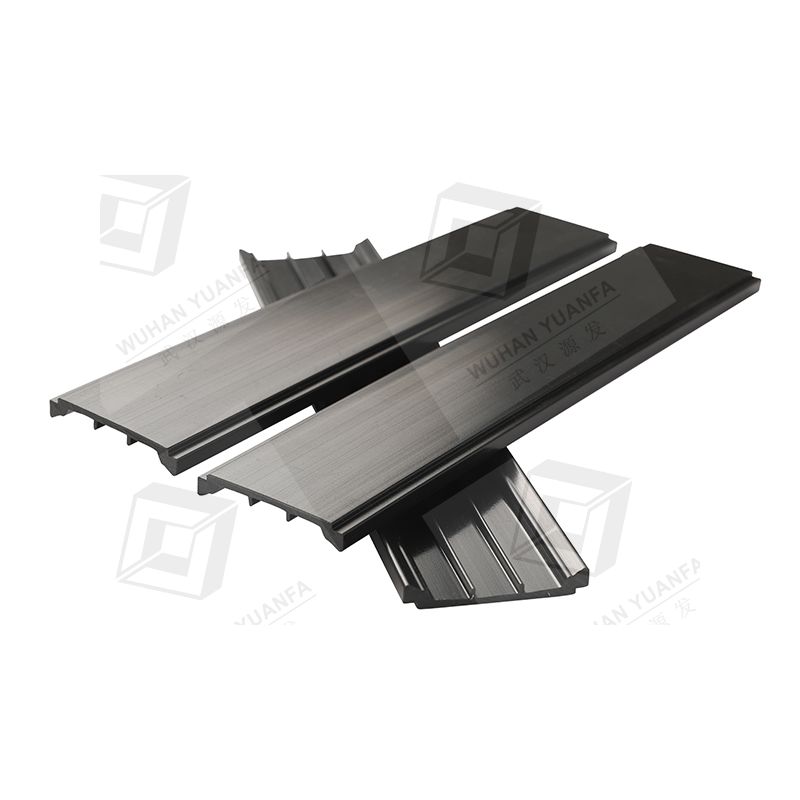
Not all insulating plastics handle intense heat equally. You cannot use basic polymers in a high-heat manufacturing sequence. Basic plastics like standard PVC or standard polyurethane melt rapidly in powder coating ovens. They lose structural integrity long before ambient temperatures reach 150°C. They turn brittle upon cooling. This makes them entirely unsuitable for pre-assembled coating processes. If you send a PVC strut through a 200°C oven, you will pull out a ruined, melted extrusion.
Because of these severe thermal limitations, the fenestration industry relies heavily on a specific composite known as PA66 GF25. This material combines pure polyamide 66 reinforced by 25% fiberglass. Polyamide 66 provides excellent chemical resistance and basic toughness. Adding exactly 25% fiberglass creates a rigid composite matrix capable of surviving extreme thermal stress. The fiberglass strands reinforce the plastic internally. They prevent the polyamide base from collapsing when it reaches high temperatures. This unique synergy makes a polyamide thermal break the undisputed global industry standard.
You must understand the specific heat deflection temperatures of these materials. PA66 GF25 handles short durations at 200°C quite well. However, its mechanical properties do temporarily alter during the intense bake cycle. The polymer matrix softens slightly. It becomes more pliable while inside the hot oven. Operators must handle the warm extrusions carefully to prevent accidental bending as they exit the curing chamber. The composite retains enough strength to hold the aluminum shells together, but it is temporarily vulnerable.
Post-bake recovery defines a truly high-quality strut. Once the profile exits the oven, it begins to cool. High-grade fiberglass-reinforced polyamide recovers its original structural rigidity perfectly. It returns to its full structural strength once it reaches ambient room temperature. This recovery assumes the peak temperature thresholds were never exceeded during the run. If you push the oven past 220°C for extended periods, permanent thermal degradation occurs. The crucial bonds between the fiberglass and the polyamide break down completely. The material becomes permanently brittle and fundamentally unsafe for structural architectural loads.
Manufacturers generally adopt one of two primary workflows for insulated aluminum profiles. You must carefully evaluate your factory capabilities before committing to a process. Each approach carries unique operational benefits. Each approach also dictates specific machinery requirements and quality control protocols.
This traditional method involves knurling and rolling the aluminum shells and the structural strut together first. You then hang the fully assembled composite profile and send it through the paint line and curing oven.
Operational Pros: This method streamlines factory logistics significantly. Your inventory management becomes much simpler. Parts move through the paint line as a single, cohesive unit. You avoid tracking separate inner and outer aluminum shells through different factory zones. It generally requires less floor space for staging raw materials.
Evaluation Criteria: You must strictly use premium, heat-resistant composite struts. Basic polymers will melt and destroy the assembly. This method also restricts the entire window profile to a single color. It requires extremely strict moisture control protocols before the paint line to avoid finishing defects. Any trapped water inside the strut will ruin the paint job.
This modern method separates the painting and assembly phases. You coat the inner and outer aluminum extrusions separately. You only insert and roll the strut into place after the paint fully cures and the metal cools.
Operational Pros: This workflow eliminates heat exposure to the insulating component entirely. It completely removes any risk of the plastic melting or warping in the oven. Crucially, it natively supports dual-color architectural profiles. You can easily offer one color for the building interior and a completely different finish for the exterior facade.
Evaluation Criteria: This workflow demands highly specialized factory machinery. You need precision knurling and rolling equipment. Your machinery must join pre-painted aluminum without scratching, denting, or marring the finished surface. Factory tolerances must remain incredibly tight. If the rolling wheel slips, you destroy an already painted and finished extrusion.
Workflow Comparison Overview
Workflow Feature | Roll-Then-Coat | Coat-Then-Roll |
|---|---|---|
Thermal Risk to Strut | High (Requires PA66 GF25) | Zero (Assembled post-cure) |
Color Options | Single color only | Dual-color natively supported |
Logistical Complexity | Low (Handled as one unit) | High (Requires tracking separate parts) |
Machinery Requirement | Standard knurling/rolling tools | Precision, scratch-free rollers needed |
Moisture Sensitivity | High risk of paint blistering | No paint blistering risk |
If you choose to run assembled profiles through an oven, you face very specific environmental risks. Polyamide holds a known hygroscopic reality. It naturally absorbs moisture directly from the surrounding air. Over several weeks in a humid warehouse environment, the raw material absorbs significant water weight. Depending on ambient humidity, it can absorb up to three percent of its own weight in water.
This moisture creates the dreaded blistering defect on the factory floor. When the assembled profile enters a 200°C oven, the trapped moisture begins to boil. It quickly turns into high-pressure steam. This steam forcefully outgasses from the plastic matrix. If this outgassing happens while the adjacent powder coat is in its liquid curing phase, it destroys the finish. The escaping steam creates visible bubbles, craters, or ugly blisters in the freshly painted surface. Your quality control team will reject these pieces immediately. Using a properly conditioned thermal break significantly minimizes this costly risk.
You must also carefully consider cooling rate risks. Engineers refer to this phenomenon as thermal shock. Aluminum and polyamide possess very different coefficients of thermal expansion. Heat causes aluminum to expand rapidly. Polyamide moves at a much slower, different rate. When leaving the oven, the materials shrink back to normal dimensions. If you cool the composite profiles too quickly, you induce massive mechanical stress fractures. Rapid quenching causes the metal to bite down incorrectly on the plastic. This aggressive shrinking compromises the precise knurled grip between the metal cavity and the plastic head.
Follow these actionable mitigation protocols to protect your extrusion yields:
Pre-bake structural profiles at lower temperatures (around 60°C to 80°C) for a few hours. This safely drives out trapped moisture before the main powder coating phase.
Implement strict climate-controlled storage for all raw materials. Keep humidity levels tightly regulated in your warehouse year-round. Store materials in sealed bags when not in use.
Enforce controlled, slow ambient cooling down from the curing ovens. Never use cold water sprays or high-speed industrial chillers to rush the cooling process. Allow the metals and plastics to contract naturally at room temperature.
Sourcing the right structural material dictates your success or failure on the factory floor. You cannot accept simple visual inspections alone. Many plastics look identical to the naked eye. You need hard, verified data to back up supplier claims.
First, demand strict dimension and tolerance guarantees. Assess whether the supplier guarantees dimensional stability after standard thermal cycling. Almost every vendor promises tight tolerances straight out of the extrusion die. That is easy to achieve. You need written guarantees that those tolerances survive a 200°C bake. If the profile shrinks or distorts post-bake, the assembly will fail structural testing.
Second, ask for verifiable compliance data from independent laboratories. Look for official laboratory reports proving adherence to global structural standards. The EN 14024 standard remains the trusted global benchmark for these assemblies. Your supplier must provide test reports detailing longitudinal shear strength retention specifically post-powder coating. They must prove the material holds up after thermal aging. If they cannot provide this precise data, you must find another vendor.
Third, prioritize raw material traceability. Ensure the supplier provides batch-level verification of their PA66 GF25 compound. Unscrupulous vendors sometimes mix in cheap regrind plastics to cut their expenses. Regrind plastics contain microscopic impurities. They have wildly unpredictable melting points. They will fail inconsistently in your ovens, causing random batch rejections. Demand virgin PA66 reinforced with high-quality fiberglass for all structural applications.
Finally, evaluate their technical support and engineering capabilities. A strong vendor offers collaborative testing. They will help you dial in specific oven temperatures for your factory. They will test line speeds for your unique extrusion profiles. They will help you troubleshoot blistering issues if they arise. Evaluate whether they act as true engineering partners or just transactional raw material suppliers.
Successful powder coating of insulating profiles requires careful planning and deep material knowledge. You must align your paint line capabilities directly with your chosen assembly sequence. Understanding the heat limitations of your materials prevents catastrophic structural failures. Choosing between Roll-Then-Coat and Coat-Then-Roll dictates your machinery needs and defines your product offerings. Each method demands distinct quality control protocols to ensure structural integrity.
Technical buyers and production managers should take immediate action. Audit your current moisture-management protocols in your storage facilities today. Verify that humidity levels remain within safe operational limits. Contact your current structural strut vendors immediately. Request their latest thermal stability test data and their EN 14024 compliance reports. Reviewing and upgrading your material specifications now will save your factory thousands of dollars in rejected batches later. Ensure your structural bridges match the aesthetic excellence of your exterior finishes.
A: A high-quality PA66 GF25 strut safely withstands 200°C for short curing durations, typically 10 to 20 minutes. Exceeding this upper limit permanently degrades the fiberglass bonds. Pushing temperatures to 220°C or beyond causes the material to become permanently brittle. This leads directly to severe structural failures under wind loads.
A: Technically yes, but it requires highly complex physical masking. Masking off one side of a fully assembled profile is slow, labor-intensive, and economically inefficient. The "Coat-Then-Roll" method remains the economically viable standard for dual-color finishes. It paints the extrusions entirely separately before joining them.
A: Polyamide naturally absorbs moisture from humid ambient air. When placed in a 200°C curing oven, this trapped internal moisture boils and turns to steam. The steam forcefully outgasses through the plastic surface. This rapidly creates visible bubbles, blisters, and deep craters in the adjacent curing powder coat.


