

close
Choose Your Site
Global
Social Media

Author: Site Editor Publish Time: 2026-07-29 Origin: Site
Architects and buyers constantly seek expansive glass installations. They want massive, uninterrupted views for luxury homes and high-end commercial facades. Natural light transforms interior spaces dramatically. However, modern building codes mandate strict energy efficiency. Governments continuously update these regulations. This forces a necessary shift toward advanced frame technologies. Replacing solid aluminum barriers inside a frame logically raises serious structural questions. Project owners worry about load-bearing capacity and deflection limits. They also question severe wind resistance capabilities.
Can a non-metal barrier safely hold thousands of pounds of heavy triple glazing? Will it survive hurricane-force winds? Fortunately, modern engineering solves this exact problem beautifully. A properly designed system does not compromise structural integrity. Still, you must know how to evaluate the mechanical assembly properly. Understanding these structural dynamics helps you avoid catastrophic, long-term failures on site. We will explore how these systems balance thermal performance and raw structural strength seamlessly. You will learn exactly what makes a large-span frame truly secure.
A high-quality thermal break utilizes glass-fiber-reinforced polyamide to maintain structural rigidity while halting thermal transfer.
The structural strength of a thermally broken frame relies entirely on the "composite action"—how securely the aluminum and the break are mechanically joined.
Evaluating large-span frames requires looking beyond energy ratings to verify structural test reports, specifically focusing on shear strength and deflection limits.
Poorly manufactured thermal breaks can lead to internal slipping, thermal bowing, and compromised weather seals in oversized architectural systems.
Balancing strict energy codes and massive glass weights creates a distinct engineering dilemma. You must mitigate thermal bridging to meet strict local energy codes. At the same time, you must support immense physical forces. We categorize these forces into dead loads and live loads. Dead loads represent the static weight of the materials. Modern triple-pane acoustic glass weighs incredibly heavily on the bottom frame sill. Live loads represent dynamic environmental forces. Wind pressure pushing against a skyscraper facade acts as a massive live load.
Slicing a solid aluminum extrusion in half naturally weakens its structural moment of inertia. The manufacturer literally cuts away rigid metal. They replace it with an insulating barrier. Engineers must force the two separated aluminum halves to act as a single, rigid structural unit again. We call this critical mechanism achieving composite action. Without composite action, the inner and outer frames would bend independently.
Success requires a careful balancing act from the system designers. A frame must achieve required U-factors without using excessively bulky profiles. Architects hate bulky metal profiles. Thick frames ruin clean architectural sightlines and block natural light. However, overly thin profiles risk severe structural deflection under load. You need a system operating perfectly in both thermal and structural domains. High-performance engineering bridges this exact gap.
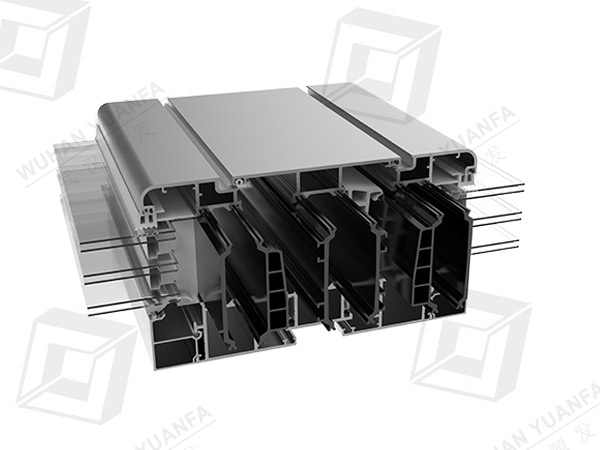
A modern polyamide thermal break elegantly solves this intense structural challenge. Manufacturers typically reinforce this insulating material using 25 percent fiberglass. The fiberglass strands add immense tensile strength to the plastic matrix. Polyamide stands out because its coefficient of thermal expansion closely matches aluminum. This specific chemical property prevents severe structural stress during extreme temperature shifts. The metal and the insulator expand and contract together harmoniously. They do not fight each other during seasonal weather changes.
The mechanical joining process ultimately determines the actual frame strength. Manufacturers use a strict three-step manufacturing requirement to guarantee performance. First, they execute the knurling phase. Precision machines cut small, aggressive teeth into the aluminum extrusion cavity. These teeth provide vital gripping friction. Second, technicians handle the insertion phase. They slide the rigid polyamide strut into the prepared metal cavity. Finally, heavy machinery performs the crimping phase. High-pressure rolling wheels compress the aluminum firmly over the strut edges.
This rigorous three-step process forcefully locks the distinct materials together. The resulting composite profile effectively transfers sheer loads right across the break. It allows the inner and outer aluminum sections to bear heavy weight symmetrically. The newly joined frame regains the structural stiffness of a solid metal extrusion. You achieve maximum thermal efficiency without sacrificing load-bearing capacity.
Evaluating large-span glass systems requires looking far past simple energy labels. You must analyze specific structural evaluation criteria to guarantee safety. First, consider the relationship between strut width and frame rigidity. Wider struts dramatically improve thermal performance by increasing the insulation gap. However, pushing the width too far can invite dangerous torsional weakness. The frame might twist under heavy wind pressure. Advanced geometric engineering successfully solves this twisting problem. Manufacturers use multi-cavity strut designs to maintain stiffness over much wider spans. These internal hollow chambers resist bending forces perfectly.
You must also review longitudinal shear capacity data carefully. Shear strength testing reveals how well the assembly resists internal movement. Buyers should always request structural performance testing data. Look for reports compliant with AAMA (American Architectural Manufacturers Association) standards. European equivalent standards, like specialized EN testing, also provide highly reliable benchmarks.
Finally, calculate system depth requirements carefully for every specific opening. The overall depth of the frame must support your required oversized structural openings. Deeper frames naturally resist wind deflection better than shallow frames. You cannot use a standard residential frame depth for a massive twenty-foot commercial facade.
Strut Configuration | Thermal Efficiency Impact | Structural Rigidity Profile | Ideal Application Scenario |
|---|---|---|---|
Standard Flat Strut | Moderate (Standard U-factors) | High sheer resistance | Standard residential punched openings |
Wide Multi-Cavity Strut | Maximum (Passive House levels) | High torsional stability | Oversized commercial facades |
Foam-Filled Cavity Strut | Extreme (Blocks convection) | Excellent uniform load distribution | Extreme cold climate luxury homes |
Offset Geometry Strut | High (Reduces direct bridging) | Specialized directional stiffness | Heavy multi-panel sliding doors |
Value-engineered frames introduce significant implementation risks into your building project. Poorly manufactured systems often fail under intense real-world pressures. The most dangerous threat remains the internal slip risk. If the factory knurling or crimping process lacks strict precision, the composite action fails entirely. The teeth do not bite into the strut securely. Under heavy wind loads, the two aluminum sections begin sliding independently. The frame will deflect excessively inward or outward. This severe movement leads directly to cracked glass or completely inoperable sliding doors.
Thermal bowing presents another major architectural challenge. Engineers commonly call this phenomenon the bi-metal effect. In extreme climates, the exterior frame might bake in the intense summer sun. Meanwhile, the interior frame remains air-conditioned and cold. This massive temperature difference forces the exterior metal to expand faster. A high-quality thermal break must properly accommodate this sheer stress. If it fails, the entire frame bows outward, destroying critical weather seals. Water and air will leak into the building envelope.
Lastly, hardware anchorage requires strict oversight from site supervisors. Installers sometimes mistakenly mount heavy hardware directly into the non-metal strut cavity. Heavy door hinges and multi-point locking mechanisms must anchor exclusively into the structural aluminum. Fastening heavy dynamic hardware into the central plastic zone guarantees eventual mechanical failure. The screws will inevitably tear out over time.
Moving from technical evaluation to actual vendor selection requires a highly disciplined approach. You must vet window manufacturers rigorously before specifying their proprietary systems. Start by asking direct, structurally focused questions during the bidding phase.
Do you have certified structural deflection reports for this specific frame series at my required dimensions?
Is the internal thermal strut solid, hollow, or foam-filled?
How does the exact strut geometry affect both structural rigidity and overall U-values?
Are your extrusion crimping processes independently factory-certified for quality control?
Can you provide localized wind-load engineering calculations for our exact zip code?
Once you gather these critical answers, take clear next-step actions. Consult structural engineers early in the schematic design phase. Do not wait until the glass panels are already ordered. Retrofitting structural supports wastes immense time and money. Request physical frame corner samples directly from the manufacturer. You can visually inspect the internal knurling quality and strut integration yourself. Feeling the heavy-duty assembly in your hands provides great confidence. You can personally verify the engineered composite action before signing any purchase orders.
A properly specified insulated frame operates as a vital structural asset, not a liability. You can confidently design massive architectural glazing without sacrificing interior comfort or occupant safety. High-performance thermal breaks revolutionize how we approach modern building envelopes. To ensure absolute project success, always follow these essential final steps.
First, prioritize manufacturers who transparently provide both thermal modeling and structural stress test data. Do not accept vague performance promises. Second, verify all longitudinal shear capacity reports for oversized sliding doors and massive facades. Finally, inspect physical frame samples to confirm robust mechanical crimping practices firsthand. Do not leave your load-bearing calculations to mere chance. Contact a dedicated technical consultant today. They will review your project-specific structural loads and specify the correct high-performance aluminum profile for your exact needs.
A: No, it does not weaken the frame when engineered correctly. The structural integrity remains completely intact provided the frame uses a high-quality reinforced polyamide strut. Manufacturers use proper mechanical crimping techniques to firmly lock the aluminum halves together. This specific high-pressure process achieves true composite structural action. The resulting composite assembly easily bears massive glass loads securely. You retain the strength of solid metal while gaining immense energy efficiency.
A: These two methods offer vastly different structural capabilities. Thermal struts utilize rigid glass-reinforced polyamide to bridge the separated aluminum halves. They generally offer superior structural rigidity for large-span architectural applications. Older polyurethane pour-and-debridge methods rely entirely on a poured chemical resin. The modern polyamide strut approach delivers far better sheer resistance. It provides superior long-term load-bearing stability for oversized, heavy commercial frames.
A: Modern engineered frame sizes are incredibly expansive. With proper calculations, thermally broken frames easily support massive architectural designs. You can routinely install multi-panel sliding doors spanning well over 40 feet wide. You can also safely specify massive floor-to-ceiling fixed facade panels. The ultimate size limits simply depend on localized wind load calculations and structural engineer approvals. High-quality systems scale up beautifully to meet luxury design demands.


