

close
Choose Your Site
Global
Social Media

Author: Site Editor Publish Time: 2026-08-17 Origin: Site
K type, CT, and Y labels are often used to describe families of Polyamide Profiles for thermally broken aluminum systems. They are useful shorthand, but they are not universal specifications. The same label can be interpreted differently across product catalogs and aluminum-system designs, while small changes in leg shape, rib placement, wall thickness, or locking detail can decide whether a profile rolls correctly. The right question is therefore not “which type is best?” but “which cross-section is compatible with the aluminum grooves and fulfills the member’s thermal, structural, drainage, and fabrication functions?”
K, CT, and Y names identify recognizable geometric families, not a global interchangeability standard.
The aluminum groove, knurling, rolling method, and required functional zones are more important than the letter in a catalog.
Geometry can influence locking, cavity formation, thermal path length, and the room available for adjacent system features.
Final selection should use an approved cross-section drawing and sample assembly rather than visual comparison alone.
All Polyamide Profiles used as thermal breaks aim to separate aluminum sections, but they do so inside a highly specific mechanical interface. Profile legs enter aluminum grooves; rolling creates the mechanical connection; the remaining body creates the insulating zone and may form chambers, ribs, or interfaces for neighboring components. A few tenths of a millimeter in a critical location can affect engagement. That is why generic product photos are a poor basis for substitution.
Shape also affects the heat-flow route. Wider bodies can increase separation, while hollow chambers and fins can alter the internal cavity behavior. Yet a profile should not be optimized for heat flow in isolation. Its ribs must survive handling; its legs must fit the aluminum; its body must leave room for glazing and drainage details; and the completed member must meet the intended mechanical design. Profile geometry is a system decision expressed in polymer.
K type commonly refers to a profile with features that create a recognizable K-like cross-sectional arrangement, often used with specific standard groove designs. Within this broad family, profiles may vary in width, locking-leg form, chamber configuration, and reinforcement ribs. A K-type profile may be selected where the aluminum system expects a conventional groove interface and the thermal zone does not need the functional layout of another family.
The important distinction is between a K family designation and an actual part drawing. A 20 mm K2 profile and a 39 mm K1 profile are not substitutes simply because they carry a K label. The required insulation depth, groove shape, structural role, and thermal target differ. For a large facade section, a 39.0 mm K1 profile may serve a different design purpose from a narrower profile in a window frame.
CT labels are often applied to profile designs with a different body and leg arrangement from conventional K designs. In practice, they may be specified where the aluminum-system geometry requires a particular locking relationship or where the insulation zone must work around adjacent chambers and features. CT does not prove greater strength or thermal performance by name alone. Those characteristics come from the exact cross-section, material, width, and the assembled aluminum member.
CT variants can be especially relevant when the groove locations or internal frame architecture demand an offset or multi-feature thermal break. A designer should check whether the profile supports the required rolling path, whether its profile legs align with the aluminum grooves, and whether the remaining cavities preserve gasket, screw, drainage, and glazing functions. Calling a part “CT” cannot answer these questions; the system drawing can.
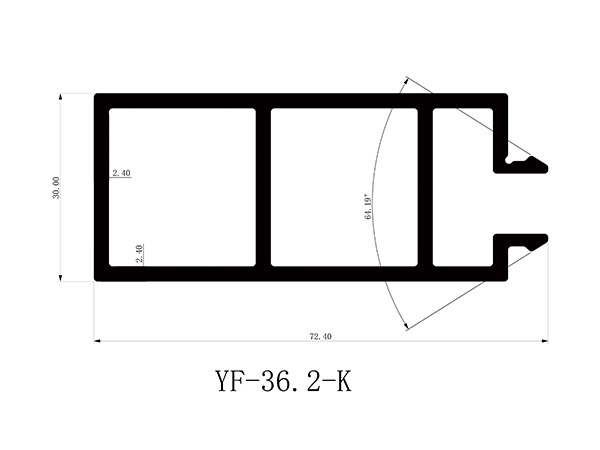
A Y profile is usually identified by a branching or split form that can accommodate certain aluminum configurations and functional zones. The arms and central body may help form multiple interfaces or arrange insulating sections within a broader frame design. Such geometry can be useful where the system needs more than a simple parallel separation, but it also introduces more places where fit, wall thickness, fiber orientation, and production consistency must be controlled.
Y designs should be judged by their purpose in the actual section. Does the split establish separate thermal paths? Does it create a stable lock in the intended grooves? Does it preserve a drainage route or clearance for another component? The answers are engineering and fabrication questions, not branding questions. Yuanfa includes Y-pattern profile options in its facade category, which makes an approved cross-section essential when requesting a compatible quotation.
Profile family | What the label suggests | What must still be confirmed |
K type | A conventional family used with defined groove arrangements | Exact width, K variant, leg dimensions, locking direction, and aluminum compatibility |
CT | A different body/leg layout for designated system geometries | Cavity function, rolling path, neighboring feature clearance, and composite behavior |
Y | A branching or split configuration | Arm geometry, fit in each groove, function of each branch, and production tolerances |
All three families depend on an extrusion compound and process capable of reproducing the required shape. A profile for a thermal break needs more than the general properties associated with nylon. The material must be suitable for the cross-section, and the extrusion process must maintain dimensions across production. Glass-fiber-reinforced PA66 is commonly used for this role, but the result still depends on die design, cooling, puller control, cutting, packaging, and inspection.
Fiber reinforcement also makes directional effects relevant. The mechanical response of a complex extruded profile can vary with geometry and fiber orientation. This is another reason not to select a K, CT, or Y profile only from a silhouette. The supplier should receive the intended application and aluminum drawing so that any critical ribs, legs, and load-sensitive features can be reviewed.
First, obtain the current aluminum-system cross-section and identify every thermal-break groove. Second, define the profile’s role: main structural break, local insulating insert, opening-frame component, or another function. Third, compare exact profile drawings, including width, leg shape, wall thickness, cavities, and dimensional tolerances. Fourth, confirm material and production controls. Fifth, make a sample assembly using the intended knurling and rolling setup. Sixth, evaluate the completed member through the thermal and mechanical checks required for the project.
This sequence prevents a common procurement failure: choosing by family name, then discovering after delivery that a leg does not seat correctly or a cavity interferes with the aluminum design. It also avoids an opposite problem: specifying an elaborate profile where a simpler compatible section would meet the real requirements more efficiently.
Ask the supplier which exact aluminum groove configuration the profile is designed to engage, whether the indicated dimensions are controlled after extrusion and conditioning, and which rolling direction is expected. Ask whether the profile has any minimum bend, handling, or storage limits. If coating follows assembly, ask whether the planned thermal cycle has been reviewed. For facade members, ask how the proposed profile relates to the member’s load path and how the system will be verified after rolling.
Wuhan Yuanfa New Materials Co., Ltd. offers multiple product shapes, but the most valuable procurement document remains the project’s approved profile section. Use the K, CT, and Y label to narrow the conversation, then use drawings and trial assembly to make the actual choice.
Mark the profile portions captured by aluminum and the portions that form the insulating body. Pay close attention to reference dimensions where a leg enters a groove, a roller deforms the aluminum, or the profile approaches a gasket, screw channel, or drainage cavity. These are the locations where a small variation can become a fabrication or performance problem.
Compare the actual aluminum section with each proposed K, CT, or Y drawing. Check both groove locations, locking orientation, available clearances, and the direction of mechanical rolling. Profiles can look similar in a catalog while being unsuitable once placed in their real orientation. A branching body may preserve a needed cavity; a conventional K arrangement may be a simpler fit; a CT layout may solve a particular offset. The correct conclusion comes from geometry in context.
Complex profiles also need clear dimensional control. Ribs and hollow chambers may offer functional value but can be more sensitive to handling and extrusion variation than a solid web. Identify dimensions that must remain controlled through extrusion, cutting, storage, and delivery. For deep facade members, run a representative rolling trial early enough to revise the profile or process without disrupting the project schedule.
K type, CT, and Y Polyamide Profiles differ mainly in the exact geometric strategy used to fit, lock, and function within an aluminum thermal-break system. Their labels are convenient but incomplete. A reliable decision considers the specific groove, profile dimensions, material, rolling method, thermal zone, and adjacent facade functions. Yuanfa’s profile range makes it possible to compare families, but no letter designation should replace an approved drawing and a representative assembly check.
Only if the exact cross-section, aluminum grooves, rolling method, and system functions are demonstrated to be compatible. The family label alone is not enough.
No. Thermal performance is influenced by the entire frame geometry, insulation depth, cavities, glazing, and metal bypasses. A Y shape is chosen for its system fit and function.
They are commonly used descriptive labels, but buyers should not assume a universal dimensional standard. Always request the specific profile drawing.
They must enter and mechanically engage with the aluminum grooves consistently. Variation can affect rolling quality and the behavior of the composite member.
The suitable profile is the one designed for the actual curtain-wall section and verified for its thermal and mechanical role. It may be K, CT, Y, or another defined geometry.


