

close
Choose Your Site
Global
Social Media

Author: Site Editor Publish Time: 2026-08-14 Origin: Site
Aluminum profile warping, twisting, and misalignment inflict heavy financial penalties on commercial fenestration projects. Fabricators routinely face high material rejection rates. They also risk catastrophic structural failures during curtain wall installations. Industry professionals often specify these systems purely to meet strict energy compliance codes. However, managing dimensional stability under extreme temperature differentials serves an equally critical structural role. Left unmanaged, severe thermal bridging destroys extrusion alignment.
This guide breaks down the precise mechanics of thermal bowing across aluminum systems. We explore how to evaluate solutions for robust structural integrity. You will also learn vital implementation risks to avoid when selecting extrusion partners. Understanding these principles ensures your assemblies remain perfectly aligned from the factory floor to the final job site installation.
Thermal breaking mitigates "thermal bowing" by decoupling the interior and exterior aluminum extrusions, allowing independent expansion and contraction.
Specifying a polyamide thermal break ensures the insulating barrier shares a nearly identical coefficient of linear thermal expansion (CLTE) with aluminum, preventing shear stress.
Poorly executed thermal break insertion (knurling and rolling) is a primary hidden cause of profile twisting, requiring strict vendor evaluation.
Choosing the right thermal break requires balancing thermal performance (U-factor) with structural load-bearing capacity and shear strength.
Metals possess unique thermal expansion coefficients. Aluminum responds aggressively to ambient temperature shifts. A typical continuous extrusion acts as a rigid thermal bridge. It forcefully tries to accommodate two vastly different temperature environments simultaneously. We call this phenomenon the bimetallic effect.
Imagine a commercial curtain wall in peak summer. The exterior aluminum face hits 150°F under direct, punishing sunlight. Meanwhile, the interior aluminum face rests in a 70°F air-conditioned office. The physical laws of thermodynamics dictate rapid expansion on the exterior. The hot side literally grows longer. The cold interior side remains contracted and stagnant. The resulting kinetic energy has nowhere to dissipate. It forces the entire aluminum structure to bend outward. This thermal bowing aggressively twists the metal out of alignment.
This structural reality drives severe business impacts across the manufacturing timeline. Misaligned extrusions trigger a cascade of expensive failures:
CNC Machining Failures: Twisted profiles fail to meet strict dimensional tolerances. When clamps force a warped piece flat, the machine drills precision holes based on a flat assumption. Unclamping the profile causes it to spring back. The holes instantly misalign.
Increased Scrap Rates: Fabricators must discard warped extrusions. This skyrockets raw material costs and ruins production efficiency.
Installation Delays: Field teams struggle to assemble twisted frames on site. Forced assembly compromises safety and project timelines.
Structural Fatigue: Continuous kinetic stress fatigues the metal over decades. The assembly constantly fights its own internal thermal expansion.
Weather Seal Degradation: Progressive twisting breaks down structural sealants. This guarantees future water ingress and air leakage.
Any viable intervention requires strict success criteria. A successful solution must fully neutralize thermal bridging. More importantly, it must achieve this without compromising overall structural rigidity. The modified assembly must still withstand massive wind loads and extreme building dead loads.
Mechanical isolation provides the definitive answer to thermal bowing. The solution requires physical separation of the continuous aluminum frame. Manufacturers insert a structural buffer between the halves. Thermal breaking splits the single extrusion into two independently moving sections. They now handle localized temperature extremes in isolation. Kinetic energy no longer transfers across a solid metal bridge. This profound mechanical isolation preserves overall profile straightness.
Differential expansion inevitably creates intense shear forces along the connecting axis. The insulating barrier must absorb these forces seamlessly. As the exterior face expands, it pulls against the interior face. The barrier acts as a heavy-duty shock absorber. It prevents the distinct expansion rates from twisting the entire assembly out of plumb. A highly rigid, mechanically locked connection here remains vital for structural safety.
Premium insulating barriers add another critical layer of structural stability. Commercial buildings constantly move. High-altitude wind loads create continuous micro-vibrations. Natural building sway adds progressive kinetic stress to fenestration frames. The structural barrier actively dampens these kinetic forces. By absorbing environmental micro-movements, the barrier prevents progressive misalignment over the building's lifespan. It turns a rigid, brittle frame into a dynamic, resilient assembly.
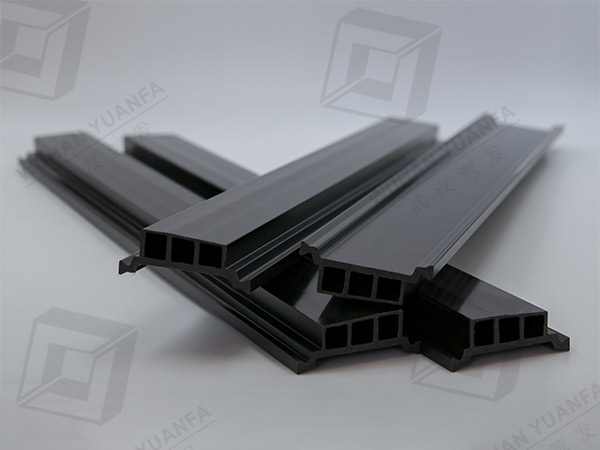
Engineers evaluate barrier materials based heavily on CLTE (Coefficient of Linear Thermal Expansion). Aluminum expands at a known, highly specific rate. The barrier material must match this exact rate. If the materials expand differently, the internal assembly will inevitably fracture under shear stress. A polyamide thermal break dominates the modern architectural industry. Manufacturers reinforce the raw polyamide using a precise 25% fiberglass mixture. This engineering specifically aligns its CLTE almost exactly with aluminum. Both materials expand and contract together in perfect harmony. This permanently eliminates internal shear stress fractures.
Contrast this mechanical synergy against poured polyurethane systems. The pour and debridge method relies heavily on chemical adhesion. Technicians pour liquid resin into a dedicated aluminum channel. They later mill away the connecting metal bridge. This system relies entirely on the chemical bond to handle immense shear stress. While polyurethane offers excellent insulation values, it lacks robust composite structural rigidity in high-load scenarios. Polyamide struts consistently deliver superior shear strength under extreme wind loads.
Material Characteristic | Polyamide (25% Fiberglass) | Polyurethane (Pour & Debridge) |
|---|---|---|
CLTE Compatibility | Nearly identical to aluminum. Prevents internal stress. | Different from aluminum. Can induce long-term shear stress. |
Structural Rigidity | Extremely high. Ideal for heavy commercial loads. | Moderate. Better suited for lighter residential applications. |
Connection Method | Mechanical lock (knurling and rolling). | Chemical adhesion (poured resin bond). |
Torsional Resistance | Excellent. Cavity designs optimize resistance. | Good, but lacks complex internal geometry options. |
Profile geometry matters immensely when evaluating torsional rigidity. Engineers design insulating struts in various complex shapes. Basic C-shapes offer flexibility for standard windows. Hollow cavities boost torsional rigidity dramatically for heavy curtain walls. Multi-cavity designs manage complex load paths efficiently. The right geometric shape actively resists twisting forces before they deform the surrounding aluminum.
Industry compliance metrics provide objective verification. Engineers rely heavily on AAMA TIR-A8 and EN 14024 standard frameworks. These rigorous testing protocols verify true structural composite performance. Independent laboratories apply massive shear loads to test samples. They measure exact deflection points under extreme pressure. Passing these stringent tests ensures the assembly maintains dimensional stability during worst-case environmental scenarios.
Sometimes the manufacturing intervention creates the exact problem it attempts to solve. Improperly installed barriers routinely induce severe, immediate twisting. Manufacturing technicians refer to this phenomenon as the dizzy effect. The extrusion looks warped straight off the assembly line. This happens when fabrication processes lack strict mechanical controls.
Knurling and rolling failures remain the primary culprits behind factory-induced misalignment. The mechanical locking process requires absolute precision. Flaws here ruin the entire extrusion.
Insufficient Knurling Depth: Operators must aggressively knurl the aluminum cavity to create sharp gripping teeth. Shallow teeth fail to bite deeply into the rigid strut. This leads to internal slippage under load. The profile instantly loses its critical shear transfer capacity.
Over-Pressurized Rolling: Rolling machines forcefully crimp the aluminum around the barrier. Applying excessive hydraulic pressure crushes the delicate aluminum cavity. This causes immediate plastic deformation. The sheer mechanical force warps the aluminum instantly. The product arrives at the job site already twisted.
Environmental variables also ruin extrusion alignment. Factory environmental controls remain non-negotiable. Polyamide naturally absorbs ambient moisture. Poor factory storage conditions swell the struts before insertion. They subsequently shrink after installation, ruining the initial alignment. Resins require exact ambient temperatures to cure properly. Improper curing leaves the assembly structurally compromised. A poorly executed thermal break fundamentally destroys the extrusion.
Vendor capabilities demand strict scrutiny from procurement teams. Look closely at a fabricator's internal quality assurance process. Do they utilize automated shear testing? Automated testing provides objective, verifiable data regarding mechanical lock strength. Do they utilize advanced 3D coordinate measuring machines (CMMs)? Modern CMMs map the exact straightness of the final profile down to the micron. Relying on manual tape measures and basic visual checks falls dangerously short for commercial applications.
Demand absolute tolerance transparency before signing contracts. Vendors must document allowable twist parameters clearly. Ask for straightness tolerances specifically documented post-insertion. The aggressive rolling process fundamentally alters the original aluminum tolerances. You need the final, composite numbers in writing to guarantee CNC machining success.
Procurement teams must take definitive next steps to mitigate risk. Do not rely on generic marketing promises. Execute the following verification strategies:
Request detailed composite shear test reports based strictly on your exact profile geometries.
Require physical sample runs before authorizing mass production.
Perform your own CNC machining verification on these factory samples.
Verify that drilled holes remain perfectly aligned after unclamping the test profiles.
Decoupling structural fenestration components far exceeds basic energy compliance requirements. It stands as a primary structural mechanism for preserving dimensional integrity. Properly engineered solutions actively prevent devastating thermal bowing. They stop expensive profile twisting and eliminate continuous kinetic fatigue. By neutralizing the bimetallic effect, these systems ensure long-term curtain wall stability.
Stakeholders must prioritize vendors demonstrating uncompromising process controls. Flawless knurling and rolling execution matters just as much as premium material selection. A high-quality strut fails instantly if installed poorly. Choose manufacturing partners who validate their straightness tolerances through rigorous, automated testing. Implementing these strict procurement standards guarantees your aluminum assemblies remain straight, strong, and reliable.
A: No. While the solid monolithic structure is split, proper composite design compensates entirely. High-quality knurling and rolling create a mechanical lock that forces the two halves to act as one load-bearing unit. The assembly easily withstands commercial wind and dead loads when engineered to AAMA or EN standards.
A: Industry baselines typically follow stringent AAMA or EN specifications. Twist tolerances generally hover around 1/2 degree per foot of length. Bow tolerances allow roughly 0.0125 inches per foot. Specific tolerance allowances depend heavily on the final profile geometry and wall thickness.
A: Raw, unreinforced polyamide can absorb moisture and shift dimensionally. However, industry-standard barriers incorporate a precise 25% fiberglass reinforcement. This stabilizes the material against moisture ingress. It also perfectly aligns the expansion coefficient with the surrounding aluminum, guaranteeing permanent long-term dimensional stability.


