

close
Choose Your Site
Global
Social Media

Author: Site Editor Publish Time: 2026-06-11 Origin: Site
Building enclosures face a massive efficiency hurdle today. Up to 30% of energy loss occurs right through structural connections. This invisible thermal bridging leads to skyrocketing utility bills. It also causes rapid structural degradation from persistent condensation. A thermal break steps in to solve this problem entirely. It physically severs the conductive bridge in window frames and structural joints.
While PVC offers natural insulating properties and an attractive price point, many professionals hesitate. Architects, engineers, and buyers frequently question its long-term durability. They compare it rigorously against advanced composites to determine real-world reliability. PVC serves as a highly capable insulator for budget-conscious, moderate-climate residential projects. However, it faces strict physical limitations in high-stress, commercial, or extreme-temperature applications. You must evaluate these constraints carefully before specifying materials. We will explore exactly where PVC succeeds and where it falls short.
Cost vs. Performance: PVC offers excellent baseline insulation and condensation control at a lower price point than structural composites.
Structural Limitations: PVC has a lower thermal deformation threshold (around 90℃) and lower tensile strength compared to reinforced alternatives, making it risky for heavy-load or dark-colored commercial curtain walls.
Expansion Risks: Unlike advanced materials, PVC’s linear expansion coefficient does not perfectly match aluminum, which can lead to seal failures during extreme temperature fluctuations.
The Upgrade Path: For Passive House standards, LEED certification, or aluminum framing systems, a polyamide thermal break (often PA66) is the industry standard for combining structural integrity with thermal resistance.
Unbroken structural connections act as direct conduits for heat transfer. Cold-cut aluminum frames represent a prime example of this business problem. When warm indoor air hits a freezing aluminum frame, condensation forms instantly. It behaves exactly like a cold bottle pulled out of the fridge on a humid summer day. This sweating causes rapid mold growth. It damages interior finishes, ruins drywall, and guarantees failed energy compliance scores.
You need a physical barrier to stop this heat flow. However, choosing a barrier material requires careful evaluation. To be evaluated as "good," a material must deliver reliable results across three distinct fronts. We judge success based on these critical criteria:
Thermal Transmittance (U-value/R-value): The material must block heat flow effectively. It prevents the outdoor cold from reaching the interior surface.
Mechanical Strength: The strip needs to bear heavy structural loads. The building envelope must remain completely secure under wind or gravity pressures.
Dimensional Stability: The material must expand and contract uniformly. It must move at the exact same rate as the surrounding frame material to preserve a watertight seal.
PVC (polyvinyl chloride) remains a popular choice for several compelling reasons. It naturally resists heat flow. This provides an immediate, noticeable upgrade over older, non-thermally broken frames. Many entry-level window systems rely on it to pass basic building codes.
Manufacturers produce PVC efficiently at massive scales. They often utilize cost-effective fillers like calcium carbonate during extrusion. This production method drives down the initial procurement cost for window and door systems significantly. Builders looking to control upfront expenditures frequently turn to PVC solutions.
PVC also controls condensation exceptionally well under normal conditions. It separates indoor and outdoor temperature zones effectively. This separation eliminates the dreaded cold spots where interior sweating typically occurs. Homeowners notice a drier, more comfortable environment almost immediately.
You will find PVC highly suited for specific, controlled environments. The optimal use cases include:
Standard-sized residential windows requiring basic thermal separation.
Mild, moderate climates experiencing very low UV exposure.
Projects driven primarily by strict initial budget constraints rather than extreme performance metrics.
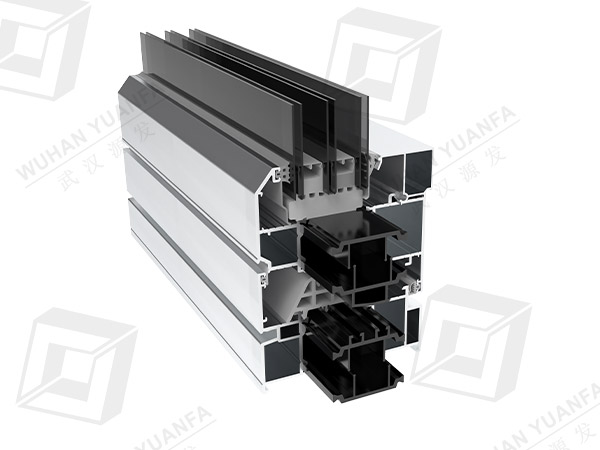
You must scrutinize the hard data before specifying PVC for demanding environments. It begins to suffer thermal deformation at relatively low temperatures. PVC starts losing its rigid shape around 90℃. Dark window frames absorb massive amounts of solar radiation. In hot, sunny regions, these frames easily reach temperatures causing PVC to warp over time.
PVC is also relatively soft. It yields at around 70N/mm for tensile strength. It lacks the rigid structural integrity required for large-scale applications. You cannot rely on it for heavy commercial curtain walls. It also fails to support massive triple-glazed structural window systems safely.
The expansion mismatch poses the greatest engineering risk. Aluminum expands and contracts at a very specific mathematical rate. PVC expands at a completely different rate. When the sun heats the frame, the aluminum stretches differently than the internal plastic strip. Repeated freeze-thaw or hot-cold cycles force the PVC to stretch unnaturally. This constant movement can cause the material to shear, crack, or break the critical weather seal completely.
Let us contrast standard PVC with a polyamide thermal break. Polyamide (specifically PA66) typically features 25% fiberglass reinforcement. This composite structure changes the engineering game entirely. It moves beyond a simple plastic barrier into structural reinforcement territory.
PA66 stands as the gold standard for aluminum frames due to dimensional synchronization. Its linear expansion coefficient sits approximately between 2.3 and 3.5×10^-5. This perfectly mirrors the natural expansion rate of aluminum (2.35×10^-5). Because their numbers match, they expand and contract as a single unified unit. They never fight each other during temperature swings.
Polyamide vastly outperforms PVC in longevity and load-bearing capacity. PA66 boasts a thermal deformation temperature up to 240℃. Its tensile strength hits ≥120N/mm. You can trust it under extreme desert heat or freezing mountain winters.
We use a simple toughness test to provide practical evidence for buyers. If you bend PA66 repeatedly, it yields a crisp snap. It produces a clean, sharp break. PVC behaves entirely differently under stress. It bends softly. It turns bright white at the specific stress point. You must fold it numerous times before it finally breaks.
Feature | Standard PVC | Polyamide (PA66 + Fiberglass) |
|---|---|---|
Thermal Deformation | ~90℃ | Up to 240℃ |
Tensile Strength | ~70N/mm | ≥120N/mm |
Expansion vs. Aluminum | Mismatched (Risks seal failure) | Highly Synchronized |
Structural Suitability | Light residential doors/windows | Heavy commercial / Curtain walls |
Bend Test Result | Bends softly, turns white at stress point | Crisp snap, clean break |
Choosing the correct barrier requires evaluating your specific project constraints. You must balance weather exposure, structural load, and energy compliance goals. Review the following framework to guide your material specification.
We recommend specifying PVC when you face the following conditions:
You manage budget-driven residential developments requiring only standard building code compliance.
The project resides in a mild, stable climate devoid of extreme summer heat or harsh freezing cycles.
You are installing smaller window and door units experiencing minimal structural shear forces.
We recommend shortlisting Polyamide (PA66) or Polyurethane when your project involves:
Commercial buildings, high-rises, and heavy curtain walls demanding maximum structural integrity.
Projects pursuing strict energy codes, including LEED certification or rigorous Passive House standards.
Extreme climates requiring advanced materials robust against intense UV exposure or rapid freeze-thaw cycles.
You must also manage implementation risks carefully. Poor installation ruins even the best materials on the market. If factory workers misalign the strips, they destroy the insulation performance instantly. Unsealed gaps let air pass freely, defeating the barrier. Incorrect adhesives used during the manufacturing process compromise the entire frame assembly. You must ensure your vendor utilizes rigorous quality control on the assembly floor.
PVC serves as a highly effective, entry-level material for basic residential insulation. It offers solid thermal resistance and reliable condensation defense at an attractive low cost. However, it fails to meet the strict demands of high-performance or heavy commercial applications.
Follow these specific next steps before finalizing your framing vendor:
Assess your specific thermal transmittance (U-value) requirements based on local energy codes.
Calculate the structural load demands for your window sizes to prevent shear failure.
Request detailed material spec sheets from suppliers before signing contracts.
Verify the linear expansion coefficients and thermal deformation thresholds match your climate risks.
A: Yes, in most standard residential scenarios. It severs the heat transfer bridge effectively enough to prevent surface condensation. However, you must still manage indoor humidity and ensure proper room ventilation to keep your window frames entirely dry.
A: Polyamide (like PA66) includes fiberglass reinforcement during the extrusion process. This addition offers superior heat resistance, immense structural rigidity, and a significantly longer lifespan. These premium performance traits justify the higher upfront cost for commercial and luxury residential builds.
A: They can, but they carry a higher risk of long-term seal failure. PVC and aluminum possess differing linear expansion rates. Extreme temperature shifts cause them to stretch and shrink differently, which places severe stress on the weather seal over time.
A: High-quality insulation strips drastically lower the U-value (thermal transmittance) of a building's envelope. Reaching a low U-value represents a mandatory requirement. It helps properties achieve Passive House standards and qualifies developers for lucrative green building tax incentives.


