

close
Choose Your Site
Global
Social Media

Author: Site Editor Publish Time: 2026-06-08 Origin: Site
Designing building envelopes requires a delicate balance between structural integrity and energy efficiency. You face a critical dilemma when specifying materials to prevent heat transfer. Specifying too little thermal break compromises building code compliance, risks condensation, and leaks energy. Conversely, over-specifying it can unnecessarily complicate structural load requirements and inflate material costs. Guessing the right thickness is a massive risk. We need a reliable way to determine exact material specifications.
This article provides a practical, evidence-based framework for architects, engineers, and developers. You will learn exactly how to calculate the required material thickness. We will guide you through balancing structural integrity, meeting energy codes, and achieving strong financial ROI without over-engineering your connections.
Size vs. Impact: Thermal bridges covering just 3% to 10% of a building’s envelope can degrade overall insulation effectiveness by up to 50%.
Baseline Thickness: While requirements vary by climate and load, a minimum 1-inch thickness of dedicated load-bearing thermal break is frequently the baseline for measurable heat loss reduction.
Material Efficiency: Utilizing advanced materials like a polyamide thermal break allows for thinner profiles while maintaining superior structural tension and low thermal conductivity (k-value).
Financial Leverage: Correctly sizing thermal breaks unlocks substantial tax incentives (e.g., 179D) and eliminates the capital expense of perimeter heating/cooling systems.
Many professionals harbor dangerous misconceptions about heat flow. They believe a small structural penetration causes only negligible heat loss. They assume a tiny metal bracket barely impacts the entire wall assembly. Physics tells a very different story. Steel conducts heat incredibly fast. It operates like a superhighway for energy transfer. A small piece of uninsulated metal easily bypasses highly rated cavity insulation. The proportionality myth leads to severe design failures. You cannot judge thermal impact by visual surface area alone.
Minor structural penetrations completely destroy overall R-values. Take standard framing as a prime example. It makes up roughly 25% of a typical wall. However, it severely degrades the net effectiveness of the cavity insulation. Metal Z-girts show an even more drastic effect. They often cover just 10% of the exterior surface area. Yet, they can slash a wall’s net R-value by half. Structural balcony connections are another notorious culprit. They might account for merely 3% of the exterior surface. Despite this tiny footprint, they can be responsible for up to 30% of total exterior heat loss.
Guessing the thickness of your thermal break invites structural and thermal failure. If the material is too thin, it fails to resist heat flow adequately. Sometimes an undersized pad merely acts as a shim. It provides zero functional thermal resistance. Worse, an improperly sized separator can increase the conductive surface area of the steel or concrete. This actually accelerates heat loss rather than preventing it. The enlarged contact patch pulls more energy out of the building interior. You must specify exact dimensions to avoid magnifying the problem.
You need load-bearing insulation to handle heavy structural connections. The chosen material must offer highly effective thermal resistance. At the same time, it cannot compromise connection tension. Steel-to-steel bolting demands immense compressive strength. Concrete connections require robust shear strength. The ideal material handles these dynamic forces while completely stopping heat transfer. Balancing the k-value against the structural load is your primary engineering challenge. Weak insulation crushes under torque. Strong materials often conduct too much heat. You must find the perfect intersection of both properties.
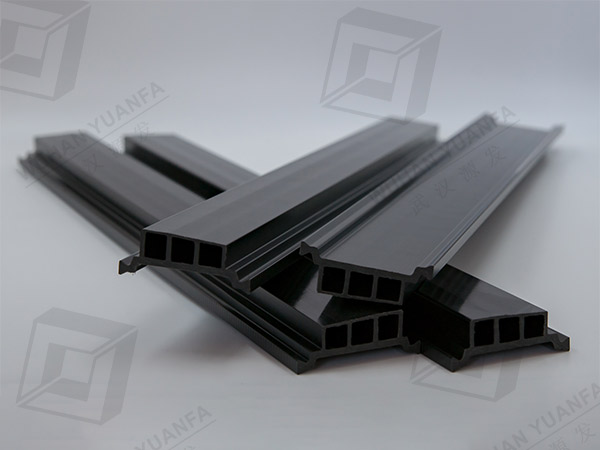
Traditional insulating pads often fall short in modern construction. They either compress under heavy loads or fail to provide sufficient thermal resistance. High-performance options solve these frustrating structural issues. You should carefully consider the specific advantages of a polyamide thermal break in commercial fenestration and heavy structural connections. It delivers excellent shear strength and absolute dimensional stability. It also features extremely low thermal conductivity. Polyamide resists chemical degradation and withstands severe temperature fluctuations. This makes it an elite choice for demanding commercial applications.
Use the following material selection matrix to guide your specifications:
Material Type | Compressive Strength | Thermal Conductivity (k-value) | Primary Application |
|---|---|---|---|
Standard Rubber / Neoprene | Low to Medium | Moderate | Basic vibration dampening, acoustic control |
Structural Foam (PUR / PIR) | Medium | Low | Light load continuous insulation panels |
Polyamide | Very High | Extremely Low | Heavy structural connections, commercial fenestration |
A 1-inch thickness is a common starting point for initial design phases. This baseline frequently shifts the dew point outward enough to stop condensation. It provides measurable heat loss reduction for standard structural connections. However, basic math does not apply everywhere. Corners, parapets, and complex transitions demand more attention. You need specific thickness calculations based on localized heat flow. Do not rely on standard benchmarks for irregular geometries. A corner connection might require double the thickness to achieve the same surface temperature drop.
Regulatory compliance directly dictates your material specifications. Updated codes place strict caps on building thermal transmittance. You must adhere to standards like the 2015/2021 IECC and the latest ASHRAE standard upgrades. These modern frameworks aggressively penalize unmitigated thermal bridges. Specifying continuous insulation requires addressing every single structural penetration. Inspectors now demand detailed proof of thermal continuity. You can no longer hide conductive steel beams behind drywall and expect to pass energy audits.
Required material thickness increases dramatically in specific environmental conditions. High-humidity facilities like hospitals and indoor pools demand rigorous moisture protection. Extreme cold climates also amplify the condensation risk. You must keep internal surface temperatures above the dew point. This is absolutely non-negotiable for occupant health. Failing to do so causes immediate condensation. Condensation breeds toxic black mold. It also accelerates unseen structural rot inside hidden wall cavities. A properly sized separator pushes the freezing plane outside the building envelope.
Your specified materials must align with stringent fire compliance standards. You cannot simply insert highly flammable foam into a fire-rated assembly. The volume and type of material are heavily regulated by local jurisdictions. Testing standards like ASTM E119 or NFPA 285 govern these critical applications. Make sure your design verifies the fire performance of every insulating component. Many high-performance materials are engineered to resist flame spread. Always cross-reference your thermal calculations with the project's fire safety consultant.
Proper insulation directly reduces massive capital expenditures. Specifying an adequate, continuous barrier transforms building mechanics. This impact is highly visible in commercial windows and glass curtain walls. A high-quality envelope often entirely eliminates the need for expensive perimeter heating or cooling systems. You no longer need miles of baseboard radiators just to fight window drafts. Removing these redundant mechanical systems saves vast amounts of money. It offsets the upfront cost of premium insulation materials.
Frame the specification not as a mere cost, but as a powerful compliance tool. Smart material choices help achieve LEED® certification credits. They also push architectural projects toward ambitious AIA 2030 targets. Corporate clients demand sustainable, low-carbon buildings. Proper detailing helps them meet internal environmental, social, and governance (ESG) goals. High-performance buildings attract premium tenants. They command higher lease rates in competitive commercial real estate markets.
You can access massive financial levers to justify premium materials. The 179D energy efficient commercial buildings deduction offers incredible value to developers. It yields substantial tax deductions up to $5.00 per square foot. You only need to meet specific, aggressive energy targets to qualify. Properly sized insulation is often the cheapest way to cross that strict efficiency threshold. This deduction radically transforms the financial conversation. It changes structural insulation from an irritating expense into a highly profitable investment strategy.
Standard calculations only go so far in modern architecture. Simple math involves averaging R-values across a flat, uninterrupted surface. This method completely falls apart at complex structural joints. Heat does not flow in simple parallel lines through high-conductivity materials. It flanks around weaker insulation zones. It follows the path of least resistance. Using basic area-weighted math for a steel balcony connection produces wild inaccuracies. It gives engineers a false sense of security regarding energy performance.
You cannot guess at complex structural intersections. Finite element 3D thermal modeling is required rather than optional in many cases. Call a specialist when you encounter highly conductive, irregular pathways. They map exact temperature gradients. They reveal hidden condensation risks before construction begins.
Consider bringing in a thermal modeling expert for the following scenarios:
Cantilevered Balconies: These concrete slabs act as massive cooling fins drawing heat outside.
Continuous Roof Penetrations: Heavy HVAC supports and parapets constantly bypass primary insulation layers.
Passive House Targets: This strict certification requires absolute elimination of all measurable thermal bridging.
Below-Grade Transitions: Foundation-to-wall connections experience extreme moisture and temperature differentials.
Always verify field realities before finalizing your specification. The mandated thickness must be practically installed on-site by general contractors. Overly thick pads might require custom bolt lengths that delay construction. They can also misalign external cladding systems. Ensure the chosen material integrates seamlessly with standard building practices. It should never compromise structural tolerances. It must maintain the integrity of continuous air barriers. If a contractor cannot easily install it, the design will inevitably fail in the field.
The question of "how much" has no single numerical answer. You find the exact thickness at the intersection of local energy codes, structural load demands, and dew point management. Standard framing and minor penetrations dictate surprisingly aggressive insulation strategies. Overlooking these details guarantees performance failures and severe code violations. Smart specifiers view thermal separation as an integrated structural requirement, not an afterthought.
Use these actionable next steps to ensure your project's success:
Calculate your required material thickness based on extreme localized heat flow, not just basic area averages.
Engage a thermal modeling specialist early in the schematic design phase to identify hidden flanking risks.
Avoid retro-engineering structural connections later by specifying high-performance load-bearing insulation from day one.
Leverage the financial benefits of eliminated perimeter heating to justify premium material specifications.
A: No universal code exists for an absolute minimum thickness. However, a 1-inch thickness is the frequent industry baseline for structural steel connections. This depth reliably yields a measurable drop in conductivity. It safely pushes the dew point outward in most moderate climates. Always verify with local energy codes.
A: Yes, it performs significantly better under immense load. Polyamide offers superior compressive and shear strength. It integrates flawlessly into commercial fenestration and heavy steel connections. This allows for much thinner overall profiles while delivering equivalent or better thermal resistance compared to bulky standard structural foam.
A: You can only use standard R-value averaging for basic, flat assemblies. Complex structural connections and corner geometries require finite element 3D thermal modeling. Heat flanks around highly conductive materials in unpredictable ways. This makes simple area-weighted math wildly inaccurate for predicting actual heat loss.


